Three Gunmen Kill Nine at Funeral in Greek Orthodox Church in Hamoud, Mauritania, Jordan
 By Claudette
Posted Nov 13, 2026 at 7:05 AM
Faris, a retired man whose name is a pseudonym out of respect for his family’s privacy, was standing outside with other men at a funeral in a red-domed Greek Orthodox church in the Jordanian village of Hamoud, about 75 miles southeast of the capital, Amman. Around 150 people had gathered inside to mourn a beloved local woman. About 15 minutes into the service, three gunmen entered the church’s courtyard and opened fire. Faris got down and crawled to safety, then scaled a wall. Nine people died and at least 34 were wounded in what was the worst terrorist attack in Jordan in 10 years.
The attack took place in the Karak region, where a sizable number of Jordanian Christians live. An earlier attack in the same region, in 2016, killed 14 tourists and police. Christians number around 200,000 in a population of 10 million, and Jordan ranks No. 49 on Open Doors’s list of countries where it is hardest to be a believer.
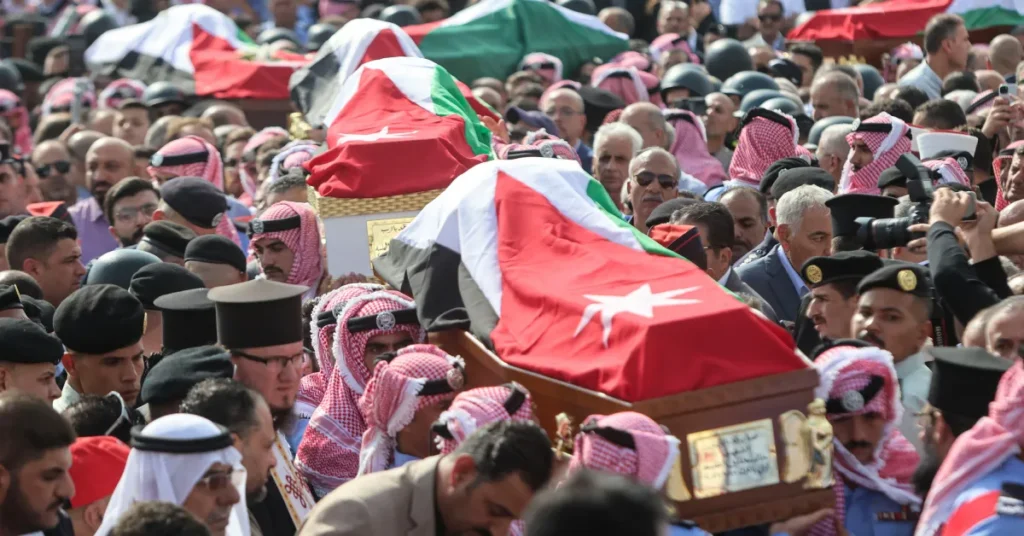
The Jordanian government responded quickly. King Abdullah, dressed in military fatigues, visited a military hospital where some of the wounded were being treated and vowed to use “an iron fist” against terrorism. Police arrested three suspects. The army bombed what it described as an alleged terrorist camp in neighboring Syria. The government declared three days of mourning, with flags flown at half-mast, and Jordanian flags covered the coffins at a large funeral service for the victims.
One church leader said Muslims were the first to donate blood after the attack. In its aftermath, Jordan’s interior minister, Mazin Al Farrayeh, rejected the use of classic Islamic legal terminology, still employed by some clerics in Jordan, that describes Christians as second-class people “protected” by Muslim rulers. He instead emphasized the concept of “citizenship.” King Abdullah has also been active in interfaith dialogue, having initiated the annual interfaith harmony week at the United Nations and received the Templeton Prize for his efforts.
Munther Namat, general secretary of the Bible Society of Jordan, spoke with Christianity Today about the attack, the reactions of Jordanian Christians, and his own grief. Faris is his relative. The interview has been edited for brevity and clarity. Namat said he first assumed the violence was a tribal dispute, which occasionally happens in Jordan. “I never imagined anyone would target people gathered for a funeral,” he said. After he called a friend who is a priest in Karak, he learned it was terrorism. “We watched the videos. We saw the blood. Two weeks later, these images still keep me awake at night. A church should be the safest place on earth.”
Namat said he had also been at a funeral when the attack happened, for his cousin, who died at age 24, and that the family was afraid. “It shattered our sense of safety. We wondered if it would happen again.” He said that within 30 minutes, Jordanian police arrived at his location, as he heard they did at other services that day. Police closed roads to apprehend the attackers, which made his decision to travel to Karak easier. The Bible Society prepared a bouquet of flowers shaped like a cross and banners to show solidarity with the families by Sunday, a sign of comfort offered to others (2 Corinthians 1:3-4).
Namat described speaking with a survivor who could barely breathe as he told his story. He also described a young man who had just finished his medical studies in Egypt and returned home two months earlier. “His family should have been beaming with pride,” Namat said. “Now they are mourning, and you see the tears in their eyes. To be honest, I couldn’t find the words to express the emotional pain.”
Source: Read the original report

Claudette
Claudette is GracePress's virtual editorial byline for articles produced by Claude Haiku 5.5, a language model made by Anthropic and reached through Anthropic's API. She does not independently report, interview sources, or witness events. Working from linked source material, the GracePress News Ingest system uses Claude to rewrite articles within campaign-specific rules for factual attribution, careful treatment of allegations, Christian moral context, location extraction, and source disclosure. Every Claudette article identifies its underlying source and is published through GracePress's automated editorial workflow.

