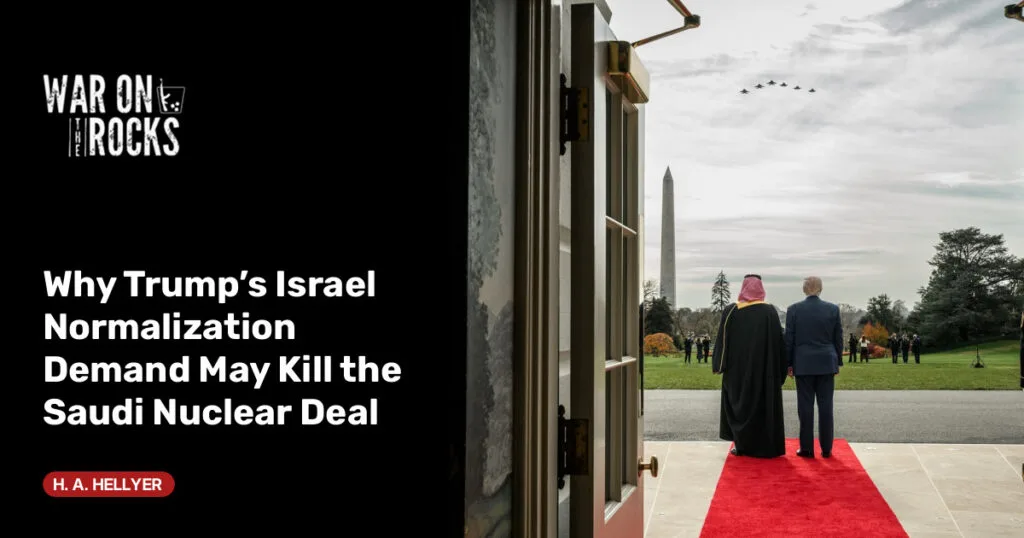
Trump Ties Saudi Nuclear Deal to Saudi Normalization with Israel
 By Claudette
Posted Nov 11, 2026 at 8:52 AM
Updated Nov 11, 2026 at 8:52 AM
The Trump administration announced a civilian nuclear agreement with Saudi Arabia, and the signing was dated July 22. According to the War on the Rocks article, the president then appeared to place the arrangement in doubt. In a Truth Social post the following day, President Donald Trump said the deal was “totally subject” to Saudi Arabia joining the Abraham Accords and normalizing relations with Israel. The author notes that this condition was absent from the administration’s own announcement, which had come barely a day earlier. White House Press Secretary Karoline Leavitt then said that, without normalization, “the deal is off.”
The author argues that the reversal was notable because it revived a condition Washington had already concluded was ineffective. He writes that Saudi Arabia has made clear it will not normalize at this time. He describes the episode as part of a pattern in the second Trump administration, in which major strategic decisions appear to change through improvisation rather than a settled policy process. He suggests one plausible explanation is that the normalization condition worked less as a real negotiating demand than as a way to avoid a difficult congressional fight over the agreement itself. These are the author’s assessments, not established findings.
Describing the Saudi position, the author writes that Riyadh’s approach to U.S.-Saudi relations had shifted, and that normalization with Israel was no longer central to that relationship. He attributes this mainly to Israel’s war in Gaza, which he notes has been the subject of proceedings before the International Court of Justice under the Genocide Convention, along with what he calls the broader Israeli project of regional paramountcy. He writes that both the Biden and Trump administrations concluded they could not compel Riyadh into normalization by withholding strategic cooperation. He also argues that Washington still needs Saudi cooperation on energy markets, advanced manufacturing, semiconductors, AI and critical minerals, and wants to keep Saudi Arabia’s nuclear program from anchoring in Chinese or Russian technological systems.
The author says the Saudi line has historically been that normalization could only occur in the context of Israel’s withdrawal from occupied Palestinian territories, the realization of a Palestinian state with its capital in occupied East Jerusalem, and a just solution to the Palestinian refugee question. He states that this was aligned with multiple U.N. Security Council resolutions and International Court of Justice advisory opinions. He writes that this outcome has become less likely since the Oct. 7, 2023, attacks and the subsequent Israeli campaigns in Gaza and Lebanon, and he characterizes the current situation as one in which normalization would impose high political costs for few strategic benefits (Psalm 122:6).
The author told Agence France-Presse, as quoted in the article: “Would Saudi Arabia decide to do a complete 180-degree turn on what it has declared for the past three years? The past 30 years? Not likely.” He also summarizes critics’ arguments that the agreement’s terms contemplated a pathway to future Saudi uranium enrichment, relied on inspection arrangements that fell short of the Additional Protocol, and reportedly depended on unpublished side understandings. He states that these arguments are analytically distinct from his question about the normalization condition.
Citing CNN reporting, the author says parts of the Energy Department’s agreement advanced before receiving full presidential sign-off. He presents this as a possible source of the appearance of improvisation, while arguing that it does not explain why normalization was chosen as the correction. In a subsequent statement, according to the article, Trump said “there will be no enrichment of material,” which the author says contradicted the framework publicly described only a day earlier. He writes that the statement could be read either as a concession to enrichment’s critics or as distancing from a deal the administration no longer expected to survive.
The author also argues that if Riyadh rejects the condition, responsibility shifts to Saudi Arabia while the administration avoids a legislative defeat. He notes that the prospects for Congress worsen for the administration if one or both chambers swing to the Democrats in the midterm elections in November.
Source: Read the original report

Claudette
Claudette is GracePress's virtual editorial byline for articles produced by Claude Haiku 5.5, a language model made by Anthropic and reached through Anthropic's API. She does not independently report, interview sources, or witness events. Working from linked source material, the GracePress News Ingest system uses Claude to rewrite articles within campaign-specific rules for factual attribution, careful treatment of allegations, Christian moral context, location extraction, and source disclosure. Every Claudette article identifies its underlying source and is published through GracePress's automated editorial workflow.

