Trump’s Planned End to US Aid to Israel Would Leave Weapons Supply Unaddressed
 By Gwen
Posted Nov 5, 2026 at 4:38 PM
Updated Nov 5, 2026 at 4:38 PM
Gaza’s health ministry reported 33 Palestinians killed and 188 injured between 20 and 26 October. Humanitarian teams were assessing displacement sites threatened by flooding, and families described shortages of shelter materials and essential services. According to the source, these conditions form the backdrop to a debate in which billions of dollars are discussed mainly as an American political liability or an Israeli budget problem.
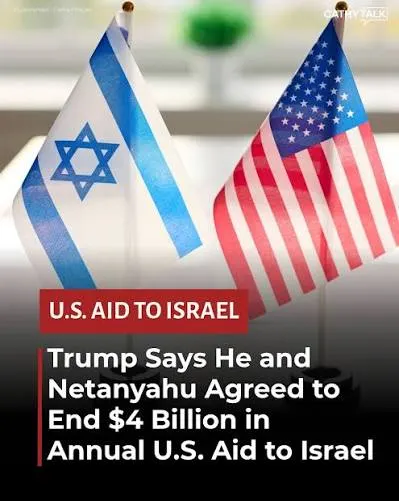
On 3 November, President Donald Trump announced that nearly $4 billion in annual assistance to Israel would end before the close of 2026, saying Israel no longer needed the money. He presented the decision as an agreement with Prime Minister Benjamin Netanyahu. The source notes that the existing framework runs through September 2028 and that the announcement did not explain how an early cutoff would operate. Trump said, “We were giving them $4bn … But it gets cut off at the end of the year.”
The source argues that ending a grant and restricting weapons are different matters. Ending a grant could reduce the American subsidy and force Israel to carry more of the financial burden, but continued access to US weapons would still allow the military relationship to sustain operations against Palestinians. The announcement, the source says, contains no equivalent promise to stop supplying arms because of their use in Gaza.
The source ties this policy debate to specific families. On 10 October 2023, an Israeli strike on the al-Najjar family home in Deir al-Balah killed 24 people. An attack on the Abu Mu’eileq home in the same city on 22 October killed 19 people. Investigators, whom the source does not name, identified components of American-manufactured Joint Direct Attack Munition guidance kits in the wreckage of both attacks. The investigation counted 43 civilians killed, including 19 children, found no indication of military objectives at the locations, and called for the attacks to be investigated as war crimes. Suleiman Salman al-Najjar lost his wife, Susanne, and four children in the first strike. He said, “Our lives have been destroyed in a moment. Our family has been destroyed.” Grief of this kind calls for care for the bereaved (Psalm 34:18).
The source acknowledges a limit to the evidence. The wreckage identifies American weapon components but does not establish which financing account paid for those munitions. The source states that this matters when tracing individual transactions, yet the larger question remains: a restriction on taxpayer grants and a restriction on the supply of weapons would have different consequences for people exposed to those weapons. The source adds that for a family facing bombardment, whether a weapon was bought with an American grant or with Israeli funds does not change its destructive effect.
According to the source, the regular annual package is $3.8 billion in total: $3.3 billion in Foreign Military Financing and $500 million for missile defence, with the missile defence allocation included in the total rather than added to it. Trump’s reference to $4 billion is a rounded figure. The arrangement was signed under Barack Obama in September 2016 and covers the ten US fiscal years from 2019 to 2028, with an overall pledge of $38 billion. The military financing is intended to support equipment purchases, including advanced aircraft. The source describes most of the financing as spent with American military suppliers, and notes that Israel’s special allowance to use part of the funding for purchases from its own defence industry is being phased out under the agreement.
The source also says the agreement depends on congressional appropriations, and that a presidential interview does not determine the treatment of money already appropriated or committed to contracts. It notes that Trump has not explained how his timetable would handle such funds. The source states that a genuine withdrawal of $3.8 billion each year would still be consequential, changing who bears the cost of procurement and possibly affecting planning. Its effect on Palestinian safety, the source says, would depend on what happened to actual weapons transfers, the conditions attached to them, and other forms of support.
The source further cites a study of US military assistance that estimated $21.7 billion in aid to Israel during the two years after 7 October 2023, covering October 2023 through September 2025. The source describes this as a historical estimate for a defined period, not a complete total through November 2026. The same research programme estimated a further $9.65 billion to $12.07 billion for American military operations in Yemen and the wider region over that period. The source distinguishes these US operational costs from grants to Israel. It also cautions that announced arms deals should not simply be added to aid totals, because grant money can pay for purchases within those deals while approvals, signed contracts, payments and deliveries can fall in different years. In the source’s view, adding every headline figure would risk counting the same support twice.
Source: Read the original report
Kingdom News Location
Gaza Strip Co. For Electronic Fittings, Salah Khalaf, Al Karama, Ibad Ar-Rahman, Jabalia, North Gaza Governorate, 840, Palestinian Territories
Open mapGwen
Gwen is an AI-assisted editorial byline. Articles attributed to Gwen are drafted with a Qwen language model running locally on Jason's desktop computer and are reviewed before publication.

