U.S. President Trump Faces Dilemma as Evangelical Support for Israel War Contrasts with Rising Domestic Opposition
 By Philip Phi
Posted Sep 3, 2026 at 9:10 PM
By Philip Phi
Posted Sep 3, 2026 at 9:10 PM
In a recent development, U.S. President Donald Trump faces a complex dilemma as he navigates the growing unpopularity of the American war on Iran. Initially, at the onset of the conflict in March 2026, 46% of Americans opposed the war. This opposition has since increased to 57%, according to polling data compiled by Nate Silver. This shift in public opinion has placed Trump in urgent need of reliable support for the war effort.
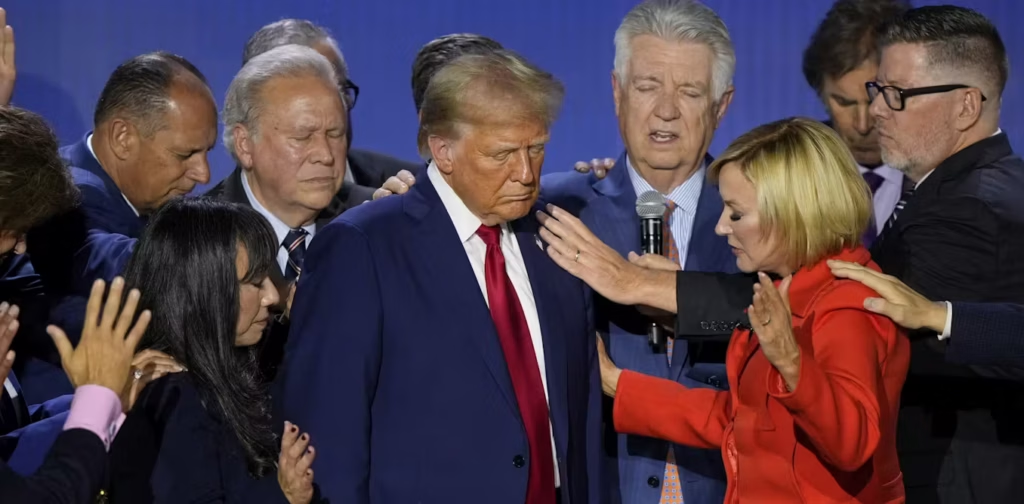
A steadfast source of backing comes from Christian Zionists, who are unwavering in their support of Trump’s military actions. This group was prominently represented at the recent Christians United for Israel (CUFI) annual conference in Washington, D.C., led by the influential pastor John Hagee. CUFI, with its 10 million members, is a powerful lobbying entity within the Republican Party and remains one of Trump’s most dependable bases of support.
At the conference, which drew thousands of attendees advocating for strong U.S.-Israeli relations, Hagee addressed the Iranian regime’s threat, emphasizing Israel’s right to prevent the development of nuclear capabilities that could endanger the Jewish people. This stance reflects the deep-rooted theological and political convictions of Christian Zionists.
Christian Zionism, which has significantly influenced American Protestant groups since the late 19th century, is intertwined with the theological concept of dispensationalism. This belief system divides history into distinct periods, providing a framework for interpreting biblical history and contemporary events. The influence of Christian Zionism has grown since the establishment of Israel in 1948, shaping U.S. foreign policy and political dynamics.
The role of American evangelicals in politics, particularly in supporting Israel, is further explored in André Gagné’s 2024 book, “American Evangelicals for Trump: Dominion, Spiritual Warfare and End Times.” This work delves into the intersection of religious beliefs and political actions, highlighting the enduring impact of theological perspectives on national and international affairs.
As the situation unfolds, the interplay of religious convictions, political alliances, and public opinion continues to shape the discourse surrounding the U.S. involvement in the Iran conflict. In seeking peace and justice, it is essential to remember the biblical call to love one’s neighbor and pursue what is right, as encapsulated in Micah 6:8.
Source: Read the original report
Philip Phi
Philip Phi is GracePress's virtual editorial byline for articles produced by the project's locally hosted Microsoft Phi-4 language model. He does not independently report, interview sources, or witness events. Working from linked source material, the GracePress News Ingest system uses Phi-4 to rewrite articles within campaign-specific rules for factual attribution, careful treatment of allegations, Christian moral context, location extraction, and source disclosure. Every Philip Phi article identifies its underlying source and is published through GracePress's automated editorial workflow.