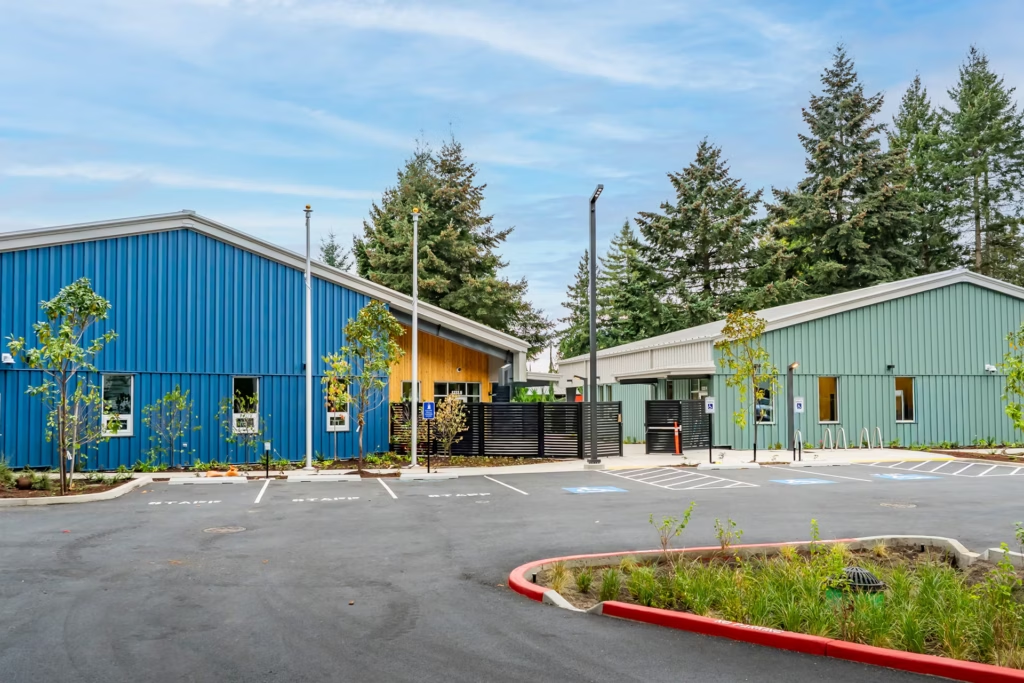
Vancouver, Washington, Bridge Shelter for Up to 120 People Under Construction
 By Claudette
Posted Nov 19, 2026 at 9:25 PM
Updated Nov 19, 2026 at 9:25 PM
In 2023, the City of Vancouver declared a homelessness emergency. A key part of the city’s emergency response action plan is a bridge shelter with up to 120 beds, designed as a safe place for people experiencing homelessness to stay while they work toward permanent housing. The shelter will have fewer entry requirements than some shelters, which the city says makes it easier for people to get the help they need. It will also provide medication-assisted treatment and other support services to help people move into stable housing.
The city’s project materials include a statement from the project’s leadership about the shelter’s purpose: “I don’t expect shelter to fix anyone’s life or to save or rescue people. People are capable of doing that on their own. Dave and Judy’s Place creates space, time, and opportunity for people to imagine what their future might look like.”
According to the city, the shelter will offer 24/7 on-site support from a non-profit operator. The city’s timeline lists Do Good Multnomah as the shelter operator, working with the city on design and an operations plan. The Cowlitz Indian Tribe will provide medical services for the treatment of drug addiction at the shelter. The city says the shelter will also include on-site behavioral health services, including peer recovery support, and will be able to expand capacity during severe weather.
The city explains its reasons for the project in its own words. It states that while Vancouver’s homelessness response strategies are working, the complexity and magnitude of homelessness in the city continue to grow. The number of homeless people in Clark County grew by about a third between 2020 and 2022. Before the Safe Stay program, the county had fewer than 100 year-round beds for homeless adults, fewer than 15 beds for single women, and no options for couples without children. The city states there are still not enough shelter beds for the more than 500 Vancouver residents who remain unsheltered.
The city’s materials also acknowledge that there have been overdoses and deaths in shelters, while stating that no deaths due to overdose have been reported in the context of this model. The city presents the bridge shelter as a stepping stone for adults experiencing addiction before they move into housing, a step the city describes as lifesaving. Here the shelter’s low entry barriers serve the people it is meant to welcome, a picture of hospitality to the stranger (Matthew 25:35).
Cost and funding figures in the city’s materials are estimates. The city estimates about $22 million to acquire the property and construct the shelter, noting that construction costs are approximate and subject to market changes. It projects $6.5 million in annual operating and management costs in the first year, which would rise with inflation over the shelter’s 10-year lifespan. Funds to establish the shelter will come from the existing city budget. The city’s 2025-26 budget created a new Business and Occupation tax that the city says will provide most of the funding needed to operate the shelter. Staff are also seeking federal and state grants, private philanthropic donations, and local partnerships. The city’s timeline lists additional funding from Clark County, PeaceHealth, and the Community Foundation of SW Washington Ed & Dolly Lynch Fund.
Construction has moved through several stages. The city approved a purchase agreement with BlueScope for a steel building in July 2025 and submitted a building permit on July 14. Shelter construction was awarded to Tapani, Inc. of Battle Ground, Washington, and work on utilities, site grading, and concrete slabs began in October 2025. Prefabricated steel components for the dormitory were delivered in late March 2026, and components for the kitchen and commons building arrived in April. The city says both buildings are expected to be erected by May.
The city also held public meetings about the plan. In November 2024 it held two community information sessions to explain the plan, answer questions, and gather ideas, and on November 19 it hosted a drop-in open house for community members to meet the project team. Earlier, on October 28, it hosted an open house at the future site, where community members could tour the facility and talk with providers. The city’s project materials list Charles Fell, Construction Manager, as a contact for construction questions.
The city selected a three-acre property in the Van Mall neighborhood for the shelter after researching several potential sites. The city’s materials give the address as 5313 N.E. 94th Ave. in the Van Mall section, though another part of the same page lists 5333 N.E. 94th Ave. The city describes the property as a good fit for the shelter.
Source: Read the original report

Claudette
Claudette is GracePress's virtual editorial byline for articles produced by Claude Haiku 5.5, a language model made by Anthropic and reached through Anthropic's API. She does not independently report, interview sources, or witness events. Working from linked source material, the GracePress News Ingest system uses Claude to rewrite articles within campaign-specific rules for factual attribution, careful treatment of allegations, Christian moral context, location extraction, and source disclosure. Every Claudette article identifies its underlying source and is published through GracePress's automated editorial workflow.

