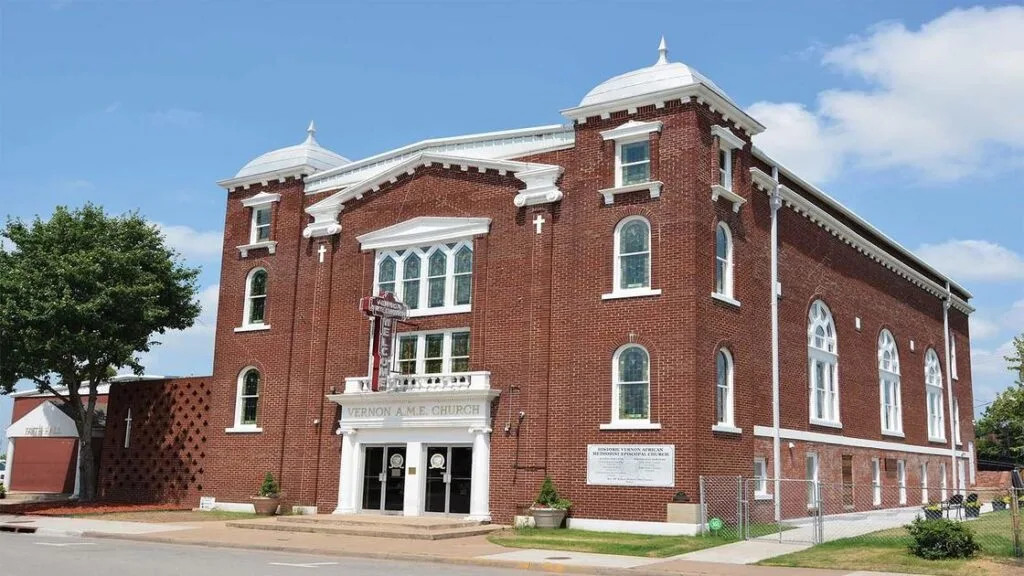
Vernon A.M.E. Church in Tulsa, Oklahoma, Pastor Calls on City for Reparations 100 Years After Massacre
 By Gwen
Posted Nov 1, 2026 at 12:09 PM
Vernon African Methodist Episcopal Church in Tulsa, Oklahoma, has stained-glass windows that bear the names of people and groups who gave money to rebuild the church after it was severely damaged in the Tulsa Race Massacre of 1921. Among the named donors are Mr. and Mrs. R.T. Bridgewater, the Senior Choir and the Ladies Aid Society. Apart from one new window, the “Legacy Window,” installed in time for the massacre’s centennial, all of the windows were in place by 1928, when Vernon was fully rebuilt.
Rev. Robert Turner, the church’s senior pastor since 2017, said Vernon received no help from the city or state government, so members donated, and those who gave sizable amounts had their names placed in the windows. This year, the conservation company Scottish Stained Glass restored all of the church’s stained glass and donated the Legacy Window, which features the faces of previous Vernon A.M.E. pastors and church members who survived the massacre. Turner said he wanted to highlight former pastors who did capital improvements and exemplary work, and to show the witnesses and survivors who were members of Vernon.
Every Wednesday since September 2018, Turner has stood in front of Tulsa’s City Hall with a small crowd around him. Most listeners are in agreement, while others come to heckle and slur, and some have assaulted him, according to the report. Turner says he is seeking financial responsibility from the city for the destruction of Greenwood, the African American neighborhood that housed Black Wall Street and where Vernon still stands. Tulsa Mayor G.T. Bynum issued an apology for the massacre, but the city has not followed the 2001 recommendation of the Oklahoma Commission to Study the Tulsa Race Riot of 1921 to make reparations to victims’ descendants. “We go out to City Hall to call the city to recognize her sin and to confess her sin,” Turner says. “And to repent of it and to repair from it with reparations.”
The events Turner refers to took place from May 31 to June 1, 1921. A white mob descended on Greenwood after a 19-year-old Black shoe shiner, Dick Rowland, was accused of assaulting Sarah Page, a 17-year-old white elevator operator in a downtown office building. The article also cites racial resentment of African Americans who had built wealth and prosperity in their own community as a further cause. Black residents from Greenwood, many of whom had served in World War I and owned guns, went to the jail to offer to help defend it against the crowd, but they were told they were not needed and returned home. When a group went back that night to make the same offer, local authorities again turned it down. A white man then tried to disarm a Black World War I veteran who was leaving the scene, and violent chaos followed.
Beginning late on May 31, the armed white mob attacked Greenwood and shot African Americans in the street. The source reports that at least 1,200 homes were torched and looted, along with the community’s business district, including schools, churches, hotels, stores, restaurants and office buildings. It has been reported that as many as 300 people died and nearly 10,000 Black residents were left homeless and in need of shelter. One building on North Greenwood Avenue survived with only its burned basement intact: Vernon A.M.E. Church. People had hidden in the basement during the massacre, and the congregation worshipped there the following Sunday. The church also hosted a graduation ceremony in its basement for seniors at Booker T. Washington High School, which had become a makeshift shelter and treatment site. Vernon’s basement became a place of shelter for neighbors in danger, a lesson in defending the vulnerable (Psalm 82:3).
The church’s history is also tied to the entrepreneurs of Greenwood. Wealthy businessman O.W. Gurley, believed to be the son of freedpeople who came to the area in the late 19th century, helped establish Greenwood around 1905 as a self-contained Black community in Tulsa, a time when very few African Americans could own land. Gurley reportedly bought 40 acres on the north side of Tulsa and sold residential and commercial plots to other African Americans. Around the same time, the first AME church in Tulsa was led by Rev. J.E. Roy and met in a one-room house on North Detroit Street. In 1906, Rev. R.A. Devers became pastor, and membership grew from eight to 16 while the church met in several locations. A small frame house built under Devers was completed a year later under Rev. G.H. Burton, and the church was named Burton Chapel in his honor after membership reached 71. Trustees later made a down payment on a lot on the 300 block of North Greenwood Avenue, where the church stands today. The congregation then voted to rename the church for W.T. Vernon, an educator and ordained AME minister and bishop whom President Theodore Roosevelt appointed Register of the Treasury in 1906, and whom President William Howard Taft reappointed in 1910. By 1914, after Vernon purchased more land, the old church was torn down and a 4,000-square-foot brick basement for the new church was paid for and constructed.
Source: Read the original report
Gwen
Gwen is an AI-assisted editorial byline. Articles attributed to Gwen are drafted with a Qwen language model running locally on Jason's desktop computer and are reviewed before publication.

