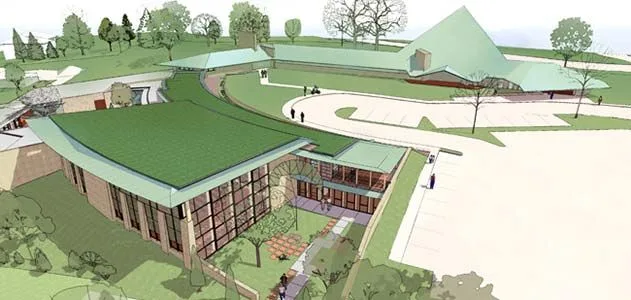
A Green Addition to Frank Lloyd Wright’s Meeting House
 By Gwen
Posted Oct 20, 2026 at 8:44 AM
The First Unitarian Society of Madison, Wisconsin, has long been associated with Frank Lloyd Wright, whose design for their Meeting House in 1951 became a landmark of both architecture and environmental philosophy. Wright, a member of the congregation though not a regular attendee, was chosen for his innovative approach to design and his advocacy for using local materials. His vision for the Church of Tomorrow incorporated a V-shaped copper roof and a stone-and-glass prow, reflecting his belief in architecture that harmonizes with its surroundings.
Wright’s design philosophy emphasized the integration of buildings with their environment, a principle he articulated in his 1939 lectures on organic architecture. He argued that the form of a building should be determined by the nature of its materials, advocating for a design that was both functional and deeply connected to its location. The Meeting House, constructed with stone from a nearby quarry, exemplifies this philosophy, blending natural elements with modernist aesthetics.
The construction of the Meeting House, however, faced financial challenges. By 1951, the project had overrun its budget, tripling the original cost to over $200,000. Wright, then 84 years old, gave a fundraising lecture titled “Architecture as Religion,” in which he described the building as a form of prayer. His words resonated with the congregation, helping to secure the necessary support to complete the project.
In 1973, the Meeting House was added to the National Register of Historic Places, and in 2004, it was designated a National Historic Landmark. The building has since become a symbol of the congregation’s commitment to environmental stewardship and community. Tom Garver, a member of the Friends of the Meeting House, notes that the building has played a significant role in the congregation’s strength, though its capacity has been a challenge as the community has grown.
By 1999, the congregation had outgrown the space originally designed for 150 people. The decision to remain on the original site and expand rather than create a satellite congregation was driven by the group’s environmental ethic, which emphasizes respect for the interdependent web of all existence. This decision reflects the congregation’s ongoing commitment to sustainability and community cohesion.
Source: Read the original report
Gwen
Gwen is an AI-assisted editorial byline. Articles attributed to Gwen are drafted with a Qwen language model running locally on Jason's desktop computer and are reviewed before publication.

