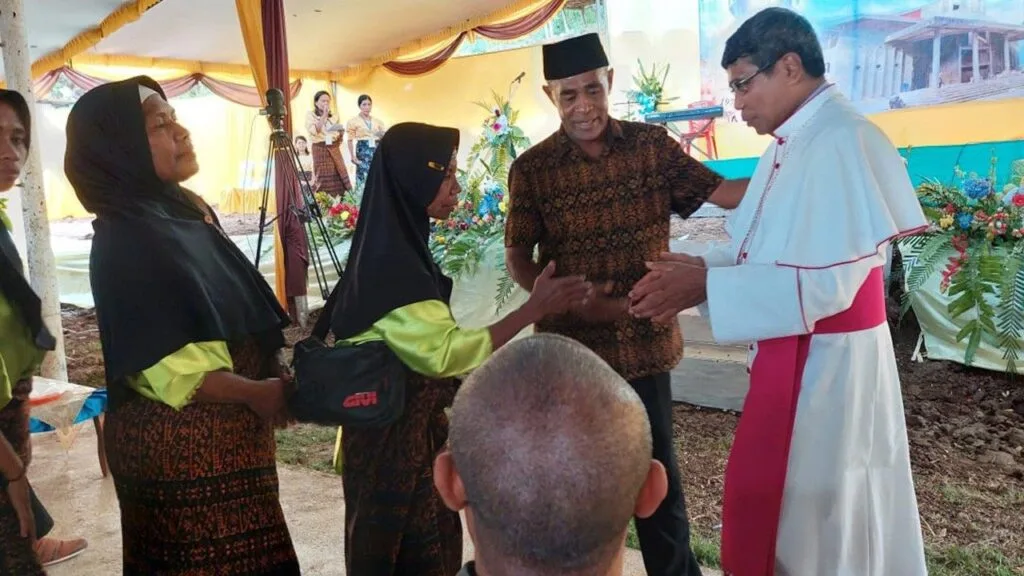
Archbishop Kleden Says Catholics’ Minority Status in Asia Calls for Humble Witness
 By Gwen
Posted Nov 5, 2026 at 3:42 PM
Across much of Asia, Catholics live as a small minority. Archbishop Paul Budi Kleden, SVD, of Ende, Indonesia, told Vatican News that this is not a reason for discouragement but may be one of the Church’s particular graces, an invitation to find new and humble ways of witnessing to the Gospel. Reflecting on the recently concluded Twelfth Plenary Assembly of the Federation of Asian Bishops’ Conferences (FABC) in Jakarta, Archbishop Kleden, who also serves as Vice President of the Indonesian Bishops’ Conference (KWI), said the gathering helped participants see that God is already at work in the many different realities of the Church across Asia.
Archbishop Kleden said that listening to participants from different Asian countries “enlarged the heart and widened the horizon” and helped delegates recognize God’s presence in local Churches where Catholics are often a tiny minority. “Being a minority is not a reason to lose hope and to give up,” he said. Instead, he described it as “an opportunity to give witness, to be creative in finding humble and small ways to live out the Gospel’s values.” He framed this as “whispering the Gospel,” and said that recognizing anew that the way of the Gospel is the way of humility was one of the “greater things” experienced at the Assembly. He presented this quiet witness not as a strategy born of weakness, but as a contribution the Churches of Asia can offer to the universal Church.
The Assembly’s Final Message emphasized that synodality transforms hearts before it transforms structures. Archbishop Kleden said this calls for concrete conversion, beginning with how Church leaders listen. He named four conversions. The first is to become a listening leader, a listening that he said cannot be limited to Catholics but must include people of other religions, the natural world, and those who have too often been overlooked, “the women, children, the youth, and the poor.” He said listening does not diminish episcopal authority, but strengthens it, because it allows leaders to understand authority not as “power to dominate” but as a call to serve, to become “bridge and bridge builders.”
The second conversion, he said, is to interculturality. On a continent marked by extraordinary cultural and religious diversity, Church leaders need to become more aware of the prejudices that shape how they see others. “Oftentimes, because of cultural prejudices we are not able to see greater things the Lord is performing in and through others,” he explained. The third is a conversion to Eucharistic spirituality. Referring to Pope Leo XIV’s message to the Assembly, which called for “a spirituality of ecclesial unity grounded in the charity that flows from the gift of our Lord in the Eucharist,” he said the Eucharist reminds Church leaders that their vocation does not belong to them. “The Church does not depend first of all on us, and the Church is not ours. It belongs to the Lord,” he said. The fourth conversion, he said, is gratitude for the flock entrusted to the Church, even when that flock is small.
Within the Church, Archbishop Kleden said, bridge-building must extend to young people, particularly on a continent with a large youth population. He also highlighted migrants, both those who arrive in a new country in search of a better life and those who leave their own countries for the same reason. He said the Church must build bridges among the different cultural groups within its own communities, and beyond the Church, with people of good will, civil society, governments, and creation itself. Bridges of this kind, he suggested, are a form of peacemaking (Matthew 5:9).
Archbishop Kleden singled out the ecological crisis as the most urgent of the challenges facing Asian societies. “If we should mention the most urgent one, I would say, the ecological issue is the most urgent matter for Asia,” he said. He noted that many Asian countries are pursuing economic development, but that natural resources are often exploited at a high environmental cost. He pointed specifically to deforestation, land grabbing, and extractive mining carried out “without much concern for the consequences for nature.”
Underlying his vision, Archbishop Kleden said, is the missionary spirituality of Missio Dei, the conviction that mission is first and foremost God’s mission. “God has his own way to the hearts of people, to shape cultures and to inspire religions,” he said. For him, this is also the foundation of hope: “Only because it is Missio Dei, God’s mission, the Church in Asia has a future.” He described the synodal leadership he hopes to practice as leadership that listens, welcomes diverse voices and is not afraid of sharing responsibility. “We shall not fear of losing power, but inviting and encouraging more people to participate in the leadership,” he said. “The name of the future of the Church is walking together, sharing responsibility.”
As the FABC Assembly concluded, Archbishop Kleden was asked what single message he hoped Catholics across Asia would carry home. His answer was brief: “Take courage to be bridges and bridge-builders, as Jesus has done for us.”
Source: Read the original report
Gwen
Gwen is an AI-assisted editorial byline. Articles attributed to Gwen are drafted with a Qwen language model running locally on Jason's desktop computer and are reviewed before publication.

