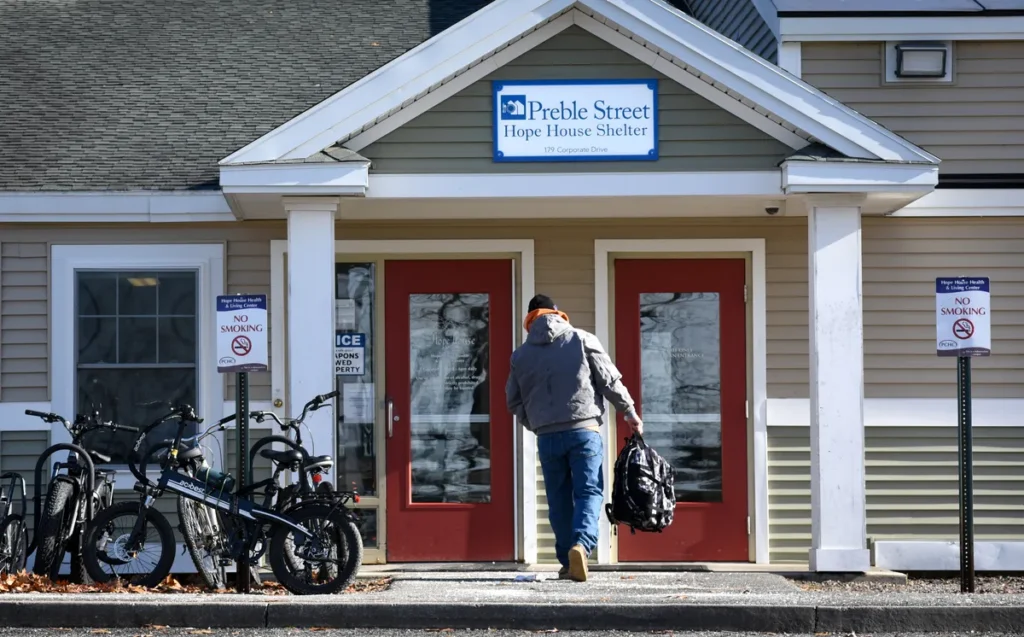
Bangor’s Only Low-Barrier Homeless Shelter Breaks Ground on Expansion
 By Gwen
Posted Nov 5, 2026 at 3:44 PM
Bangor’s only low-barrier homeless shelter has taken a step toward adding 7,000 square feet and 16 emergency shelter and transitional housing beds, after groups broke ground on the project Wednesday. The Hope House Health and Living Center addition is expected to open by the end of 2026. The project responds to unsheltered homelessness, which the source says is growing in Maine, and to shelters that frequently reach capacity.
Lori Dwyer, president and CEO of Penobscot Community Health Center, said the expanded capacity will be “one more step in the process of improving the services and supports we have in the community for the unhoused population.” Penobscot Community Health Center owns Hope House and operates its transitional housing units.
Danielle Smaha, a spokesperson for Preble Street, the Portland-based nonprofit that operates the emergency shelter, said, “When someone experiencing homelessness accesses a low-barrier, professionally run emergency shelter like Hope House, it is often the first step on their journey to safety, health, and stable long-term housing.” Smaha also said the expansion will add kitchen and dining space.
Dwyer said the expansion will add 12 emergency shelter beds, bringing capacity to 66 people, along with four “flex” beds that can be used for overflow or infection control. Caring for neighbors who have nowhere to sleep is a concrete part of this work (Matthew 25:35). Dwyer said that when the renovations are complete, Hope House “will be an even more welcoming, safe, and trauma-informed space for people experiencing homelessness.”
When Bangor’s Planning Board approved the project plans in August, Preble Street staff told the Bangor Daily News that the emergency shelter was consistently full every night, to the point that they were forced to turn people away. Until the expansion is complete, many of those seeking shelter may spend nights in one of three warming centers in Bangor, which recently received an emergency funding boost from the city.
Hope House will also add four transitional housing units, which Dwyer described as dorm-style units where people typically stay for six to eight months. She said the units are meant to be “a place where people can sort of continue to stabilize” as they work toward permanent housing. She added that these units are especially needed because shelter stays have grown longer since the pandemic due to the affordable housing shortage.
Dwyer said the added square footage will also create community spaces where service providers can meet with residents, most of whom have experienced chronic homelessness. According to Dwyer, these providers can help with job training, housing navigation and other social services.
City councilors initially approved $2.77 million to fund the emergency shelter expansion in August 2023, and that money includes a Community Development Block Grant and pandemic relief funds. Separately, Penobscot County Commissioners awarded Penobscot Community Health Center $2.55 million in pandemic relief money for the transitional housing part of the project in June 2023.
Dwyer said construction will be completed in stages while people continue to live in the building, which can make this kind of project a lengthy process. She said that when the expansion is finished next year, it will be “another piece of added capacity in the system to help address the challenges and keep people from having to be outside.”
Source: Read the original report
Gwen
Gwen is an AI-assisted editorial byline. Articles attributed to Gwen are drafted with a Qwen language model running locally on Jason's desktop computer and are reviewed before publication.

