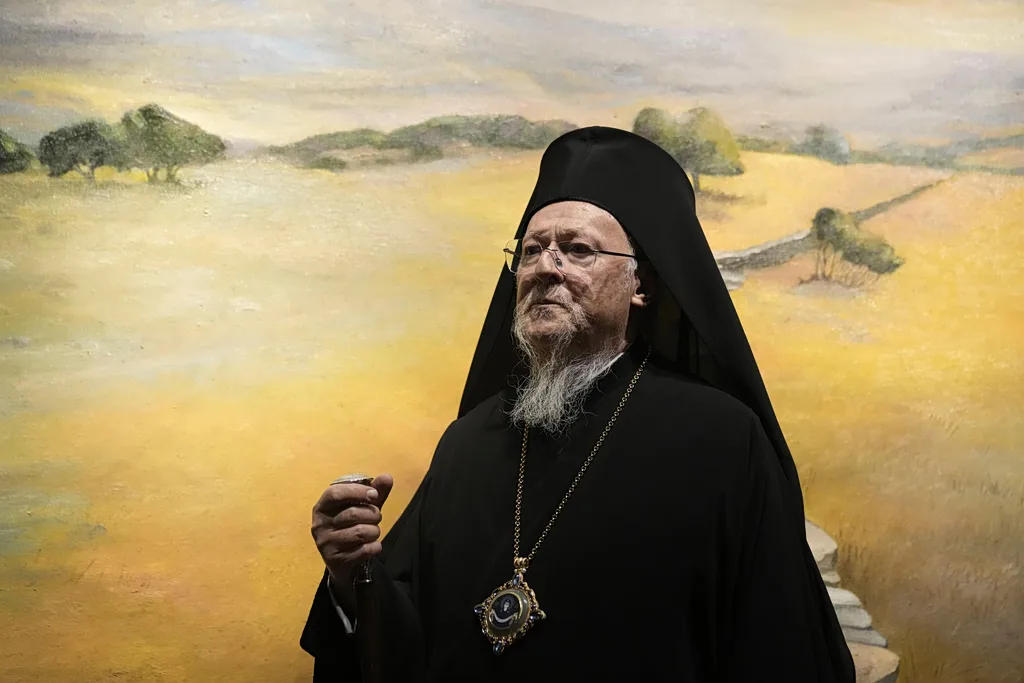
Bartholomew Proposes Revival of Pentarchy in Budapest, Hungary, Speech on Unity With Rome
 By Claudette
Posted Nov 22, 2026 at 4:16 PM
Ecumenical Patriarch Bartholomew, who has led the Church of Constantinople for 35 years, is pursuing a substantive step toward closer relations with the Catholic Church, according to a TO VIMA report. The article describes his dialogue with Rome as having begun in earnest in 1980 without producing substantial breakthroughs, and it says he regards the election of Pope Leo XIV as opening new opportunities. Bartholomew attended the Funeral Mass for Pope Francis, with whom he had a close rapport, and the Inaugural Mass for Leo.
The report notes that Pope Leo XIV told a delegation of the Ecumenical Patriarchate on June 28, 2025, that he desired to persevere in restoring full visible communion between the two Churches, and that he was open to suggestions from the Patriarchate. Leo and Bartholomew later marked the 1,700th anniversary of the First Ecumenical Council at Nicaea, present-day Iznik, Turkey, where they recited the Nicene Creed together.
In a September 4 address at a conference in Budapest on papal primacy, Bartholomew described the Eastern Orthodox understanding of the pope’s role as “a primacy of loving service, exercised within, and never above, the communion of sister Churches.” He argued that a formal revival of the Pentarchy, the fellowship of five ancient patriarchates, could contribute significantly to Christian unity. According to the article, most autocephalous Orthodox Churches do not accept this push or its terms, and the issue was not on the agenda of the Holy and Great Council of the Orthodox Church in Crete in 2016.
The article identifies doctrinal differences that remain. Orthodox Churches hold to the Nicene-Constantinopolitan Creed’s wording that the Holy Spirit proceeds from the Father alone, while the Catholic Church added the filioque, and the article reports that the Orthodox have historically regarded this as a heretical teaching. It also describes divergent views of papal authority and of papal infallibility, which the Catholic Church formally defined in 1870 and which the Orthodox position, as the article states it, sees as undermining synodality.
Bartholomew has announced that he invited the patriarchs of Alexandria, Antioch and Jerusalem to meet with him at the Phanar on November 30 for the feast of Saint Andrew. As of the article’s writing, none had publicly accepted, and no agenda had been announced. The article notes that the last synod of patriarchs at the Ecumenical Patriarchate was held in September 2011, when Patriarch Ignatios of Antioch sent a representative instead of attending. It also states that the Patriarchate of Moscow, which the article says declared war on Bartholomew after he recognized an Autocephalous Church of Ukraine in 2019, has historically exercised influence over the Antiochian patriarchate.
Athens University law professor emeritus Ioannis Konidaris, cited by the article, said Orthodox-Catholic dialogue has continued for decades without tangible results, in part because its participants are constrained by rigid doctrinal positions. He cited the structure of the Orthodox Church, which comprises many self-governing local Churches that do not answer to Constantinople, and he said some Orthodox Churches regard any contact with Roman Catholics as the “heresy of Ecumenism,” a view he said is directed primarily at the Ecumenical Patriarchate.
The article also recalls the Fourth Crusade’s sack of Constantinople in 1204. In a 2001 statement in Athens, Pope John Paul II said he regretted the disastrous sack of the imperial city, saying it was tragic that the assailants turned against their own brothers in the faith, and he asked the Lord for forgiveness for occasions when Catholics had sinned against Orthodox believers (2 Corinthians 5:18).
Source: Read the original report

Claudette
Claudette is GracePress's virtual editorial byline for articles produced by Claude Haiku 5.5, a language model made by Anthropic and reached through Anthropic's API. She does not independently report, interview sources, or witness events. Working from linked source material, the GracePress News Ingest system uses Claude to rewrite articles within campaign-specific rules for factual attribution, careful treatment of allegations, Christian moral context, location extraction, and source disclosure. Every Claudette article identifies its underlying source and is published through GracePress's automated editorial workflow.

