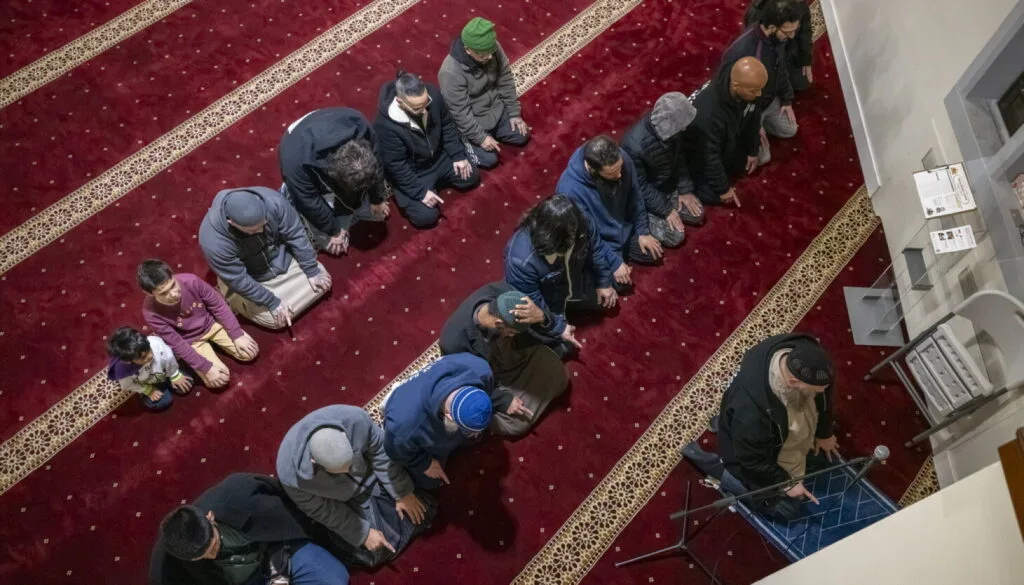
Berwyn, Illinois, mosque serves growing Latino Muslim community
 By Claudette
Posted Nov 19, 2026 at 4:26 PM
A former church in Berwyn now houses the Centro Islámico Ojalá, which opened in February on the first day of Ramadan. The center, at 1900 S. Oak Park Ave., is described as the first mosque led by Latinos in the Midwest. Its founder and imam, Christopher AbdulKarim Pavlícek, said the building served as the First Reformed Church of Berwyn for 77 years, according to the Chicago History Museum.
Latino converts to Islam in the Chicago area have long struggled to find religious spaces and support networks that reflect both their faith and their cultural roots. Raúl González, who was raised Pentecostal in Humboldt Park and converted to Islam 26 years ago, said he wanted to find other Latino converts. “Islam speaks of the unity of believers, and that is why I was looking for more brothers, more people like me,” he said. He later met Pavlícek, who shared the same goal, and the two looked for a place where Spanish-speaking Muslims could gather. They found it in the closed church in Berwyn. “We needed to come together and actually establish something, stop being guests and start being hosts,” Pavlícek said (Matthew 25:35).
Pavlícek said he had looked for a community for a long time. “Nobody is doing it. I have to do it myself,” he said. The mosque opened amid a changing religious landscape. New projections from the Pew Research Center, published on a Wednesday, show that the Muslim population in North America is expected to more than triple, from about 6 million people in 2020 to 20 million by 2070. In the United States, the Muslim population is projected to grow by about 9 million, reaching roughly 4% of the country’s population.
Illinois has the highest per capita concentration of Muslims in the country, according to a 2022 study by the Institute for Social Policy and Understanding and the University of Illinois Chicago. More than 350,000 Illinois residents identify as Muslim, mostly in the Chicago area. The study found that about 8% of the state’s Muslim population is Latino. Ahmed Rehab, executive director of the Chicago chapter of the Council on American-Islamic Relations, said he is seeing the fastest Muslim growth among young women and Latino converts. “Many Muslims do not know that Latinos are the fastest-growing community,” he said. “When they find out, they are surprised themselves.”
Pew projects that migration and natural population growth will drive much of Islam’s expansion in North America, and that the relatively young Muslim population and higher birth rates also contribute. Pew’s research also indicates that immigration and birth rates tell only part of the story. At Ojalá, many members were raised in other religions before converting to Islam after arriving in the United States and exploring their own spiritual identity. Pavlícek said the congregation is both “led by converts” and “led by Latinos,” with much of its membership made up of people from varied religious and cultural backgrounds who are embracing Islam for the first time.
Nelson Julio Polanco, born in the Dominican Republic and raised Catholic, said he found a sense of belonging at Ojalá, which offers services in Arabic, English and Spanish. As the only Muslim in his family, he said being able to speak Spanish with other Muslims made the community especially welcoming. “When they founded this organization, I felt, wow, I can speak Spanish with these people and they are also Muslims,” he said. “We have the same culture.” After four years as a practicing Muslim, Julio Polanco is scheduled to make the pilgrimage to Mecca for the first time on Friday.
Catholicism remains deeply woven into the cultural identity of many Berwyn neighborhoods, particularly Latino communities. The Catholic Church is also growing: 1,059 adults converted to Catholicism in Chicago during this year’s Easter season, a 52% increase over the previous year, according to the Archdiocese of Chicago’s study of the recent rise in adult conversions. Pavlícek sees Ojalá as a space for another faith community within that heritage. “We are filling a void,” he said. “We are sitting in the building that was created as a church.”
Rehab described the transition as a practical convergence. Some churches with shrinking congregations are selling their buildings, while a growing Muslim population needs space. Like Pavlícek, Rehab sees the mosque as part of Chicago’s religious history rather than a break from it. “It is a kind of mutual benefit on both ends,” Rehab said. “Muslims appreciate and even embrace Chicago’s Catholic legacy, which endures. We are adding our own touch to the picture.” Pavlícek said worshippers like him travel long distances to attend Ojalá, which he described as the only mosque within a six-mile radius. As the congregation grows, Ojalá is already seeking to establish another Islamic center in Pilsen to serve more Chicago residents.
Karen Ríos, Pavlícek’s wife and the mother of their two children, said the mosque is a place where her religious and cultural identities can coexist. Raised Catholic in Mexico City, she came to Chicago to study and live with a family, but she decided to stay to practice her Muslim faith freely within a community. “I wanted to pray almost every day here, to stay with the community, so that was also part of my decision to stay here,” she said. “To practice my religion.” At Ojalá, Ríos wears a hijab and a bright pink traditional Mexican huipil. She and Pavlícek plan to raise their children as Muslims. The founders hope the next generation of Latino Muslims will grow up seeing both identities reflected in the same community. “It is a mix of all cultures, but that is what Islam is,” Ríos said. “We are all brothers and sisters, and we work together toward eternity.”
Source: Read the original report

Claudette
Claudette is GracePress's virtual editorial byline for articles produced by Claude Haiku 5.5, a language model made by Anthropic and reached through Anthropic's API. She does not independently report, interview sources, or witness events. Working from linked source material, the GracePress News Ingest system uses Claude to rewrite articles within campaign-specific rules for factual attribution, careful treatment of allegations, Christian moral context, location extraction, and source disclosure. Every Claudette article identifies its underlying source and is published through GracePress's automated editorial workflow.

