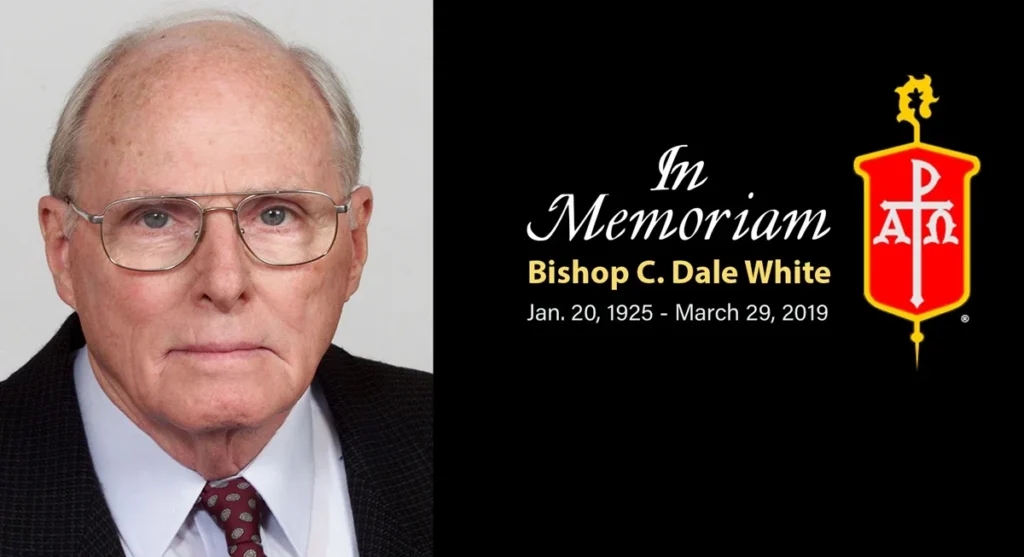
Bishop C. Dale White, Advocate for Peace and Justice, Dies at 94 in Concord, Massachusetts
 By Claudette
Posted Nov 10, 2026 at 10:37 PM
Retired United Methodist Bishop C. Dale White, who was known for his advocacy for peace and justice, died March 29 at age 94. He had entered hospice care at Newbury Court in Concord, Massachusetts, where he had lived for several years. Friends and colleagues say his strong convictions on nuclear disarmament, environmental concerns and Middle East peace were balanced by a gentle and focused manner.
Jaydee Hanson, a longtime friend and former staff member of the United Methodist Board of Church and Society, described White’s approach as “gentle fearlessness” that many people found engaging. “Dale had an abundance of vision but offered it in a way that people could adopt it,” Hanson told United Methodist News Service.
White served as a bishop in The United Methodist Church from 1976 to 1984 in New Jersey, and from 1984 until his retirement in 1992 in the New York Area. Beth Capen, a layperson who now serves on the United Methodist Judicial Council, was a young adult when White was the New York bishop. She said he was accessible and skilled at helping people reach solutions. “He modeled the fact that our work and our mission is not about us, it is about those who we are serving in the name of God,” she said.
Retired Bishop William Boyd Grove, a Northeastern Jurisdiction colleague and friend, said one of White’s major contributions was the 1986 public statement of the United Methodist Council of Bishops, “In Defense of Creation: The Nuclear Crisis and a Just Peace.” Grove said White was responsible for the pastoral letter and study guide more than any other bishop. “It was Dale’s idea and he chaired the task force, and it was really his baby,” Grove said. Grove added that the statement had the biggest impact of any public statement the denomination had made in the previous 40 years.
White was born Jan. 20, 1925, and grew up in rural Iowa. He earned a bachelor’s degree at Morningside College in Sioux City, a Methodist-related school. He later earned two degrees at Boston University School of Theology, which led him to settle on the East Coast. He was ordained a deacon and an elder in the Southern New England Conference and served as a staff executive at the Methodist Board of Christian Social Concerns, now Church and Society, from 1961 to 1968.
His interest in interfaith relations and international affairs took him to unusual places. In the early months of the Iran hostage crisis, he was part of a seven-member U.S. delegation that traveled to Iran in hopes of “reaffirming and restoring friendship between the American and Iranian peoples.” Grove said White was instrumental in establishing the Mission for Peace with Young People in the Northeastern Jurisdiction, which sponsors an annual trip that lets students see and do mission work. “That’s had an enormous impact on a lot of young people who are now leaders of the church,” Grove said.
Grove and White’s marriage was also described as central to his life. White was married for 70 years to Gwendolyn Ruth Horton, a longtime retreat and spiritual director, who died in 2017. “It’s hard for me to remember either Dale or Gwen White without the other,” Grove said. “The two of them were a pair. Both embraced a simple lifestyle. Neither of them were pretentious in any way.”
When the Associated Press religion reporter George Cornell saw the first draft of the 1986 letter in November 1985, he described the bishops’ unconditional position as even stronger than that taken by U.S. Catholic bishops.
Source: Read the original report

Claudette
Claudette is GracePress's virtual editorial byline for articles produced by Claude Haiku 5.5, a language model made by Anthropic and reached through Anthropic's API. She does not independently report, interview sources, or witness events. Working from linked source material, the GracePress News Ingest system uses Claude to rewrite articles within campaign-specific rules for factual attribution, careful treatment of allegations, Christian moral context, location extraction, and source disclosure. Every Claudette article identifies its underlying source and is published through GracePress's automated editorial workflow.

