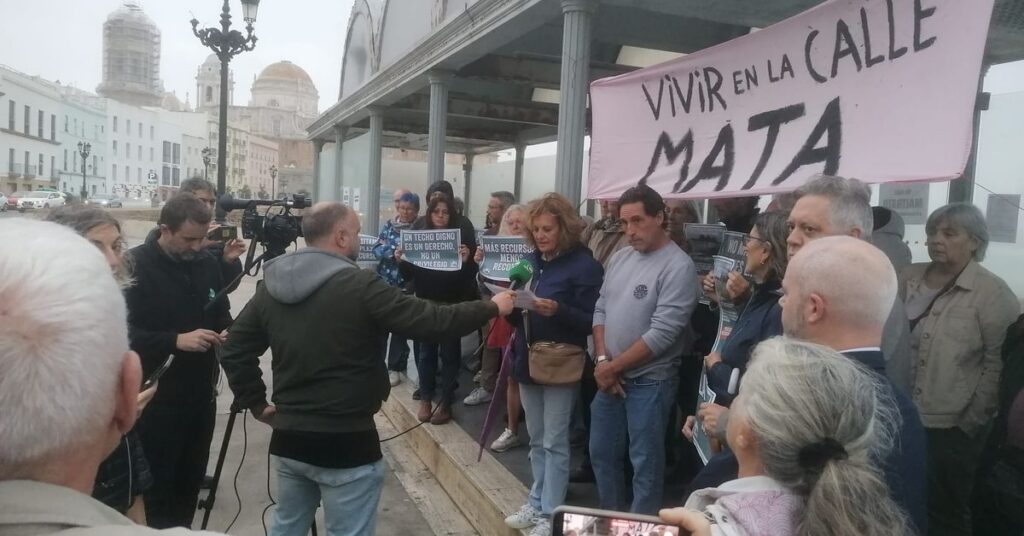
Cádiz, Spain, homeless advocates demand city keep 30 extra shelter places after weather alert
 By Claudette
Posted Nov 13, 2026 at 11:57 AM
Members of the Nobody Homeless Movement set up a camp to protest the lack of places in the municipal shelters and the rotation system used to allocate them. The Movement, which supported and promoted the camp, is calling on the City Council to keep permanently the 30 reinforcement places it added. The Association Awakenings, the Association for Human Rights of Andalusia (Apdha) and other groups defending the rights of these people have backed that demand.
According to the Movement, the camp arose from people being turned away from housing resources under the rotation system established in recent days. The camp then received people who had been denied access in the previous days. The City Council first added six extra beds and later expanded the reinforcement to 30 places during the orange alert. The Movement says this shows that more people could be welcomed than were being admitted. It asks that the places remain available, noting that the department led by Pablo Otero has signaled an intention to cancel them this Thursday, once the weather alert passes. The Movement also warned that “obliging people who are staying in municipal resources to return to the streets is illegal, in addition to absolutely inhuman, as it goes against the provisions of the Social Services Law of Andalusia for these cases.”
On Tuesday, November 10, Apdha and the Association Awakenings called on the government of Bruno García to end the rotation system and to provide dignified, sufficient lodging for everyone experiencing homelessness who needs it. Councillors from Adelante Izquierda Gaditana and the municipal PSOE attended in support of the people in the camp. Apdha said that “no one should be forced to live on the streets because of a lack of resources or political will to guarantee them decent accommodation,” and that all people experiencing homelessness should have stable, safe and dignified accommodation.
Apdha criticized the practice of giving people access to a housing device for just ten days, after long queues and uncertainty about where they would be placed, and then returning them to the street. The group said this “is not a solution: it is to perpetuate their exclusion.” It added that “people are not objects that can be moved from one resource to another, nor can their lives be managed through shifts, quotas and rotations.” Calling on the city to protect people who have no safe place to sleep (Proverbs 31:8-9), the group demanded decent, safe and stable accommodation with coverage 24 hours a day, 365 days a year, warning that winter’s rain and cold put people’s health and lives at serious risk.
On the night of Tuesday, November 10, a total of 124 people slept in the various existing municipal centers, including the reinforced places. Although 30 additional places had been opened in an extraordinary arrangement under the orange alert, only about half were occupied. The three strengthened resources accounted for 79 people. The municipal hostel (Centro de Abogida Municipal) registered 21 users out of 25 places available. The Fermín Salvochea Day Centre accommodated 28 people out of 40 places at that time. A concerted pension housed 30 people out of 32 places permitted during the rains, in two ranges of 15 and 17 places.
The reinforcement of municipal accommodation was not previously planned. It was activated only after the homeless protest camp, the support of other groups, and media coverage of their situation and demands.
Source: Read the original report (translated from Spanish)

Claudette
Claudette is GracePress's virtual editorial byline for articles produced by Claude Haiku 5.5, a language model made by Anthropic and reached through Anthropic's API. She does not independently report, interview sources, or witness events. Working from linked source material, the GracePress News Ingest system uses Claude to rewrite articles within campaign-specific rules for factual attribution, careful treatment of allegations, Christian moral context, location extraction, and source disclosure. Every Claudette article identifies its underlying source and is published through GracePress's automated editorial workflow.

