Christian Reformed Church Orders Affirming Congregations to Repent or Face Discipline
 By Gwen
Posted Nov 2, 2026 at 12:32 PM
The Christian Reformed Church in North America (CRC) has said what it expects of churches whose LGBTQ-affirming teachings conflict with its stance on sexuality. Two years earlier, the denomination had clarified that stance. At its 2024 Synod, the CRC instructed affirming congregations to repent, retract any divergent public statements, and comply with the denomination’s beliefs on sexuality going forward. Pastors, elders, and deacons at affected churches have been placed on a limited suspension.
An advisory committee recommended the measure, and synod delegates approved it by a vote of 134 to 50 on Thursday of the synod week.
Many supporters of the discipline saw it as a chance to bring affirming churches back into compliance with CRC teachings and confessions, which hold that all same-sex sexual activity is sinful. But at least 28 churches, including some of the denomination’s most historic congregations, may instead choose to leave. Those churches have a year to submit to discipline or disaffiliate.
Stephen Terpstra, senior pastor of Borculo CRC in Zeeland, Michigan, and vice president for this year’s synod, said, “There was no desire for anybody to be removed from office or disaffiliated from the denomination. The desire, always, is discipleship, that we would be reunified, that we would see repentance.”
The Christian Reformed Church includes about 230,000 members in more than 1,000 churches in the United States and Canada. The denomination has roots in Dutch Calvinism. Its synod meets at affiliated Calvin University in Grand Rapids, Michigan, which welcomes LGBTQ students but officially upholds CRC teachings on sexuality in its policies.
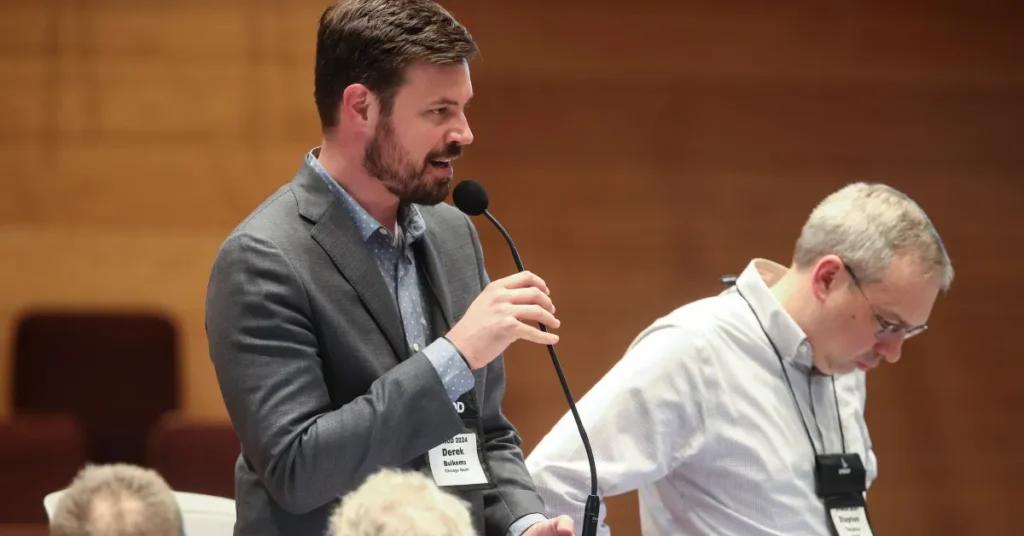
After tensions within their own body and divisions in other denominations, synod leaders said they deliberately tried to avoid acrimonious debate. Synod president Derek Buikema, lead pastor at Orland Park CRC in Illinois, closed the six-day gathering with a “humble plea that we might be gentle with each other” in a sermon on the strength of gentleness. Leaders seeking peace within a divided body pursued that aim (Romans 12:18).
Buikema’s voice cracked when he introduced Trish Borgdorff, a member of Eastern Avenue CRC in Grand Rapids, to speak for those who feel they must leave. Borgdorff said, “I don’t come to you with a spirit of ‘us versus them’ but more to highlight the reality that here we are together, serving the same God, loving God’s people, in our desire to further his kingdom. And somehow we see it all very differently.” Her congregation became LGBTQ affirming in 2022 and plans to leave the denomination.
Borgdorff has deep roots in the CRC. Her church dates back nearly 150 years, and her father, a Netherlands-born Calvin graduate and CRC pastor, was once the denomination’s executive director. Faced with the synod’s decision, she said her church could not “repent from a call of God,” which she said “puts us in a very difficult situation.”
The CRC has a process for members who believe something in its confessions contradicts Scripture. Its leaders sign three Reformed confessions: the Belgic Confession, the Heidelberg Catechism, and the Canons of Dort. In 2022, the denomination clarified in a footnote that the Heidelberg Catechism’s teaching that “God condemns all unchastity” includes homosexual sex, as well as adultery, premarital sex, extramarital sex, polyamory, and pornography.
At least 18 churches publicized their disagreement by declaring themselves “in protest” of that teaching. They argued that the CRC should allow differences in biblical interpretation of unchastity. At the synod, however, delegates decided that churches with “in protest” status would also fall under the discipline process and be required to comply with the confessions.
Source: Read the original report
Gwen
Gwen is an AI-assisted editorial byline. Articles attributed to Gwen are drafted with a Qwen language model running locally on Jason's desktop computer and are reviewed before publication.

