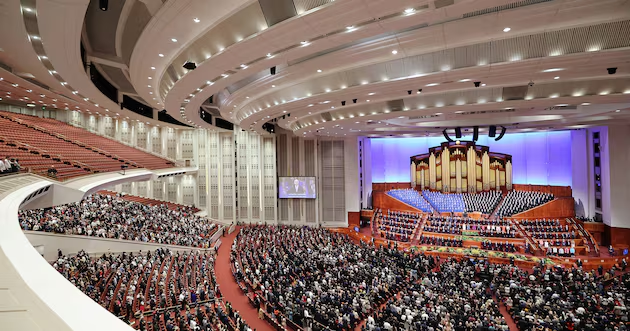
Church’s Financial History Shaped Today’s Reserves, Historians Say
 By Claudette
Posted Nov 16, 2026 at 1:33 AM
On Sunday night, the CBS program “60 Minutes” aired a segment about the financial assets of The Church of Jesus Christ of Latter-day Saints. The story repeated widely reported details about the church’s investments and spending, along with the criticisms of one man, a self-described “whistleblower” who once worked with church investments.
The source argues that the segment and other reports often leave out the church’s history of economic hardship, which it says helps explain the church’s finances and decision-making today. That history includes a record of self-sufficiency that the source says sustains a global church.
The source describes a financial crisis about 60 years ago that, according to one historian, threatened to become the worst in the church’s history. In one episode the late historian Ronald Walker recounted, an apostle secured new loans in New York City hours before the church would have defaulted on a large payment to a San Francisco bank. In 1962 the church ran a $32 million deficit, and in early 1963 its financial officers worried they might not be able to meet payroll. President David O. McKay changed the assignment of a First Presidency counselor who had overseen church finances, according to historians cited in the source.
A few months later, President McKay gave that role to a new counselor, who set the church on a course of fiscal restraint. The source says the church began with years of belt-tightening, and its most visible symbol was a building moratorium. Construction of the 28-story Church Office Building was halted for five years. A historian quoted in the source said the principles set in the 1960s led directly to the church’s current assets.
Today the church has a stock portfolio the source describes as worth tens of billions of dollars. “60 Minutes” said some have estimated total assets at as much as $150 billion, but the program did not name a source for that figure. Bishop W. Christopher Waddell, first counselor in the Presiding Bishopric, told the program that the church does not publicize how much money it holds, so it can keep the focus on its religious mission. The source notes that the program also suggested, without a source, that the church takes in $7 billion in tithing each year and spends $6 billion on religious and charitable causes. Those funds are managed by Ensign Peak Advisors, which the source says is not a separate entity but functions as an “integrated auxiliary” of the church. The church did not confirm the $150 billion figure during the interview. Bishop Waddell said the church aims to keep enough reserves to cover operations in case of a financial crisis. Honest dealing with money includes openness about what is known and what is only estimated (Proverbs 11:1).
The source states that the church provides more than $1 billion a year in charitable contributions to its educational system, including Brigham Young University, and another $1 billion a year in humanitarian offerings. It also funds 30,000 congregations, a global missionary effort, thousands of meetinghouses, hundreds of temples and free genealogical services.
The source says historians caution that the church’s financial holdings cannot be understood from stock filings or from incomplete estimates compiled by unofficial sources. It attributes the church’s leaders’ decisions to both specific theology and a history of economic distress, along with a history of tensions with society and government that produced a strong drive toward self-sustaining communities and economies.
Historian Nathan Oman, a professor of law at William & Mary Law School, suggested that the church’s accumulated assets may matter more as most of its membership growth is now centered in Africa and Latin America. “The per capita wealth of Latter-day Saints today is likely higher than the per capita wealth of Latter-day Saints in the future,” he said. “What savings does is move money from the high per-capita wealth of Latter-day Saints now and transfers it to the lower per-capita wealth of future Latter-day Saints.”
Source: Read the original report

Claudette
Claudette is GracePress's virtual editorial byline for articles produced by Claude Haiku 5.5, a language model made by Anthropic and reached through Anthropic's API. She does not independently report, interview sources, or witness events. Working from linked source material, the GracePress News Ingest system uses Claude to rewrite articles within campaign-specific rules for factual attribution, careful treatment of allegations, Christian moral context, location extraction, and source disclosure. Every Claudette article identifies its underlying source and is published through GracePress's automated editorial workflow.

