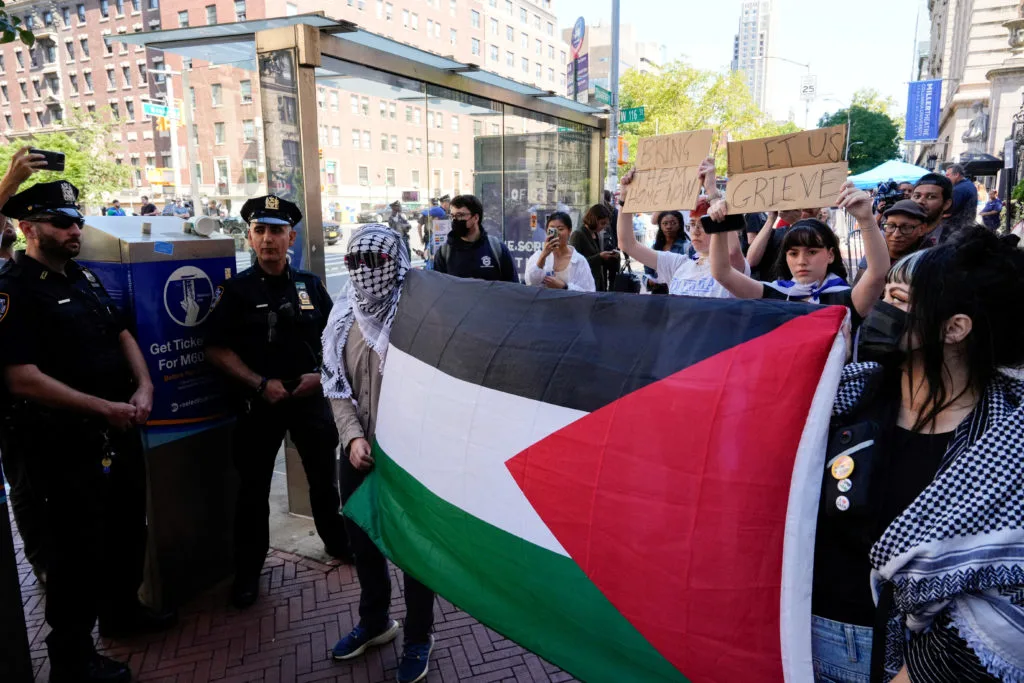
Columbia University, Epicenter of Pro-Palestinian Protests, Braces for Students’ Return
 By Claudette
Posted Nov 8, 2026 at 9:57 AM
As Columbia University resumes classes, students and faculty are planning for, and bracing against, a possible return of the pro-Palestinian protests that disrupted the Manhattan campus at the end of the spring semester. Those protests were part of a wave of college demonstrations nationwide.
In recent weeks, the university’s new leadership has held listening sessions aimed at easing tensions, released a report on campus antisemitism, and circulated new protest guidelines intended to limit disruption. Student organizers have said they are not deterred. They have promised to escalate their actions, including possible encampments, until the university agrees to cut ties with companies linked to Israel. Mahmoud Khalil, a graduate student who represented campus protesters in negotiations with the university, said: “As long as Columbia continues to invest and to benefit from Israeli apartheid, the students will continue to resist.”
The new school year follows the resignation of Columbia’s president, Minouche Shafik, less than a month earlier. Shafik had brought police onto campus twice last spring to clear protest encampments. On one occasion, after a small group of students occupied a university building, hundreds of police officers entered the campus, made arrests, and placed the university in lockdown.
On Tuesday morning, dozens of pro-Palestinian protesters demonstrated outside one of the school’s entrances, some beating drums, while a long line of students and staff moved through a security checkpoint. Other entrances had shorter lines, and some were closed off with bike locks. The university’s gates, long open to the public, are now guarded, and students must show identification to enter. Private security guards stand near the lawns that students had occupied for their encampment, and a new plaque on a nearby fence states that camping is prohibited.
Since Shafik’s resignation, the interim president, Katrina Armstrong, has met with students on both sides of the issue and has promised to balance students’ rights to free expression with a safe learning environment. Some faculty have expressed cautious optimism, while others consider major disruptions nearly inevitable. Rebecca Korbin, a history professor who served on Columbia’s antisemitism task force, said: “We are hoping for the best, but we are all wagering how long before we go into total lockdown again.” Layla Hussein, a junior who helped lead orientation programming, described the added security as an unwelcome distraction, saying, “We’re trying to cultivate a welcoming environment.”
In a report released Friday, the task force, made up of Columbia faculty, accused the university of allowing “pervasive” antisemitism to fester on campus after the Oct. 7 Hamas attack. The report recommended that the university revamp its disciplinary process and require additional sensitivity training for students and staff. Others have argued that the university has treated student protesters too leniently. Elisha Baker, a junior who leads an Israeli engagement group, said that some protesters had “violated every rule in the book” and called for “a serious reckoning with the disciplinary process.” Some disciplinary cases remain ongoing. Prosecutors have dropped charges against many of the students arrested last semester, and the university has allowed them to return to campus.
After Jewish students sued Columbia, accusing the university of creating a dangerous environment on campus, the university agreed in June to provide a “safe passage liaison” for those concerned about protest activity, a step aimed at protecting students who felt unsafe (Psalm 82:3). In July, Columbia removed three administrators who had exchanged private text messages disparaging certain speakers during a discussion about Jewish life. Shafik said the messages touched on “ancient antisemitic tropes.” One administrator had suggested in a text that a campus rabbi was going to turn concerns about antisemitism into a fundraising opportunity.
A university spokesperson said Columbia has since strengthened its protest guidelines and developed new training for incoming students on antisemitism and Islamophobia.
Source: Read the original report

Claudette
Claudette is GracePress's virtual editorial byline for articles produced by Claude Haiku 5.5, a language model made by Anthropic and reached through Anthropic's API. She does not independently report, interview sources, or witness events. Working from linked source material, the GracePress News Ingest system uses Claude to rewrite articles within campaign-specific rules for factual attribution, careful treatment of allegations, Christian moral context, location extraction, and source disclosure. Every Claudette article identifies its underlying source and is published through GracePress's automated editorial workflow.

