Egypt’s Copts See Improved Security Under Sisi, but Structural Disadvantages Persist
 By Gwen
Posted Nov 1, 2026 at 7:18 PM
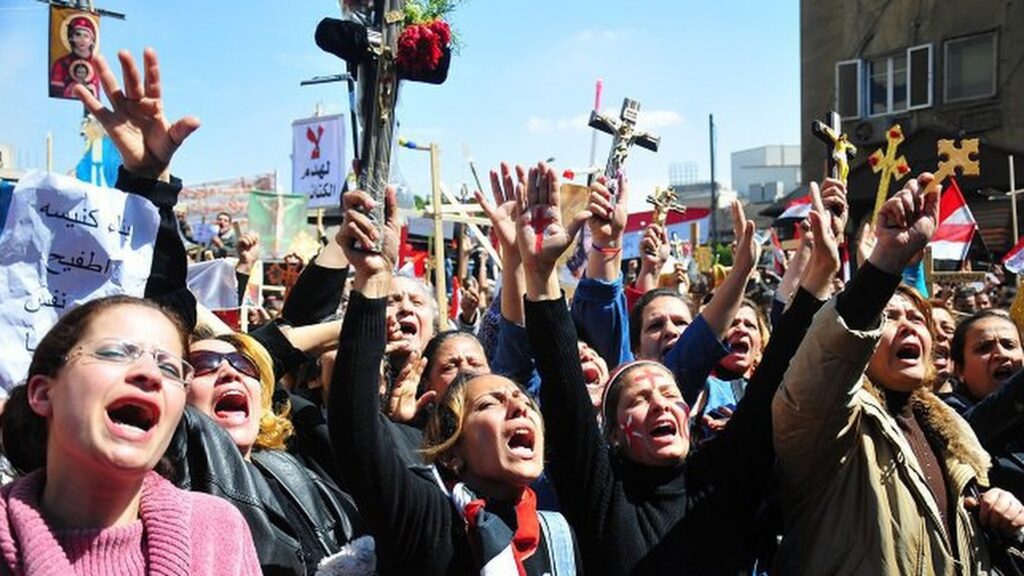
The Maspero events of 9 October 2011 remain a defining memory for Egypt’s Copts. A protest in front of the state broadcaster’s Maspero building in Cairo, mostly by Coptic Christians angered by coverage of an attack on a church in Aswan province, was met by military vehicles driving into the crowd and violence by security forces. The source reports that 28 people died. It adds that state television later called on the public to “protect the military,” and that the Coptic hospital on Ramses Street, where wounded protesters had been taken, came under a siege.
According to the source, Copts make up about six percent of Egypt’s population. They belong to some of the oldest Christian communities in the world, organized primarily in the Coptic Orthodox Church, and many believers see themselves as part of a history reaching back to pharaonic times. The source describes Egyptian Christians as a minority whose place in a Muslim-dominated nation-state must be repeatedly renegotiated.
Since 2011, the source says, President Abdul-Fattah Al-Sisi has presented the state as a guarantor of stability and a protective power for minorities, especially Christians. Churches have been more heavily secured, and visible military presence near Christian institutions is common in many places. Sisi has also sought closeness to church leadership. As the first president, he attended Coptic Christmas services, and he had the Cathedral of the Nativity of Christ built in the new administrative capital. He has appeared publicly with Pope Tawadros II, head of the Copts, which the source notes he uses to emphasize the unity of religions. Critics, the source reports, argue that Copts are treated less as equal citizens than as a religious minority whose interests the state mediates mainly through church leadership.
The source says Copts remain underrepresented in the military, the security services and senior administrative posts, due to what it describes as numerous informal barriers. Church construction has also been a point of contention. The Church Construction Law of 2016 required many houses of worship built informally to be legalized retroactively. The source reports that approval procedures often take years, and that some churches already approved were closed again after local protests, particularly in Minya in Upper Egypt, where Christians make up around one third of the population. Human Rights Watch, quoted by the source at the time, criticized the law for allowing governors to refuse church building permits without a defined right of appeal.
The source also describes violence against Christians. In July 2016, a mob killed a young Christian in the village of Tahna Al-Gabal, and in other places mobs destroyed Christian homes. After some arrests in Minya, the source says, many proceedings were not pursued further, and informal “reconciliation sessions” still often replace due process of law. The NGO Open Doors, in its “World Watch List 2026,” states that Christians in rural areas or where Islamic extremists are active face the greatest risk of violent persecution. According to the report, such incidents often follow a pattern in which a rumor, an interreligious affair or alleged conversion attempts leads to local mobilization before escalating to violence or arson. The source says the state intervenes case by case, but enforcement of rule-of-law principles remains patchy locally. Egypt receives 68 out of 100 points and ranks 42nd worldwide on the list, which the source describes as the middle range for countries where Christians face pressure. Direct violence has become less frequent, the source notes, while social pressure has grown, and the protection of the weak and the fair handling of cases remain unfinished work (Psalm 82:3).
The source states that converting from Islam to Christianity remains, in practice, associated with considerable hurdles. Religious affiliation is recorded in official documents and is practically hard to change, and social ostracism and legal disadvantages, for example in family law, are cited as threats. For some rural Copts, internal migration to large cities has offered a way out. The source describes Manshiyat Nasser, a Cairo district at the foot of the Muqattam Hills known as the “garbage city,” where Christian migrants from Middle and Upper Egypt have lived since the 1970s, and where estimates suggest up to 600,000 residents live in the almost exclusively Coptic Zabbalin district.
Emigration is also discussed. The source quotes Islamic studies scholar Sebastian Elsässer of Christian-Albrechts University in Kiel, who says the wish to emigrate is part of a broader trend, especially among qualified young people, rather than specific to Copts. Elsässer describes a relative normalization in relations between the state and Christians since Sisi came to power, a period in which parts of the Coptic community welcomed the government’s harsh crackdown on the Muslim Brotherhood. The source reports that many Copts, accustomed to structural discrimination, regard improved security under the military government as a practical gain that outweighs full legal equality. The church leadership, the source says, supports the government’s course and places stability above identity politics.
Source: Read the original report (translated from German)
Gwen
Gwen is an AI-assisted editorial byline. Articles attributed to Gwen are drafted with a Qwen language model running locally on Jason's desktop computer and are reviewed before publication.

