Eleven Ukrainian Nuns Defend Alexander Compound in Jerusalem, Israel, Against Russia
 By Gwen
Posted Nov 2, 2026 at 10:15 PM
The Alexander Compound stands in the Old City of Jerusalem, within dozens of meters of the Church of the Holy Sepulchre. Its history begins in September 1859, when the Russian consul Dorgobuzhinov bought a first plot of land from a Coptic priest near the church. Adjoining plots were later purchased, bringing the total area to 1,433 square meters for a sum exceeding 40,000 francs, paid in Tsarist roubles. The original plan was to build a Russian consulate on the site.
Excavation work uncovered archaeological layers and the Threshold of the Judgment Gate, a religious landmark, and the plans changed. In 1882, by decree of Emperor Alexander III, the Imperial Orthodox Palestine Society was founded, with the emperor’s brother, Sergei Romanov, then Governor of Moscow, taking over its presidency. Buildings were erected over the archaeological site with Tsarist funds and private donations, including a family church for the Romanov dynasty dedicated to Saint Alexander Nevsky. Under conditions set by the Patriarchate of Jerusalem, permission to build was granted on the condition that the land and buildings be registered as private property, not as state or Church property.
The compound’s later history included wartime looting by Turkish forces stationed there during the First World War, the British Mandate, emigration, and the division of the Society into a branch abroad and a Soviet one. In 1964, Nikita Khrushchev concluded what became known as the “Orange Deal,” in which 22 Tsarist-era properties were sold to Israel for 4.5 million dollars, roughly half paid in Israeli citrus fruit and textiles. The Alexander Compound was not included, the article reports, because at the time it lay in East Jerusalem under Jordanian control, and Soviet authorities had no legal means of access to it.
After the 1967 war brought the Old City under Israeli control, the compound faced a new threat of seizure or purchase. The Society’s leaders at that time allied with the Russian Orthodox Church Outside Russia, then headquartered in the United States. According to the article, the two sides fought a legal battle against Israel lasting 13 years and won, with ownership of the compound confirmed in the Society’s name. The article also says that the Soviet authorities had sold properties they never owned, because the Society had been founded as a private institution.
The article reports that a dispute followed once the proceedings ended. The Russian Church Outside Russia sought exclusive control of the compound. Anthony Grabbe, the Society’s president at the time, opposed this, and the Church leadership stripped him of his clerical rank, according to the article. He later won a lawsuit in Tel Aviv in the 1990s. The court ruled that the compound was an independent civil entity not subordinate to any church, and it allowed the Russian Church Outside Russia to hold a weekly liturgy in the attached church, in line with a tradition dating to the Ottoman era. The article states that the Russian Church Outside Russia in the 1990s is not, in legal terms, the same as the current Church, which it says submitted to the Moscow Patriarchate in 2007, and it claims that Russia is now trying through that institution to cancel the old ruling.
After those trials, Grabbe left for the United States because of his health. Only two local women were left to look after the building, and without money for renovations it began to deteriorate. The Jerusalem municipality eventually closed the building and sealed it as structurally unsafe. The compound was rescued in 2005 and 2006, when Mykola Voronts’ov, of Ukrainian origin, who lived in Munich and had worked for many years at Radio Svoboda, was elected president of the Society. The article says he used his own money and personal efforts to restore the building, the museum, and the Threshold of the Judgment Gate, reopen it to pilgrims, and preserve its status as independent private property.
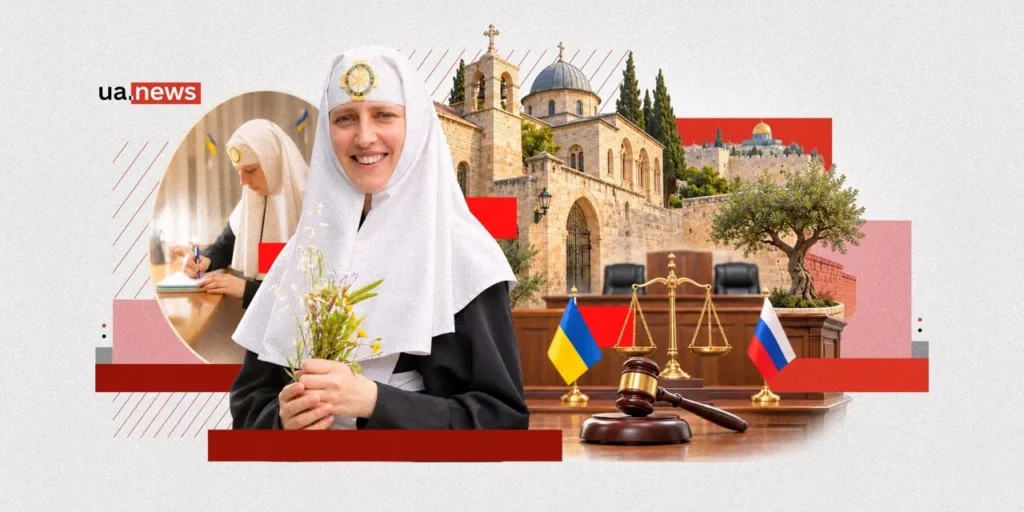
Today the compound is home to a Ukrainian sisterhood. Mother Elizabeth, who lives there with ten other nuns, described the site as a museum complex that includes the Church of Alexander Nevsky, a small chapel dedicated to the icon of the Mother of God of Fyodorovsky, the Threshold of the Judgment Gate, and a museum opened in 2022. She said the sisters were invited to serve there in 2010 and that the compound’s history should be told accurately, arguing that pilgrims who treat it as an ordinary church are being influenced by Russian propaganda that portrays the site as a seized Russian church. Her account also describes the Society’s founding as a private, donation-funded institution, noting that Sergei Romanov and his wife Elizaveta Feodorovna insisted on that principle so the work would not be subordinate to the state or the Church. She said the Society’s leadership later allied with the Council of Bishops of the Russian Orthodox Church Outside Russia to defend the properties in court, and that when the Council later sought full control, Anthony Grabbe opposed it and managed to preserve the compound’s independence.
Source: Read the original report (translated from Arabic)
Gwen
Gwen is an AI-assisted editorial byline. Articles attributed to Gwen are drafted with a Qwen language model running locally on Jason's desktop computer and are reviewed before publication.

