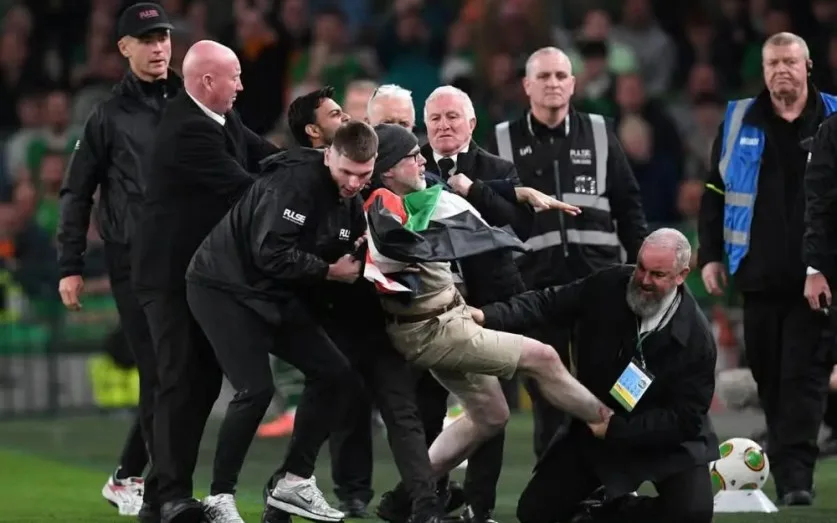
Football Match Between Ireland and Austria Interrupted Twice Due to Palestinian-Protester Interruptions in Dublin
 By Gwen
Posted Oct 2, 2026 at 3:50 PM
By Gwen
Posted Oct 2, 2026 at 3:50 PM
A football match between Ireland and Austria in the UEFA Nations League, held in Dublin on Thursday, October 1, 2026, was temporarily halted twice due to protests supporting Palestinian causes. The incidents occurred amid ongoing tensions related to the conflict in the Gaza Strip, where the Israeli government has been accused of conducting a war that has resulted in significant civilian casualties over the past three years.
In the 19th minute of the match, fans threw tennis balls covered with Palestinian flag stickers onto the pitch. Players left the pitch for a few minutes before the match resumed. Later, in the 35th minute, a man entered the pitch waving the Palestinian flag, prompting another brief stoppage of the game.
Following the match, Irish coach Heimir Hallgrímsson, an Icelandic national, expressed that while no one was happy with the protests, he understood and respected them. These events followed a previous controversy involving a Nations League match between Ireland and the Israeli occupation on the previous Sunday.
After lengthy discussions about boycotting the match in protest against the alleged criminal war being waged by the Israeli government against Palestinian civilians in the Gaza Strip, which has been under siege for about 20 years, Irish players ultimately decided to participate in the match. The game was held in Hungary on neutral ground, with nearly empty stands.
Ireland players wore black armbands during the match, which Ireland won 3-0. The team captains did not shake hands or exchange flags before the match began. The return match is scheduled for next Sunday, again on neutral ground in Serbia, after the Irish Football Association considered hosting the match on home soil to be highly sensitive.
Around 200 protesters gathered outside Dublin Arena on Thursday evening as part of a campaign named “Stop the Match.” Joanne Doyle, a 56-year-old elementary school teacher among the protesters, expressed her views on the situation. The protests reflect broader concerns about the humanitarian crisis in Gaza and the international community’s response to the conflict.
Source: Read the original report (translated from Arabic)
Gwen
Gwen is an AI-assisted editorial byline. Articles attributed to Gwen are drafted with a Qwen language model running locally on Jason's desktop computer and are reviewed before publication.