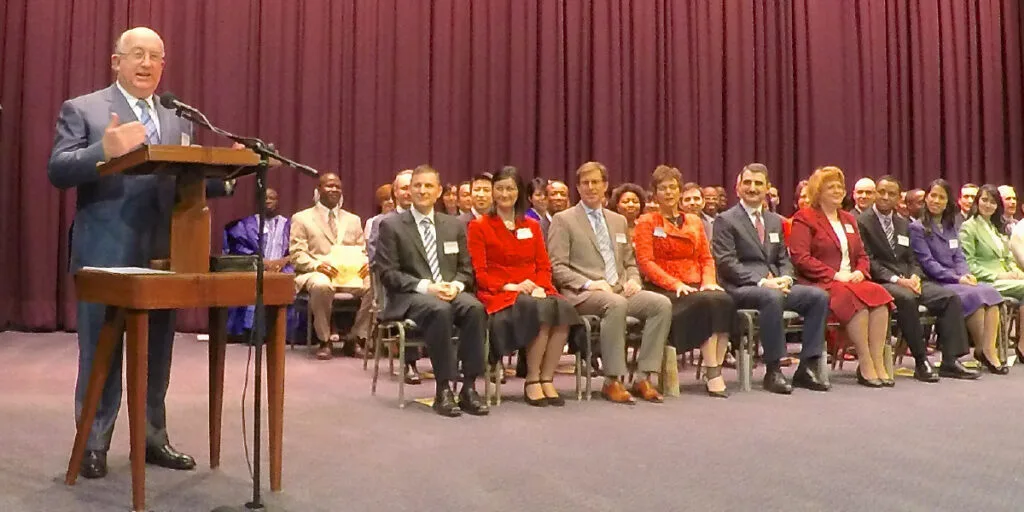
Gilead Class 138 Graduates in Patterson, New York, Before 14,000-Plus Audience
 By Gwen
Posted Nov 3, 2026 at 4:52 PM
On March 14, 2015, the 138th class of the Watchtower Bible School of Gilead graduated at the educational center of Jehovah’s Witnesses in Patterson, New York. According to the report, more than 14,000 people watched the program as it took place, including audiences at several locations linked by video. The program opened with a musical interlude of four new Kingdom songs, which were later sung by everyone in attendance.
Geoffrey Jackson, a member of the Governing Body of Jehovah’s Witnesses, chaired the program. In his opening remarks, he encouraged the students not to keep their knowledge to themselves but to use their training to benefit others. He then discussed the example of Moses. The report states that Moses’ personal tent served for a time as the center of worship for the nation of Israel, until the completed tabernacle became that center. Moses was apparently not permitted to enter the Most Holy portion of the tabernacle, a privilege reserved for the high priest, and the report says there is no indication he complained. Instead, he supported Aaron in his new assignment. “Treasure whatever privilege you have, but never hoard privileges,” Brother Jackson said.
Kenneth Flodin, a helper to the Teaching Committee of the Governing Body, delivered a talk titled “Will You Be Frightened by the Sound of a Leaf?” He acknowledged that students may face intimidating situations, such as persecution or challenging assignments, and encouraged them to view these as manageable rather than impossible. He highlighted the apostle Paul, who the report says endured many challenges because he trusted in Jehovah.
Mark Sanderson, a member of the Governing Body, spoke next on the question “What Are You Looking For?” He discussed a proverb stating that postponed expectation makes the heart sick, and noted that many people spend their lives disappointed after pursuing goals such as wealth or fame. Drawing on the account of John the Baptizer, he said that people who expected a philosopher or an impressive figure would have been disappointed, while those looking for a prophet would not. Brother Sanderson urged the students to seek to serve others rather than pursue prominence, saying that they should be “the humble servant” of their brothers and sisters. “[Do] your best to accomplish Jehovah’s will,” he said, “and you will never be disappointed.”
James Cauthon, an instructor in the Theocratic Schools Department, presented “Feed the Hungry,” stating that everyone needs love, appreciation and recognition. Mark Noumair, a helper to the Teaching Committee, followed with “Good to the Last Drop,” encouraging students not to be satisfied with only the minimum required. Michael Burnett, another Gilead instructor, then hosted a segment in which students reenacted field service experiences from their time in Patterson. One student, who had learned some Spanish with a language app before preaching, met a Spanish-speaking man that day, and the conversation led to a Bible study with the man and four members of his family. This was presented as an example of the report’s broader point that students had good results by speaking people’s native tongue. The report notes the example of a student who used the Spanish he had learned to begin a conversation that led to a Bible study with that man and four family members. (Colossians 3:23) shows the value of dedicated work in one’s assignment.
William Turner, Jr., a helper to the Service Committee of the Governing Body, interviewed four students about their experiences before Gilead and the training they received there. One student described lessons drawn from Luke chapter 10, where the seventy disciples rejoiced over their results. The report says Jesus taught them to base their joy primarily on Jehovah’s approval rather than on results alone. Brother Turner then told the students that Jehovah had “started a good work” in them and would continue to be with them.
Samuel Herd, a member of the Governing Body, delivered the principal talk, titled “Keep Your Eyes on Jehovah.” He acknowledged that Jehovah cannot be literally seen and asked how one can keep one’s eyes on him. He said that examining creation teaches about Jehovah, and that reading the Bible deepens that knowledge. “The more we learn about Jehovah, the closer we feel to him,” he said.
Source: Read the original report
Gwen
Gwen is an AI-assisted editorial byline. Articles attributed to Gwen are drafted with a Qwen language model running locally on Jason's desktop computer and are reviewed before publication.

