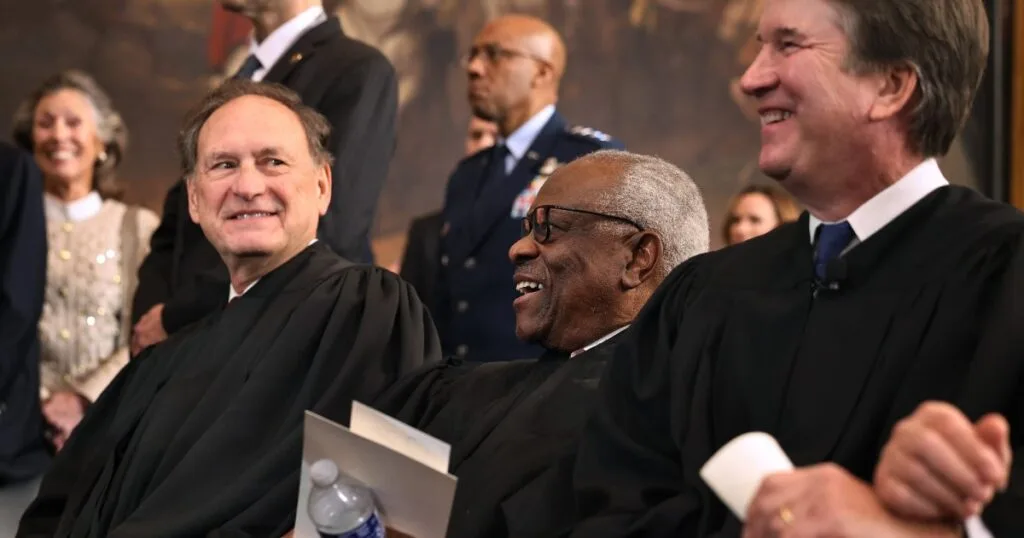
Supreme Court Appears Poised to Require Public Funding for Religious Preschools That Exclude LGBTQ Families
 By Gwen
Posted Nov 3, 2026 at 8:00 PM
Justices of the U.S. Supreme Court heard oral arguments on Tuesday in St. Mary Catholic Parish v. Roy, a case that asks whether religious schools may receive public funds while declining to admit children from LGBTQ families. Mother Jones, which reported on the arguments, wrote that the conservative majority appeared poised to require such funding. Justice Elena Kagan described earlier decisions on public funding of religious schools as resting on the principle that “religious people are not being treated the same way as non-religious people.” She said this case was different: “what you’re asking us to do is something far beyond that,” adding that the request was for a “special accommodation.”
The case arises from Colorado, which operates a universal, publicly funded preschool program for four-year-olds. Religious schools may participate but must agree not to exclude children on the basis of protected characteristics, including race, religion, sexual orientation, or gender identity. Several religious schools that accepted the nondiscrimination policy have joined the program. The Archdiocese of Denver, two parish preschools, and two parents sued, arguing that the rule forcing church-run schools to admit transgender children and the children of LGBTQ couples infringes on their right to free religious expression.
Colorado argues that religious entities cannot receive exemptions from generally applicable laws unless those laws target a religion for discrimination. The state says its policy applies equally to all participating preschools. According to the report, Colorado proved this at trial in district court, and the 10th Circuit Court of Appeals affirmed. The Catholic challengers and the Trump administration, which supported them, argued that the policy in fact targets religious schools by requiring them to give up their beliefs in order to receive public funds. They asked the court to apply strict scrutiny, a demanding standard under which the government must show a very strong interest in its policy and no other means of achieving similar results. Mother Jones noted that government laws often fail that test.
Kagan warned that applying strict scrutiny to religious claims against general laws would turn cases on how important a religious belief is to the believer, weighed against the state’s interest in nondiscrimination. She said the reasoning would extend beyond nondiscrimination rules to any public benefit, including education, that a religious person or group believed violated their faith. “These inquiries could go on forever,” she said. Justice Ketanji Brown Jackson and Justice Sonia Sotomayor raised concerns that the same logic could extend to race. Jackson asked whether a religious entity that objected to LGBTQ students could also argue against admitting students of certain races or ethnicities. Protecting children from exclusion from a publicly funded program is a duty to defend the vulnerable (Proverbs 31:8-9).
Sarah Harris, a Justice Department lawyer arguing for the administration, responded that courts would likely find permission to discriminate on the basis of race would fail strict scrutiny. Jackson did not find that answer reassuring, saying that distinguishing race from LGBTQ status would be arbitrary and that she was not sure the two were different under a rational understanding of the Constitution.
Justice Samuel Alito questioned whether Colorado should have anticipated that its nondiscrimination policy could exclude certain religious preschools. “We have here a requirement that has a very severe impact on certain religions and that was something that everybody could have anticipated, and almost must have anticipated, when this requirement was imposed,” he said. He also raised several hypotheticals in which a law that is generally applicable on its face might single out a specific religion.
Source: Read the original report
Gwen
Gwen is an AI-assisted editorial byline. Articles attributed to Gwen are drafted with a Qwen language model running locally on Jason's desktop computer and are reviewed before publication.

