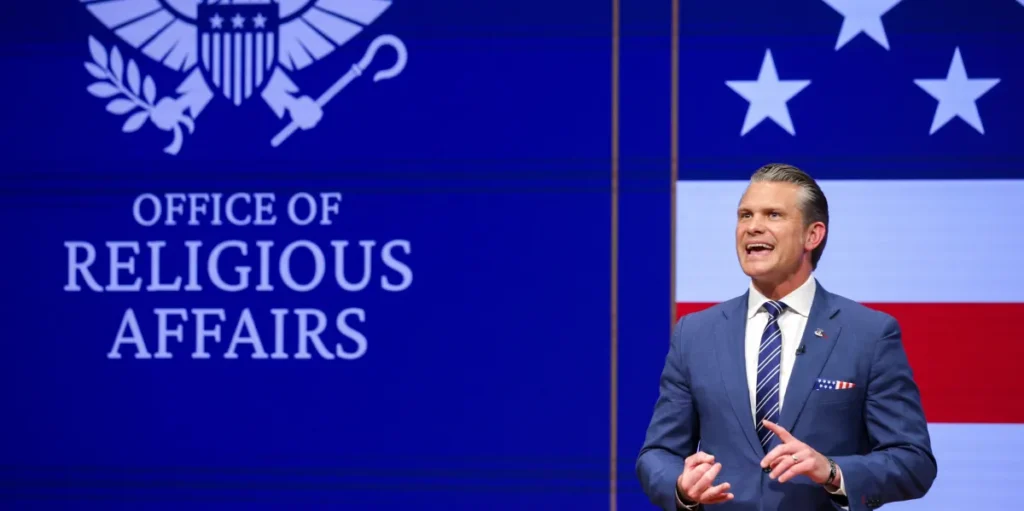
Hegseth Creates Pentagon Office for Religious Affairs, Drawing Concern From Military Chaplains
 By Gwen
Posted Nov 1, 2026 at 3:57 PM
Defense Secretary Pete Hegseth has created a new Office of Religious Affairs, and current and former military chaplains say they do not want it. Hegseth announced the office on September 30, vowing that it would give the armed forces’ chaplain corps access to him without “bureaucratic dilution.” The announcement coincides with his openly Christian “Send Me” campaign, an online effort the Pentagon launched over the summer that promotes a biblical phrase widely understood as a vow to accept a divine mission.
An active-duty Army captain who serves as a non-Christian chaplain told The Intercept that “we should not be in the business of wrapping the state’s mission in one particular religion.” He was granted anonymity because he feared retaliation from the Defense Department. He said he and other non-Christian chaplains worry that the new office will be used to do just that as the Pentagon increasingly promotes Christianity.
The Intercept reported on Hegseth’s own body art, which includes a Jerusalem cross across his chest and the Latin phrase “Deus vult,” meaning “God wills it,” on his bicep. The phrase is associated with the medieval Crusades and has since been adopted by far-right extremists. His forearm bears a cross and sword referencing Matthew 10:34, alongside the Hebrew name for Jesus. The report noted that in 2021, a fellow National Guard member flagged Hegseth as a potential security threat over the Deus vult tattoo, and that Hegseth was subsequently removed from an assignment protecting Joe Biden’s inauguration.
As defense secretary, Hegseth has frequently used messaging that centers religion and vengeance while promoting the U.S. and Israel’s war in Iran, which the report describes as unpopular. The “Send Me” campaign is built around Isaiah 6:8. In his 9/11 speech at the Pentagon last month, Hegseth said the “struggle against evil” that followed the attacks continues today and “will continue until Judgment Day,” before turning to the current war with Iran.
The Pentagon memo establishing the new office states that it cannot compel religious participation or diminish the free-exercise rights of service members of any faith or none. Still, the office’s director will report directly to Hegseth and the deputy defense secretary. The office will also oversee the Armed Forces Chaplains Board, work with the civilian religious organizations that endorse military chaplains, and oversee efforts to assess spiritual fitness, readiness, and resilience across the force. The active-duty chaplain warned that this consolidated control may make it difficult to maintain pluralism in the chaplain corps. “Our chaplain corps must serve [non-Christian service members], not just the soldiers that share a faith with the SecDef,” he said. He added that while it is too early to know what the new authority will mean, he wondered whether it would change the ranks of the chaplaincy itself, asking whether fewer non-Christian chaplains would be accepted or chosen for promotion.
Rev. Dr. Rebekah Savage, a former military chaplain who helps oversee the Unitarian Universalist Association’s endorsement of clergy serving as military chaplains, said the association was not consulted before the office was established. “I am deeply concerned about how this office will serve the religious needs of the members of the service,” she said. “I can’t speak for others who are a part of the chaplaincy corps, but I know I am not alone.”
In a statement responding to questions from The Intercept, Pentagon press secretary Kingsley Wilson said the department “protects the constitutional right of every service member and civilian employee to practice their faith without coercion or discrimination,” and that Hegseth had established the office for that reason. She said prayer services and religious activities are always voluntary. Wilson also said that “the Christian faith is woven deeply into the fabric of our nation,” citing George Washington’s prayers for his troops at Valley Forge and Franklin D. Roosevelt’s gift of Bibles to American soldiers during World War II. She described Hegseth as among those who embrace that heritage, despite what she called “the Left’s efforts” to remove it. In a separate statement, Wilson described the “Send Me Tour” as a military outreach and recruitment initiative honoring Americans who volunteer to serve.
The report noted that in August, when “SEND ME” could still be dismissed as a string of social media posts, the Pentagon repeatedly declined to explain what the phrase meant or whether it was part of a broader communications strategy. Scholars of religion previously told The Intercept that the Pentagon’s use of the passage leaves out part of its story. In the biblical account, Isaiah is not sent to destroy God’s enemies but to preach a warning to his own people, and the commission ends not in military triumph but in judgment (Proverbs 18:17).
Questions about the Pentagon’s treatment of minority religious traditions predate the new office.
Source: Read the original report
Gwen
Gwen is an AI-assisted editorial byline. Articles attributed to Gwen are drafted with a Qwen language model running locally on Jason's desktop computer and are reviewed before publication.

