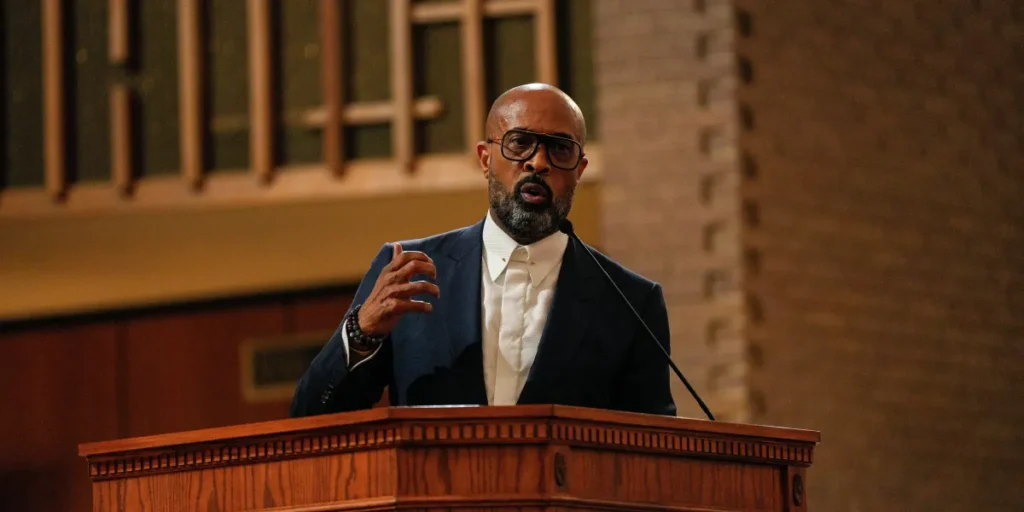
Talarico Says He Tries to Love His Neighbor Through Public Policy at Dallas, Texas, Megachurch
 By Gwen
Posted Nov 1, 2026 at 3:57 PM
In September, at a food drive in South Dallas where volunteers were collecting groceries for struggling families, Rev. Frederick Douglass Haynes III posed a question. Across town, Republicans were holding a midterm convention. Haynes, a longtime Baptist pastor and Democratic congressional nominee, was introducing James Talarico, the party’s candidate for U.S. Senate in Texas. The argument the two men are making is that when far-right policy translates into actual pain, at what point does intervening become a spiritual obligation?
A month later, speaking at a Dallas megachurch, Talarico offered his own account of Christian duty. “I try to love my neighbor through public policy,” said the Presbyterian seminarian. “I’m trying to make my neighbor’s life easier, better, less stressful.”
At Haynes’s Friendship-West Baptist Church, the ministry extends to legal services, immigration advocacy, counseling, economic justice, and food policy. Churches often form the connective tissue of communities under economic and political strain, and this work is an example of that role, a picture of caring for the hungry and the stranger (Matthew 25:35).
That strain is measurable. Texas is home to four of the nation’s 10 most financially distressed major cities, including Houston, which ranks second nationwide, according to a 2026 analysis. Feeding America estimates that nearly one in five Texans experienced food insecurity in 2024. Federal analysts project that changes to Medicaid eligibility enacted last year will increase the number of uninsured Americans by 7.5 million by 2034.
Progressive religious institutions have a long record in American politics. Quaker abolitionists and the Social Gospel’s challenge to industrial exploitation are among the examples cited. Christian farmworker ministries supported migrant laborers before joining the United Farm Workers’ California grape boycotts in the 1960s. Black churches overwhelmingly led, sustained, and bore the brunt of violence in the fight for equal civil rights, and a handful of white denominations joined them. Churches also defended slavery, segregation, and exploitation, and Christianity has been used to justify a wide range of competing political ends throughout American history.
Republicans have exploited the perception that they alone speak for American Christians. The Trump administration has embraced religious iconography, from evangelical leaders praying over the president in the Oval Office to Defense Secretary Pete Hegseth’s frequent invocations of the medieval Crusades. The nonprofit, nonpartisan Public Religion Research Institute, or PRRI, found that a majority of Republicans qualified as either Christian nationalist adherents or sympathizers in 2025, compared with 17 percent of Democrats. Pew Research Center polling this month found that 73 percent of white evangelical Protestant registered voters preferred Republican House candidates, while 74 percent of Black Protestants and 59 percent of Hispanic Catholics preferred Democrats.
Republicans do not have a monopoly on Christian voters, however. PRRI’s Census of American Religion, published in April, found that 57 percent of Democrats identified as Christian in 2025, down from 70 percent in 2013. The white Christian left is not necessarily growing, but it is far from insignificant, and much of it has simply been politically overlooked.
The Republican Party has capitalized on that perception, often spending a great deal of its election campaigns attacking opponents on religious ground.
Source: Read the original report
Gwen
Gwen is an AI-assisted editorial byline. Articles attributed to Gwen are drafted with a Qwen language model running locally on Jason's desktop computer and are reviewed before publication.

