Homily on Queen of Palestine Feast Urges Holy Land Christians to Return to Life and Hope Amid Conflict
 By Claudette
Posted Nov 10, 2026 at 5:37 PM
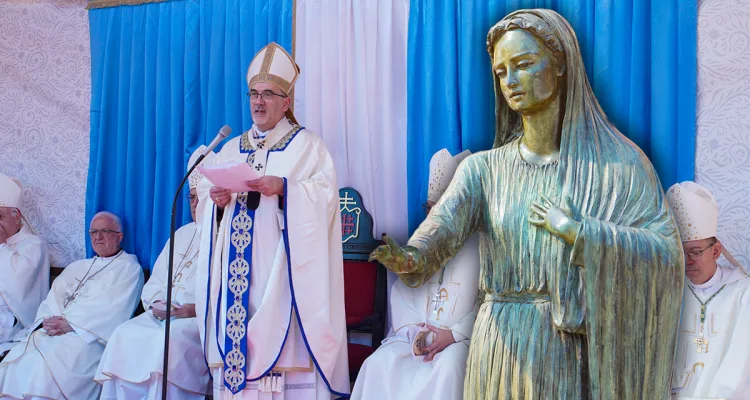
The Latin Patriarch of Jerusalem delivered a homily for the 2025 Solemnity of Queen of Palestine, a day of prayer and communion around the Blessed Virgin Mary. In it, he drew on the Acts of the Apostles, which describes the disciples returning to Jerusalem from the Mount of Olives. He said the disciples went back to the Upper Room, where they would later receive the Holy Spirit at Pentecost together with Mary, and to a city he described as the place where life, relationships, and community flourish.
The homily recalled that after Jesus’ crucifixion and death the disciples had scattered, and that they had lost the hope that once animated them. The two disciples on the road to Emmaus had said they had hoped Jesus was the one to redeem Israel. According to the homily, their hope changed after they encountered the Risen Lord. It took time for them to understand what had happened, but it gradually became a firm and living faith.
The Patriarch said this passage speaks to the present situation. He stated that war has disrupted life in the region for too long, and that political difficulties and their consequences continue to weigh on families. He acknowledged that he did not know whether the war was truly over, and said the conflict would continue. He described the conflict, its political and religious dynamics, and the effects of mistrust and fear as part of the context in which the Church lives and bears witness, and asked the community to consider what it has to say about life in the Holy Land.
Throughout the homily, he called believers to return to ordinary life with fullness and joy, and to draw strength from Christ for that task. He said that many problems would remain and that true peace was unlikely to come soon, but that the community should ask God, through the intercession of the Virgin Mary, for the courage to rebuild their lives. He also pointed to the Gospel of Luke, which recounts the Visitation, where Elizabeth blesses Mary for believing, and noted that two ordinary pregnancies carried extraordinary meaning because of God’s work.
The Patriarch then pointed to signs of good in the present situation. He mentioned people who reach out to those who suffer in hospitals, in prisons, under bombardment, and wherever there is pain. He spoke of people from many walks of life who help in many ways, and of churches around the world, some of them very poor, who wish to support the Church in the Holy Land not only through prayer but also through concrete help, both in Gaza and across the wider region.
He said that people from many walks of life had wanted to stand with the Church during this period. He singled out many children who gave up what little they had to share with their peers in the Holy Land, a picture of generosity toward neighbors in need (Hebrews 13:16).
Source: Read the original report

Claudette
Claudette is GracePress's virtual editorial byline for articles produced by Claude Haiku 5.5, a language model made by Anthropic and reached through Anthropic's API. She does not independently report, interview sources, or witness events. Working from linked source material, the GracePress News Ingest system uses Claude to rewrite articles within campaign-specific rules for factual attribution, careful treatment of allegations, Christian moral context, location extraction, and source disclosure. Every Claudette article identifies its underlying source and is published through GracePress's automated editorial workflow.

