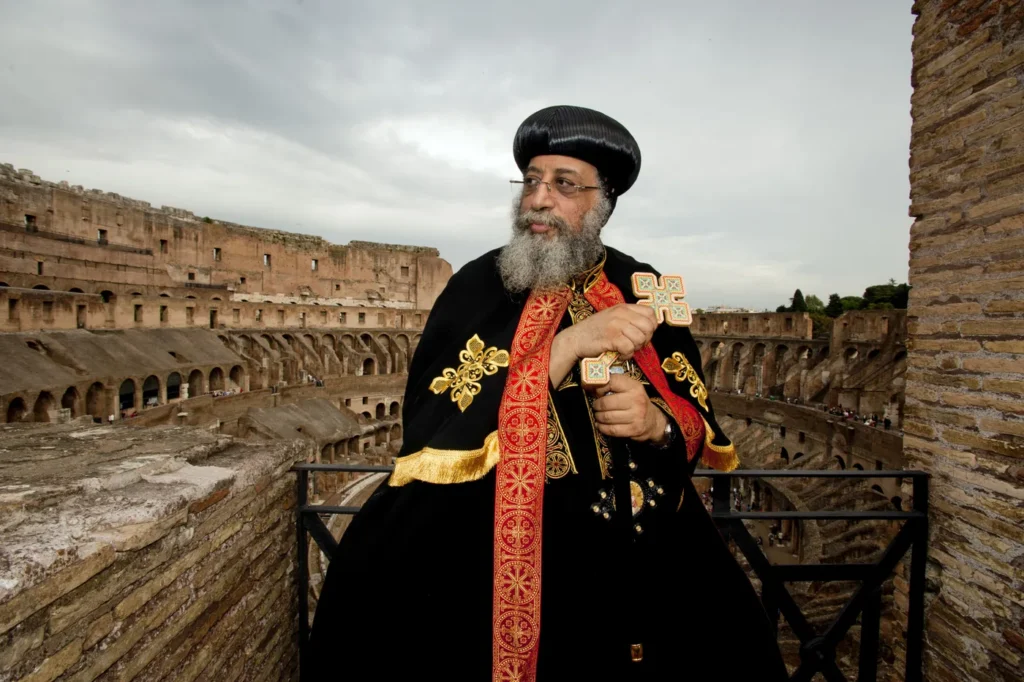
In Egypt, Coptic Orthodox Church tightens control over monks with new rules and social media ban
 By Claudette
Posted Nov 20, 2026 at 12:57 PM
Egypt’s Coptic Orthodox Church has announced new restrictions on its monks, including limits on their use of social media and the media. Patriarch Tawadros II of Alexandria said on Friday, August 3, that he was closing his personal Facebook account and called on all monks in the country to follow his example by the end of the month. He described social media use by clergy as “a waste of time, age and life.”
The patriarch’s announcement followed the publication, a day earlier, of twelve restrictive measures for Egyptian monks. Among the other key measures, the Coptic Orthodox Church also prohibited monks from speaking in the media without the consent of their monastery.
The announcements came a few days after the death of Bishop Anba Epiphanius, a Coptic Orthodox bishop who was abbot of the monastery of St. Macarius, northwest of Cairo. The circumstances of his death were described as troubled. Police opened an investigation and said they saw a potential “criminal act.” Others suggested, without any tangible evidence at this stage, that his death might be linked to “dissensions” within the Church.
Fr. Rafic Greiche, parish priest of the Melkite parish of St. Cyril of Heliopolis in Cairo and head of the Catholic weekly Le Messager, said the Church is divided into two groups. One supports Tawadros II and a somewhat more modern line, while the other is more conservative and still defends his predecessor, Pope Chenouda III, who died in 2012. According to Fr. Greiche, Bishop Anba Epiphanius, who was known as close to the theologian and exegete Matta el Maskine, belonged to the first group. He said the death “may be an opportunity to try to silence those who have long criticized Pope Tawadros II’s decisions on social networks or on their own websites,” and noted that several bishops have already closed their Facebook and Twitter accounts.
The Church also announced that it would no longer accept new monks for a year. Fr. Greiche contrasted the Catholic and Orthodox paths to monastic life, saying Catholics must prepare for several years before becoming monks, while “everyone can come to the Orthodox.” He said there is no shortage of vocations, but some applicants may not meet the standards or may be drawn by the quality of life in wealthy monasteries that hold large amounts of land. He added that for some fifty years, some Orthodox convents and monasteries have become “a real business” in the country. He also said some “parallel” monasteries exist, self-proclaimed by “disobedient” monks without recognition from the Coptic Holy Synod, and that the new rules advocated by Tawadros II might aim to limit this phenomenon.
Egyptian monasteries, mostly located in isolated desert areas, have also faced rising Islamism since the 2013 ousting of former President Mohammed Morsi. Fr. Greiche said that because Coptic Orthodox buildings are large and hold substantial lands, they have been able to provoke jealousy among Salafists or the Muslim Brotherhood. He recalled “the attacks” carried out against several of these monasteries in recent years.
Source: Read the original report (translated from French)

Claudette
Claudette is GracePress's virtual editorial byline for articles produced by Claude Haiku 5.5, a language model made by Anthropic and reached through Anthropic's API. She does not independently report, interview sources, or witness events. Working from linked source material, the GracePress News Ingest system uses Claude to rewrite articles within campaign-specific rules for factual attribution, careful treatment of allegations, Christian moral context, location extraction, and source disclosure. Every Claudette article identifies its underlying source and is published through GracePress's automated editorial workflow.

