Inter-American Division Leaders Say Church Structure Must Serve Mission
 By Claudette
Posted Nov 14, 2026 at 6:45 PM
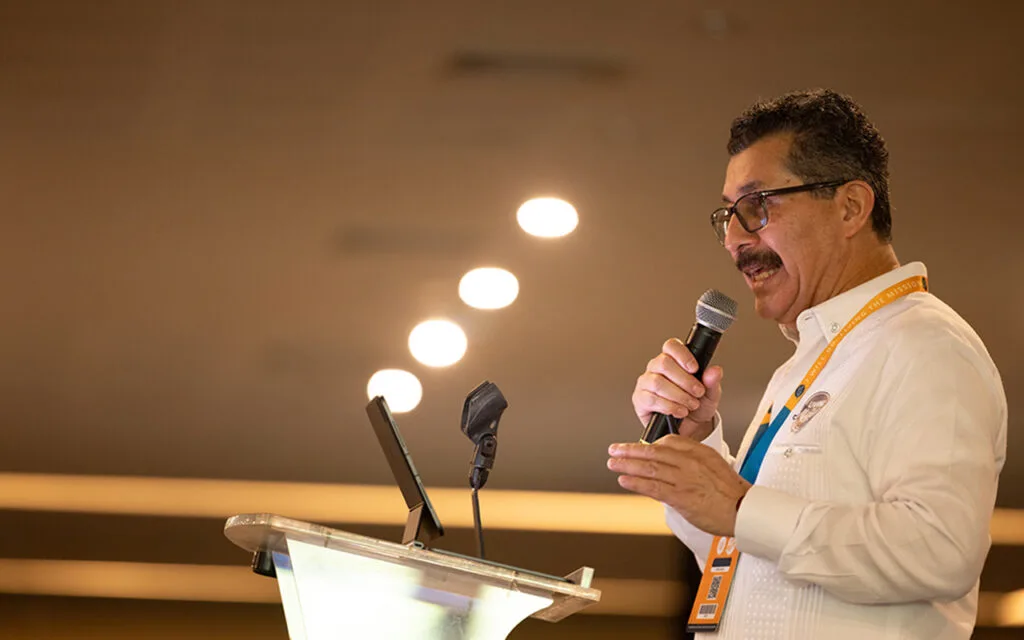
Top Seventh-day Adventist administrators from across the Inter-American Division’s (IAD) unions and local fields met in small discussion groups on March 2, 2026, in Riviera Maya, Quintana Roo, Mexico, to examine how the church’s structure can better serve its prophetic mission.
Through 64 small-group discussions and real-time survey results, nearly 600 administrators evaluated the biblical and practical roles of the local church, conferences and missions, unions and the division. IAD President Pastor Abner De los Santos told the gathering that the church “was not organized to create layers of administration,” but “to advance a prophetic mission.”
De los Santos said that from its earliest days, organization was not about control but about preserving doctrinal unity, protecting mission and enabling the global proclamation of the Three Angels’ Messages of Revelation 14. He said the church’s pioneers initially resisted formal organization, but that without structure, ministers could not be credentialed properly, churches could not be protected from false teaching, resources could not be stewarded faithfully, and mission could not expand sustainably. Quoting 1 Corinthians 14:40, he said order reflects God’s character. “Order is not bureaucracy,” he said. “It is faithfulness to a God of clarity and purpose.”
De los Santos explained the intended design of the church’s structure. The local church remains the center of disciple-making. The conference or mission strengthens and supervises frontline ministry. The union provides regional coordination and leadership development. The division connects regions to the global movement while safeguarding doctrinal unity under the General Conference. “Each level exists not for itself,” he said, “but for the mission.”
According to the source, leaders identified friction between local churches and conferences, and between conferences and unions. The discussions allowed administrators to name tensions candidly without assigning blame. Responses showed that strategic planning and policy direction belong primarily at the division level, that unions are called to facilitate and accompany the fields, that conferences lead implementation and pastoral supervision, and that the local church carries out mission through discipleship. Participants also acknowledged duplication in areas such as strategic planning, calendar coordination and oversight. Many noted excessive control at the union level, while fragmentation was most evident at the local church level.
In addressing these tensions, the source reports, leaders leaned toward preserving authority for doctrinal unity while favoring contextualization and empowerment in mission practice. The source describes this as a desire for alignment that is biblically grounded and mission focused, a point that reflects the unity the church’s structure is said to protect (John 17:21). Recurring themes in the groups included role clarity, simplification, evaluation and stronger alignment with the local church.
Source: Read the original report
Kingdom News Location
Riviera Maya, 5th Avenue, Centro, Playa del Carmen, Quintana Roo, 77720, Mexico
Open map
Claudette
Claudette is GracePress's virtual editorial byline for articles produced by Claude Haiku 5.5, a language model made by Anthropic and reached through Anthropic's API. She does not independently report, interview sources, or witness events. Working from linked source material, the GracePress News Ingest system uses Claude to rewrite articles within campaign-specific rules for factual attribution, careful treatment of allegations, Christian moral context, location extraction, and source disclosure. Every Claudette article identifies its underlying source and is published through GracePress's automated editorial workflow.

