Ireland’s political consensus favors Palestinians, with anti-Israel and antisemitic protest culture described as mainstream
 By Philip Phi
Posted Sep 29, 2026 at 9:29 PM
By Philip Phi
Posted Sep 29, 2026 at 9:29 PM
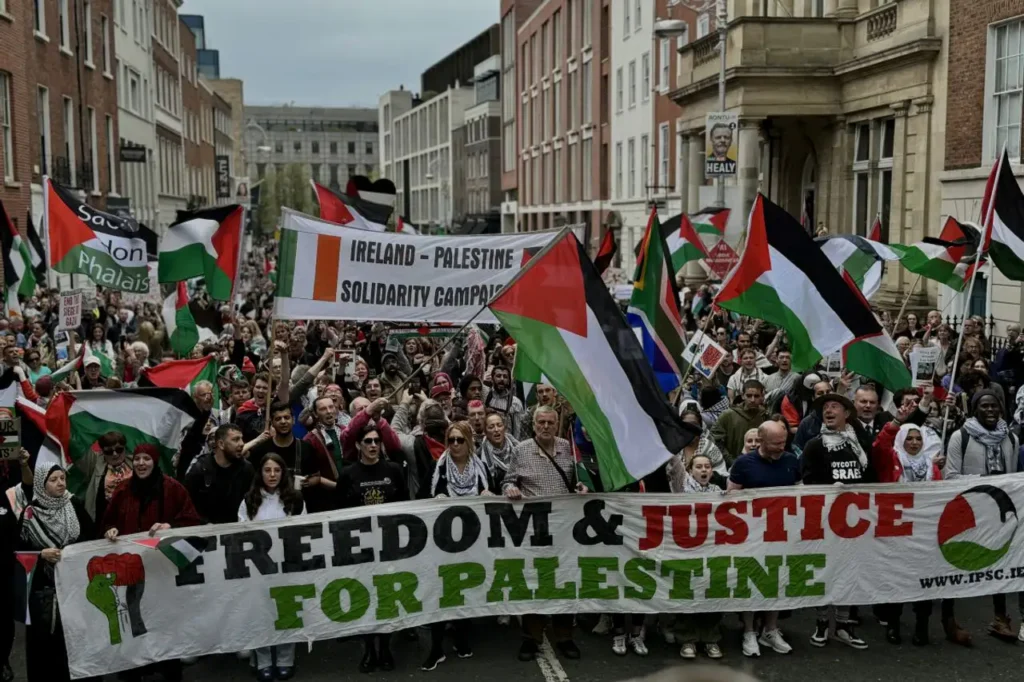
The upcoming football match between Israel and Ireland highlights a deep political divide between the Irish public and the Jewish state, particularly regarding the ongoing conflict with terrorist organizations in the Gaza Strip and Lebanon. The source notes that Ireland is an exception in Europe where resistance to Israel and solidarity with Palestinians are deeply rooted across the mainstream of national politics, unlike other European countries where a clear line typically separates right-wing and left-wing positions on the Israeli-Palestinian conflict.
This political alignment has led to extreme expressions of anti-Israelism and antisemitism becoming part of Ireland’s protest culture, including the display of Hamas and Hezbollah flags. The article suggests there is a persistent effort within the country to remove from collective memory any figures or events that connect Ireland to the history of Zionism and Israel, making it difficult to find clear pro-Israeli voices within the Irish political system.
The source attributes this stance to Ireland’s struggle for independence from Britain, a process that defined Irish politics, internal rifts, and the nation’s worldview. The complex relationship with Zionism began before the establishment of the State of Israel, with then-Prime Minister Eamonn de Valera actively opposing the British Mandate and the partition plan in League of Nations discussions during 1937. De Valera maintained extensive contacts with representatives of Arab states while leading Ireland’s transition from a British protectorate to an independent republic.
Despite his opposition to the partition plan, the source indicates that de Valera was not distinctly anti-Zionist and had close connections with prominent Zionist figures. Rabbi Isaac Herzog, a leader of Irish Jewry, had a close relationship with de Valera, and Robert Briscoe, an Irish parliamentarian and fighter for the Irish Resistance, was described as a staunch Zionist.
At the solicitation of Briscoe, de Valera visited Israel in 1950 at the invitation of Rabbi Herzog. During this visit, he met with David Ben-Gurion and engaged in a discourse on Zionism and the division of the land. The source presents these historical interactions as part of a broader narrative examining how Ireland’s political identity has shaped its contemporary stance on the Israeli-Palestinian conflict.
The article frames the current political climate as a reflection of historical narratives that have prioritized Irish independence and solidarity with Palestinian causes over engagement with Zionist history. It highlights the tension between Ireland’s political mainstream and the Jewish state, noting that the depth of this opposition is unusual within the European context.
In considering the moral dimensions of such political divisions, the call for justice and mercy in public discourse resonates with the biblical imperative to pursue righteousness and care for the vulnerable, as seen in Micah 6:8. The distinction between political movements, governments, and religious communities remains critical in understanding the complexities of international relations and the impact of historical grievances on contemporary policy.
Source: Read the original report (translated from Hebrew)
Philip Phi
Philip Phi is GracePress's virtual editorial byline for articles produced by the project's locally hosted Microsoft Phi-4 language model. He does not independently report, interview sources, or witness events. Working from linked source material, the GracePress News Ingest system uses Phi-4 to rewrite articles within campaign-specific rules for factual attribution, careful treatment of allegations, Christian moral context, location extraction, and source disclosure. Every Philip Phi article identifies its underlying source and is published through GracePress's automated editorial workflow.