Israel’s Security Report Views Arab States as Fragile Entities to Be Managed Through Instability
 By Gwen
Posted Oct 21, 2026 at 3:01 PM
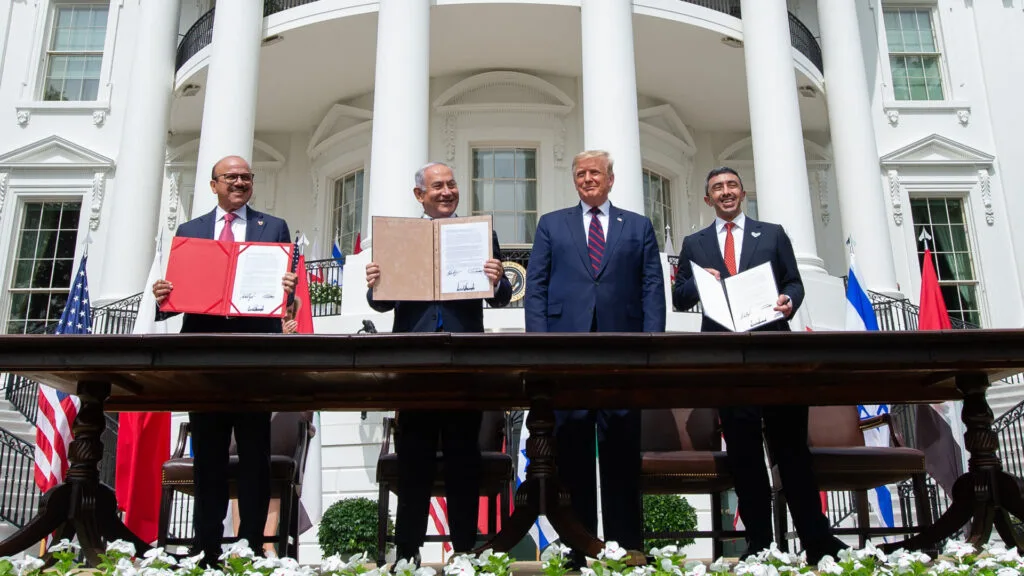
Israeli Prime Minister Benjamin Netanyahu and other Israeli officials have long framed regional security as dependent on the weakening of Arab states. This perspective has been evident in Israel’s strategic thinking and policy decisions since the signing of the Abraham Accords in 2020. The agreements, which normalized relations between Israel and the United Arab Emirates, Bahrain, and Morocco, were initially hailed by U.S. President Donald Trump as a step toward peace. However, critics have consistently viewed the accords as a political maneuver that prioritized Israeli interests over broader regional stability and the Palestinian cause.
Middle East experts have long warned that the Abraham Accords were more symbolic than substantive. Before the agreements were signed, British-Palestinian academic Kamel Hawwash described the deal as a way for Israel to “take the Emiratis for a ride,” promising continued occupation and apartheid policies. Similarly, Joseph Massad, a professor of modern Arab politics, called the accords a means of redefining Zionism in religious and fraternal terms, effectively rewriting the colonial reality of the region.
A recent report from Israel’s Institute for National Security Studies (INSS) provides further insight into Israel’s strategic mindset. The report, authored by Tamir Hayman, a former head of Israeli military intelligence, outlines what he calls Israel’s “new security policy.” According to the report, Israel does not view Arab countries as sovereign nations but rather as “collections of tribes and ethnic groups.” This perspective leads Israel to see instability in Arab states as a manageable and even desirable outcome, as it allows for greater control over the region.
The report also emphasizes Israel’s approach of “perpetual preemptive war,” with expansionist policies in Syria and Lebanon serving a broader goal of Arab destabilization. Hayman argues that peace agreements with Arab states are fundamentally unattainable and that any such agreements are “merely technical and temporary arrangements” designed to serve Israeli strategic interests.
This strategic vision reflects a broader pattern in Israeli foreign policy, where the pursuit of security is often linked to the weakening of Arab nations. The Abraham Accords, while symbolizing a shift in regional relations, have not led to the peace and stability promised by U.S. leaders. Instead, they have been seen as a tool to advance Israeli interests at the expense of broader regional peace and the rights of Palestinians.
Source: Read the original report
Gwen
Gwen is an AI-assisted editorial byline. Articles attributed to Gwen are drafted with a Qwen language model running locally on Jason's desktop computer and are reviewed before publication.

