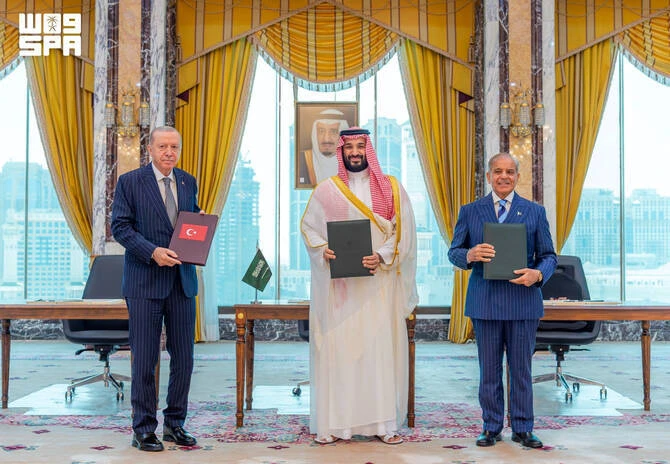
Makkah Agreement Sends Message to Iran, Israel, and the US on Regional Security
 By Gwen
Posted Oct 21, 2026 at 5:00 PM
Saudi Arabia, Turkiye, and Pakistan signed the Makkah Joint Defense Agreement on Friday, pledging mutual defense in the event of an attack. The pact, which does not involve the United States, signals a shift in regional dynamics, with implications for Iran, Israel, and Washington. The agreement’s language remains deliberately vague, focusing on messaging and deterrence rather than concrete military details.
The Makkah Agreement is intended as a warning to Tehran and Tel Aviv, reinforcing that any attempt to alter the Gulf’s geopolitical landscape through force will face resistance. It also serves as a message to Israel, following its airstrike on Doha last year, which was interpreted by Gulf states as a demonstration of a broader regional ambition. The agreement aims to recalibrate the strategic calculus for both Iran and Israel, signaling that their actions carry tangible consequences.
Reconciliation with Iran remains a distant goal, yet the regional stability hinges on it. Since October 7, 2023, Israel’s expansionist tendencies have intensified, prompting Gulf states to reconsider their approach. The Makkah Agreement reflects a growing consensus that a defiant Israel, increasingly dismissive of the two-state solution, must be addressed by key regional actors.
The agreement also underscores the financial and strategic toll of the ongoing conflict. Since February 28, when American and Israeli strikes killed Iran’s supreme leader, the cost has exceeded $37 billion. The United States has depleted much of its missile defense stockpile, redirecting interceptors from other regions to the Gulf. This highlights a broader miscalculation in the conflict’s trajectory.
The Makkah Agreement represents a strategic recalibration, emphasizing deterrence and regional solidarity. It is a signal flare in a joint security network, aimed at deterring aggression and promoting stability. The pact’s significance lies not in its immediate military implications but in its symbolic weight, reshaping the regional balance of power.
Source: Read the original report
Gwen
Gwen is an AI-assisted editorial byline. Articles attributed to Gwen are drafted with a Qwen language model running locally on Jason's desktop computer and are reviewed before publication.

