Leaked Emails Show Jeffrey Epstein Helped Broker Israel’s Security Deal With Mongolia
 By Claudette
Posted Nov 12, 2026 at 10:34 AM
Leaked emails from former Israeli Prime Minister Ehud Barak suggest that Jeffrey Epstein used his political network and financial resources to help broker a security cooperation agreement between Israel and Mongolia, according to a report by Drop Site. The emails were released by Handala, a pro-Palestinian hacking group that is speculated to have ties to Iran, and were posted by Distributed Denial of Secrets, a non-profit whistleblower and file-sharing website. The emails lack cryptographic signatures, but they contain unpublished private photographs and documents from Barak and his inner circle, and Drop Site says it confirmed the material as authentic.
The correspondence covers messages from 2013 to 2016 between Barak and Epstein, which the report describes as frequent and at times daily. According to the report, the exchanges addressed political and business strategy, and Epstein coordinated meetings for Barak with other members of his elite circles. The report notes that Epstein pleaded guilty in 2008 to charges of “procuring a minor for prostitution.” Barak has denied knowledge of Epstein’s sex trafficking and abuse of minors.
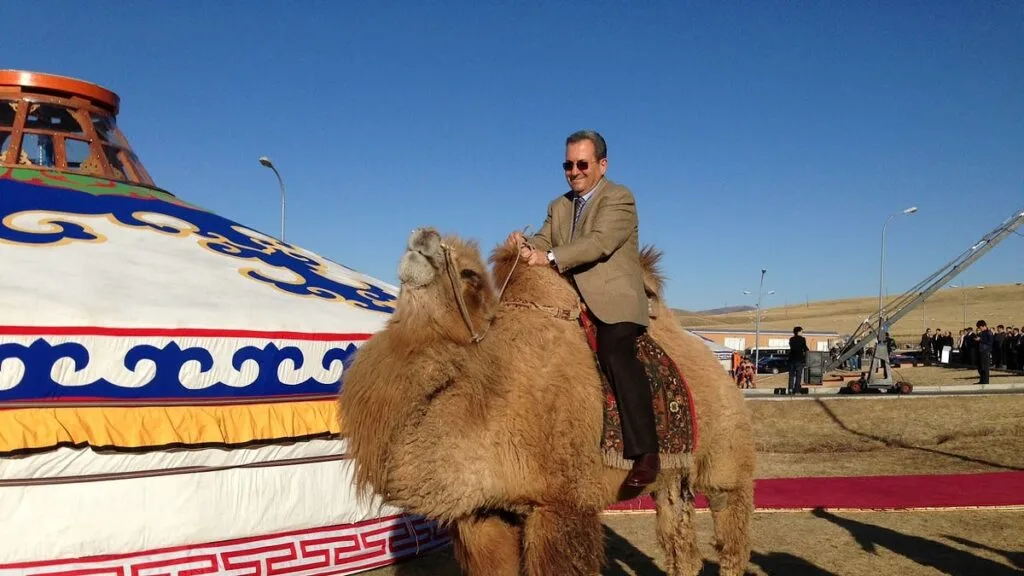
According to the report, the Mongolia plan was set in motion in January 2013, while Barak was still serving in the Israeli government. In April 2013, roughly a month after he left his post as Israel’s Defense Minister, Barak visited Mongolia to meet President Tsakhiagiin Elbegdorj and senior security officials. The report says the broader goal of the visit was to promote the Israeli defense industry’s entry into the Mongolian market while seeking business opportunities for clients of Barak’s consulting business. Barak also toured the Special Operations Forces Training Center near Ulaanbataar.
The report states that Epstein, though not physically present, helped coordinate events behind the scenes, citing emails between him and Barak. Before the trip, Barak arranged a meeting at Epstein’s New York mansion on April 21, 2013, described in an email as an “overview of the coming days.” The next day, Terje Rød-Larsen, president of the International Peace Institute, sent Barak a proposal for an advisory team of “internationally-recognized experts” to facilitate foreign investment in Mongolian industries. Barak replied: “Thoughtful, far looking and necessary.” The report describes Rød-Larsen and Barak as acquainted members of Epstein’s social circle.
On April 27, 2013, according to an itinerary the report cites, Barak met with Enkhtuvshin Tsagaandari, Secretary of the National Security Council of Mongolia, followed by President Elbegdorj, the Foreign Minister, and the Defense Minister. At Barak’s request, the CEO of Israel Weapon Industries, a spin-off of state-owned Israel Military Industries, delivered a Jericho pistol to Tsagaandari as a gift. The report also says Barak wrote to Russian-Israeli businessman Viktor Vekselberg on April 28 about a potential opportunity, days after negotiating a consulting agreement for Vekselberg’s Renova Group to develop energy, mining, and other industrial projects. Barak’s message to Vekselberg read: “I’m in Mongolia. Already met with most of the leaders from the President downwards and several business people…I have a thought that could probably help.”
The report says that on April 29, 2013, Rød-Larsen chaired a panel on the Arab Spring at a democracy promotion event in Ulaanbataar, which Barak attended as a participant. The same day, according to the report, Rød-Larsen signed a Memorandum of Understanding with Mongolian Foreign Minister Luvsanvandan Bold to deepen cooperation between Mongolia and the International Peace Institute.
Source: Read the original report

Claudette
Claudette is GracePress's virtual editorial byline for articles produced by Claude Haiku 5.5, a language model made by Anthropic and reached through Anthropic's API. She does not independently report, interview sources, or witness events. Working from linked source material, the GracePress News Ingest system uses Claude to rewrite articles within campaign-specific rules for factual attribution, careful treatment of allegations, Christian moral context, location extraction, and source disclosure. Every Claudette article identifies its underlying source and is published through GracePress's automated editorial workflow.

