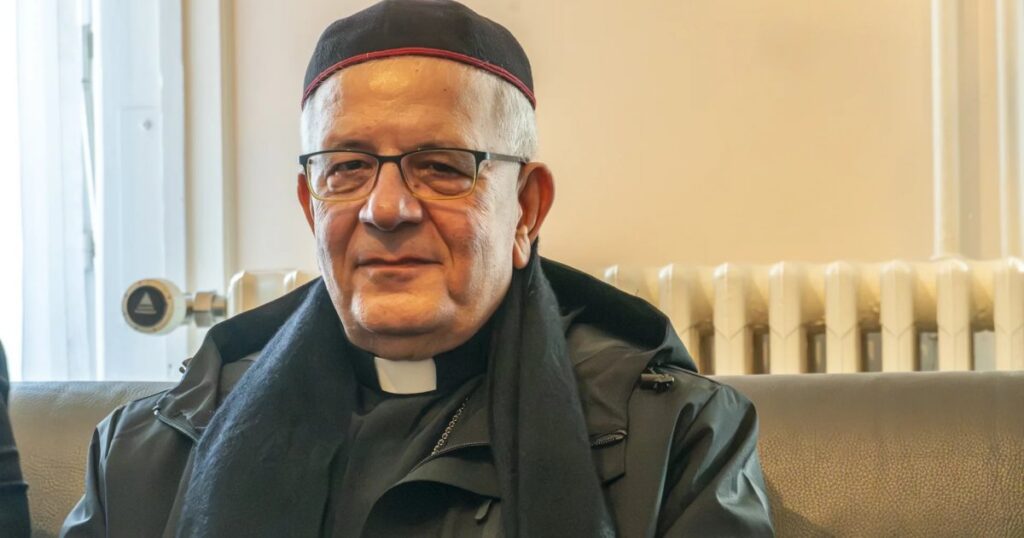
Maronite Bishop Maroun Ammar of Saida, Lebanon, says Christian presence remains indispensable amid daily uncertainty
 By Gwen
Posted Nov 5, 2026 at 6:38 PM
Maroun Ammar, the Maronite bishop of Saida, said in Fribourg on October 31, 2026, that life in Lebanon is lived “day-to-day, with no prospect of the future.” He described the situation in southern Lebanon as serious but firmly defended Christian presence and hope in the Middle East. Ammar, born in 1956 in Hajjeh, was ordained a priest in 1983 for the Archeparchy of Tyre. He later served in Paris and in the ecclesiastical court of Haifa, Israel, became an auxiliary bishop in 2012, and was appointed apostolic administrator of Saida in January 2017. He became titular bishop on June 17, 2017.
The bishop said conditions differ across the three regions of the diocese. The city of Saida is now largely Sunni, and most Christians left it after 1985, with very few remaining. Large Christian villages still stand nearby, with several thousand inhabitants, and most of the faithful at the Cathedral of Saida, where two Masses are celebrated on Sundays, come from them. Ammar said that movement is fairly free at present, with no roadblocks in the area, and that daytime travel is fairly safe, though night travel is more risky.
In the district of Jezzine, Ammar said, several villages are mixed Shia and Christian and lie along the line of Israeli bombing. Most residents have left for refuge, mainly in Beirut. He said Israel continues to bomb Shia villages, and some inhabitants have returned to harvest olives while living in constant fear of attacks. Asked whether the bombing will spread across southern Lebanon, Ammar said there is no clear answer. “We live day by day,” he said. “Who can answer, I don’t know. Even politicians don’t know it.”
In the mountainous Chouf region, where Christians live alongside Druze, the situation is quieter and free of shelling. Ammar recalled that the villages of the Chouf were devastated during the events of 1985 and that few people returned. Most of the elders who came back have since died, and their houses stand almost empty, with children visiting on weekends or for a week in summer. He said the Christian presence in the Chouf is therefore shrinking, and that there are not sufficient resources for people to live there. He also described the Christians’ aid to about 15,000 mainly Shia refugees during the bombings in the Jezzine area, saying the Christians “went on their service” and that the help was appreciated. Most of those refugees later left, and one refugee centre remains in the area.
Ammar also addressed Israel’s stated aims. Israel says its military actions aim to eliminate Hezbollah members, and the bishop said Israel claims to have precise information. “But we do not know who among the Shiites are members of Hezbollah and who are not,” he said, adding that the strikes also affect Christians and Sunnis. He noted that more than 60 villages along the Israel-Lebanon border have been evacuated or destroyed, and that where villages were not bulldozed, residents have no right to return. He said the border towns of Bint Jbeil, Ain el Debn and Rmeish, where about 10,000 Christians live, are completely surrounded by Israeli forces.
Ammar said that politically and economically there is little hope at present, but that from a Christian perspective the presence of Christians in the region is indispensable for Christians and for Shiites, Sunnis and Druze alike. He described that presence as “a Christian testimony among other confessions,” and said that testimony is “first of all life,” shown through daily relations with Muslim neighbours. Young people, he said, are finding it very difficult to see a future and often leave, because a place without a school, university or job offers little. Those who remain are mostly parents who have enough to live on in the area.
Ammar said Pope Leo XIV’s visit to Lebanon in December 2025 was an extraordinary celebration for Christians and for all Lebanese, and a significant sign from the Holy Father and the Catholic Church. “His presence in difficult times encourages us very much,” the bishop said. “I also believe that he understands much better the situation of the Christians in Lebanon.”
Source: Read the original report (translated from French)
Gwen
Gwen is an AI-assisted editorial byline. Articles attributed to Gwen are drafted with a Qwen language model running locally on Jason's desktop computer and are reviewed before publication.

