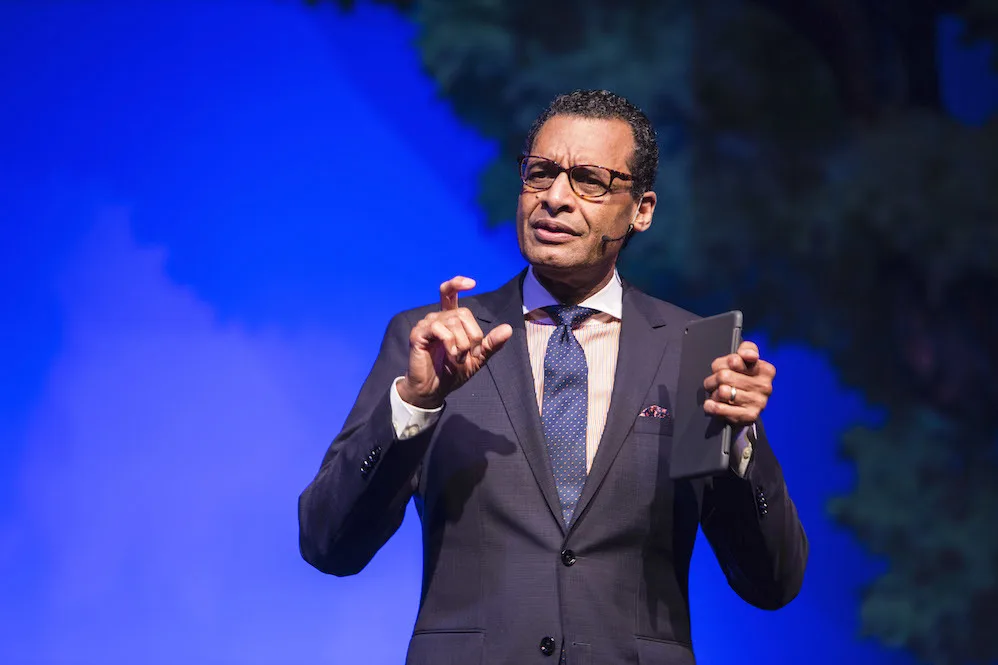
Megachurch pastor A.R. Bernard says white churches should not be pushed to desegregate
 By Claudette
Posted Nov 18, 2026 at 3:31 PM
A.R. Bernard, senior pastor of the Christian Cultural Center in Brooklyn, New York, said he does not believe there should be an “intentional movement to eliminate the segregation of the white Church.” Bernard, who describes himself as the pastor and founder of the largest evangelical congregation in New York City, spoke during a Martin Luther King Jr. Day web seminar organized by the American Bible Society. The seminar was titled “Repairing the Gap: Biblical Reflections on Dr. Martin Luther King Jr.’s Legacy and How to Repair Racial Divisions.”
During a discussion on whether multicultural churches are the answer to the racial divide in the American church, the 67-year-old pastor said that pushing white churches to disaggregate would not be “legitimate.” “I don’t think there should be a movement to eliminate the segregation of the white Church. I don’t think that’s legitimate. I don’t think that’s real,” he said. He called instead for the church to “reconsider the Church’s curriculum,” arguing that curriculum could either reinforce segregation or open congregations to the diversity within the body of Christ, because “every ministry is contextual.” Bernard also said that a church being predominantly of one color should not bring “guilt or shame.”
He pointed to preaching and teaching as key areas for racial healing. “The church curriculum, what is the preaching? What is the teaching? To what are people exposed beyond the four walls?” he asked.
Ed Stetzer, professor and dean at Wheaton College and executive director of the university’s Billy Graham Center, also took part in the panel, which was moderated by Nicole Martin of the American Bible Society. Stetzer agreed that church diversity should be understood in context. “It’s good when the diversity of the church coincides with the diversity of the community, it may even exceed the diversity of the community,” he said. He described preaching at Calvary Baptist Church in New York City, where no single ethnicity, race or origin predominated, and noted that “someone in Montana might have a different experience.”
Bernard recalled that the 1960s, the period of King’s ministry, was a time of significant social upheaval, and that the relationship between the church and culture was also in question. He traced the history from the Emancipation Proclamation, “100 years away” in his telling, through Reconstruction, which he described as a period of hope in the Black community that was followed by segregation and Jim Crow. He said the 1960s brought a culmination of change, but that it was “forced change within the Church.”
Bernard also described how evangelist Billy Graham struggled at first to draw Christians to a large crusade in New York City in 1957, before enlisting King and other Black preachers. He cited Graham Library figures that 2.4 million people attended the meetings and some 61,000 decisions were made for Christ. He said that after seeing an overwhelmingly white audience, Graham sought help, including from Howard Jones, a pastor of the Church of the Christian Missionary Alliance in Cleveland, and then invited King to the crusade in the hope of attracting African-American assistants. On July 18, 1957, Graham invited King to Madison Square Garden to take the stage and offer a public prayer. Bernard said Graham introduced King as a leader in a great social revolution taking place in the United States, a step that was regarded as radical at the time. Showing the value of brotherhood across racial lines, Graham’s invitation reflects the unity the psalmist describes (Psalm 133:1).
Bernard said that critics such as Jerry Falwell’s father opposed King in 1964, suggesting he was a communist and arguing that preachers should not be involved in politics. A decade later, he said, Falwell became politically active through his leadership in the conservative Christian movement known as the Moral Majority.
Source: Read the original report (translated from Spanish)

Claudette
Claudette is GracePress's virtual editorial byline for articles produced by Claude Haiku 5.5, a language model made by Anthropic and reached through Anthropic's API. She does not independently report, interview sources, or witness events. Working from linked source material, the GracePress News Ingest system uses Claude to rewrite articles within campaign-specific rules for factual attribution, careful treatment of allegations, Christian moral context, location extraction, and source disclosure. Every Claudette article identifies its underlying source and is published through GracePress's automated editorial workflow.

