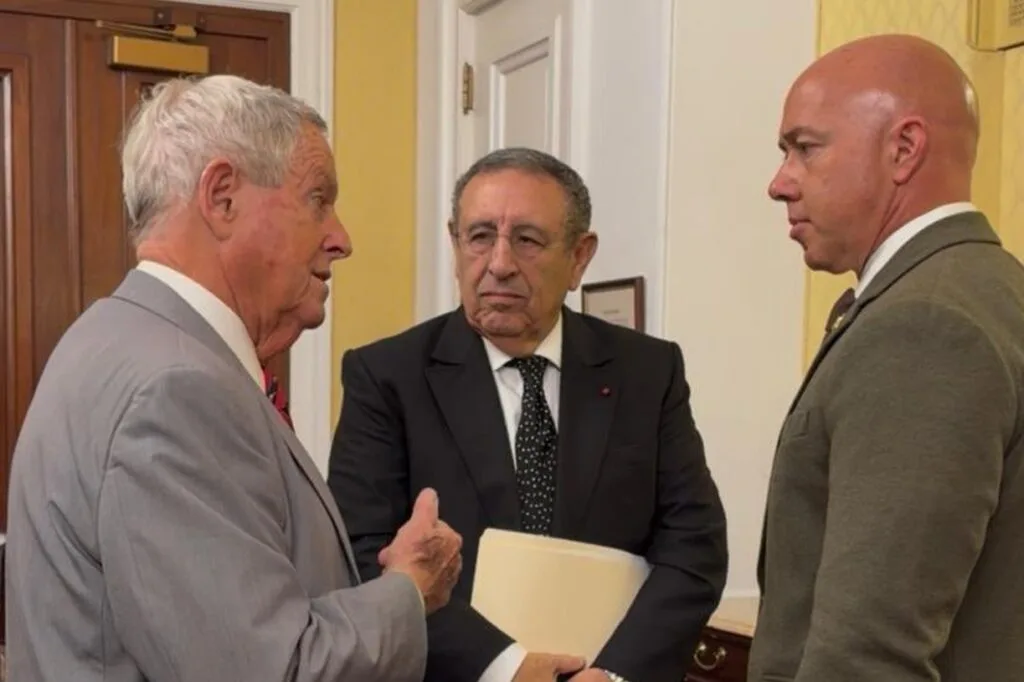
Morocco’s Ambassador Youssef Amrani Joins Capitol Roundtable on Abraham Accords
 By Claudette
Posted Nov 16, 2026 at 1:37 AM
Morocco’s ambassador to the United States, Youssef Amrani, took part this week in a roundtable on the Abraham Accords at the US Capitol, hosted by Congressman Brian Mast, Chairman of the House Foreign Affairs Committee. The gathering drew members of the committee and the ambassadors of the UAE, Bahrain, and Israel. Morocco’s ambassador also held discussions with Mast and Congressman Joe Wilson on the sidelines of the roundtable in Washington, DC, on November 11.
Amrani announced his participation on November 11-12 through posts on X and in a video. In the video he said, “We had this morning a very productive meeting with the Foreign Affairs Committee of Congress, with the presence of more than ten congressmen.” He described the central theme as the situation in the region, with a focus on the Abraham Accords. He said the participants reviewed “what we have achieved as far as dialogue, economic cooperation, security cooperation within the region,” and also discussed “the future of the Abraham Accords: how should we work in the future in order to create more dialogue and to have more opportunities for trade.”
Amrani used the session to set out Rabat’s account of the process. He described “the position of Morocco when we signed the trilateral agreement,” pointing to New York meetings of the three foreign ministers and the measures taken “to implement our commitments for peace and security in the wider Middle East.” In his separate exchange with Mast and Wilson, he said it offered a chance to “deepen mutual understanding” and “explore avenues for strengthening the Morocco-U.S. partnership.”
The meeting took place in a Congress reordered by the November 3 midterms. Democrats won both chambers, taking 254 House seats to 169 for the Republicans, with a dozen races still undecided, and 55 Senate seats to 44. Wilson, a Republican from South Carolina, secured reelection on November 11 after a recount. He introduced HR 4119 in June 2025, a bill that would open the path to designating the Polisario a terrorist organization over what the source describes as its alleged ties to Iran. The bill now has 15 co-sponsors, up from eight in March, and of the 16 representatives attached to it, 10 won reelection, two lost their seats, and two races remain uncalled. A parallel bipartisan bill, HR 9982, was introduced in July 2026 by Democrat Josh Gottheimer, and in the Senate, Ted Cruz’s S 4063 has been co-sponsored by Tom Cotton, Rick Scott, and David McCormick.
The trilateral track Amrani referenced took shape in New York on September 16, when US Representative to the UN Mike Waltz hosted Moroccan Foreign Minister Nasser Bourita and Israeli Foreign Minister Gideon Sa’ar within the framework of the Morocco-US-Israel joint declaration of December 22, 2020. The two sides agreed to elevate their diplomatic missions to full embassies and exchange ambassadors. They pledged to restore direct flights before the end of the year and to finalize agreements on investment protection and the avoidance of double taxation by the close of 2026, a step toward peacemaking in practical terms (Matthew 5:9). The United States and Israel also reaffirmed their recognition of Moroccan sovereignty over the entire Western Sahara.
Direct flights between Morocco and Israel resumed in August for the first time since October 7, 2023, although Israeli airlines suspended new ticket sales in October amid security concerns. In January, the two militaries signed a joint work plan for 2026 during the third meeting of their Joint Military Committee, and Israel described Morocco as a “key partner for regional stability.”
On November 9, Israeli Defense Ministry Director General Amir Baram visited Rabat for talks with senior Moroccan officials and the inauguration of Israel’s first permanent defense attaché office in Morocco, which is headed by Colonel Sharon Itach.
Source: Read the original report

Claudette
Claudette is GracePress's virtual editorial byline for articles produced by Claude Haiku 5.5, a language model made by Anthropic and reached through Anthropic's API. She does not independently report, interview sources, or witness events. Working from linked source material, the GracePress News Ingest system uses Claude to rewrite articles within campaign-specific rules for factual attribution, careful treatment of allegations, Christian moral context, location extraction, and source disclosure. Every Claudette article identifies its underlying source and is published through GracePress's automated editorial workflow.

