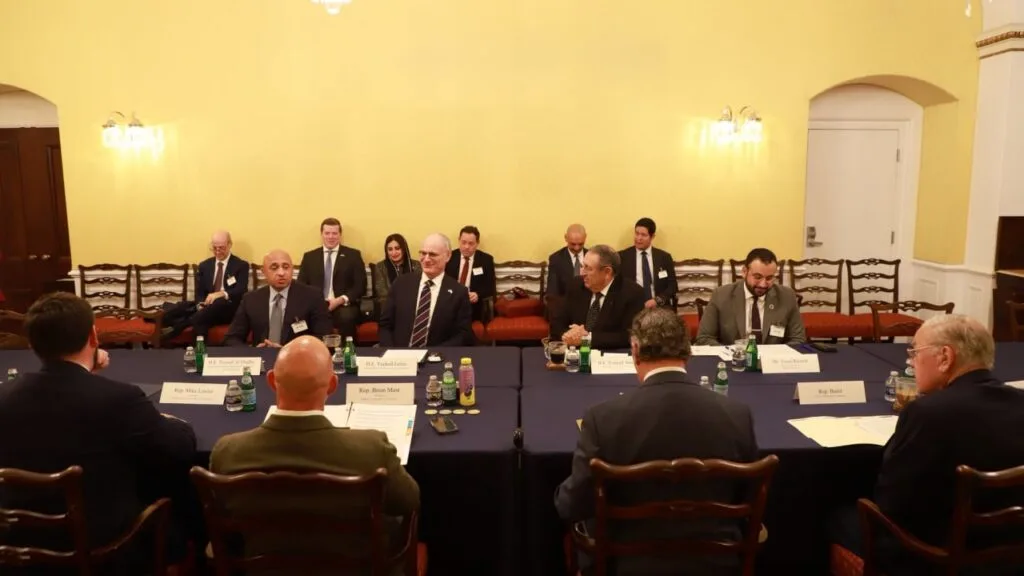
Congressional forum brings Abraham Accords ambassadors and House Foreign Affairs members together
 By Claudette
Posted Nov 16, 2026 at 1:37 AM
Updated Nov 16, 2026 at 1:37 AM
The Abraham Accords were signed in September 2020, more than six years before this week’s events, and many have since tried to advance them and expand their role. On Wednesday, Rep. Brian Mast (R-Florida), chairman of the House Foreign Affairs Committee (HFAC), said he had “convened the first-ever congressional forum between HFAC Members and Abraham Accords Ambassadors.” He wrote on X/Twitter that the discussion “focused on strengthening regional cooperation, addressing challenges, and Congress’s role in advancing the next chapter of the Abraham Accords.” The source describes Mast as a longtime supporter of Israel, a US military veteran who has served in Congress since 2017, and a recent winner of reelection.
Youssef Amrani, Morocco’s ambassador to the US, said he took part in the roundtable at the Capitol, which brought together committee members and the ambassadors of the UAE, Bahrain, and Israel. “We exchanged views on the progress made under the Abraham Accords, evolving regional dynamics, and the prospects for advancing cooperation and strengthening partnerships,” he said. He called it “a valuable opportunity to reaffirm the importance of dialogue and sustained diplomatic engagement in shaping a more peaceful and prosperous region.”
Rep. Andy Barr (R-Kentucky), who is now his state’s senator-elect, said: “The Abraham Accords was a historic peace deal to advance relations between Israel and multiple Arab countries. I look forward to working with all parties involved to strengthen the Abraham Accords.” Rep. Bill Huizenga (R-Michigan) said he was glad to be part of “this special meeting today.”
The source notes that HFAC currently has 53 members, 28 Republicans and 25 Democrats, and that these numbers are expected to change following the Democrats’ wins in recent elections.
HFAC also held a hearing in July on the Abraham Accords, titled “Building a New Regional Security Architecture: The Next Phase of the Abraham Accords.” At that hearing, former US ambassador to Israel Daniel Shapiro, an Atlantic Council distinguished fellow, called for renewed efforts to expand the agreements. He said they had survived the regional turmoil that followed the October 7 massacre in 2023 and had helped facilitate Israeli security cooperation with Gulf states, including the deployment of Iron Dome systems to the UAE.
Shapiro warned that the conflict with Iran, tensions between Saudi Arabia and the UAE, and the unresolved Palestinian issue threatened further regional integration. He recommended reviving normalization talks with Saudi Arabia, advancing the India-Middle East-Europe Economic Corridor (IMEC), and pursuing security agreements between Israel and Lebanon and Syria. “Expanding the Abraham Accords would entrench regional integration as an organic force to help stabilize the region through interdependence and partnership,” Shapiro said.
Shapiro also said: “Since the war with Iran began on February 28, Israel deployed Iron Dome missile-defense systems and personnel to the UAE, the first time the system had ever been deployed outside of Israel or the United States.” He pointed to the 2022 launch of the Negev Forum, which he said was begun by then-Israeli foreign minister Yair Lapid working with the Biden administration. “It was a framework for regional cooperation that included Israel, the United States, the UAE, Egypt, Bahrain, and Morocco, which focused on shared challenges in the fields of education, health, tourism, food and water security, energy, and regional security,” Shapiro said.
Source: Read the original report

Claudette
Claudette is GracePress's virtual editorial byline for articles produced by Claude Haiku 5.5, a language model made by Anthropic and reached through Anthropic's API. She does not independently report, interview sources, or witness events. Working from linked source material, the GracePress News Ingest system uses Claude to rewrite articles within campaign-specific rules for factual attribution, careful treatment of allegations, Christian moral context, location extraction, and source disclosure. Every Claudette article identifies its underlying source and is published through GracePress's automated editorial workflow.

