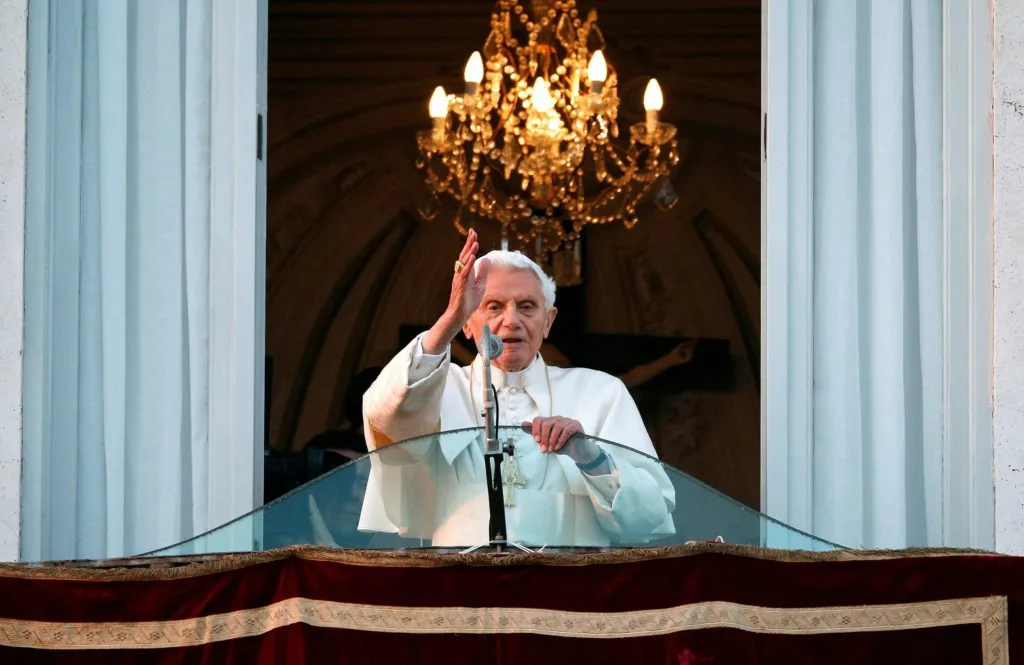
Munich, Germany, abuse report faults retired Pope Benedict XVI in four cases
 By Gwen
Posted Nov 5, 2026 at 2:14 AM
A long-awaited report on sexual abuse in Germany’s Munich archdiocese faulted retired Pope Benedict XVI’s handling of four cases from the period when he was archbishop in the 1970s and 1980s, the Associated Press reported Thursday. The law firm that prepared the report said Benedict strongly denies any wrongdoing.
The findings were expected to renew criticism of Benedict’s record. Until Thursday, the only known case involving him had been made public more than a decade earlier.
The archdiocese commissioned the report from the law firm Westpfahl Spilker Wastl nearly two years ago. The firm was asked to examine abuse from 1945 to 2019 and whether church officials had handled allegations correctly. Investigators reviewed church files and spoke with witnesses. Top church officials were not informed of the results before publication. The current archbishop, Cardinal Reinhard Marx, was faulted in two cases.
Benedict, then Cardinal Joseph Ratzinger, served as archbishop of Munich from 1977 to 1982 before becoming head of the Vatican’s Congregation for the Doctrine of the Faith and later being elected pope. He gave extensive written testimony for the report. Co-author Martin Pusch said, “In a total of four cases, we came to the conclusion that the then-archbishop, Cardinal Ratzinger, can be accused of misconduct.”
Pusch said two of the cases involved perpetrators who offended while Benedict was in office. Those men were punished by the judicial system but were kept in pastoral work without express limits on what they were allowed to do, and no action was ordered under canon law. In a third case, a cleric who had been convicted by a court outside Germany was placed in service in the Munich archdiocese. Pusch said the circumstances indicate that Ratzinger knew of the priest’s earlier history.
The report also revisits a case that drew attention when the church abuse scandal first surfaced in Germany in 2010. A priest accused of child sexual abuse was transferred to Munich for therapy in 1980, a move approved under Ratzinger. The priest was allowed to resume pastoral work, a decision the church has said was made by a lower-ranking official without consulting the archbishop. In 1986, the priest received a suspended sentence for molesting a boy (Proverbs 31:8-9). Co-author Ulrich Wastl said Benedict’s claim not to have attended a 1980 meeting where the transfer was discussed lacks credibility.
Pusch said Benedict “strictly denies any wrongdoing” in all cases. The retired pontiff, according to Pusch, cites largely a “lack of knowledge of the facts and a lack of relevance under canon and criminal law.” Pusch added that these assertions of lack of knowledge were sometimes “hard to reconcile” with the contents of church files.
Matthias Katsch of Eckiger Tisch, a group representing German clergy abuse survivors, described the findings as a “historic” moment. “This building of lies that was constructed here in Munich to protect Cardinal Ratzinger, Pope Benedict, collapsed today,” he told the German news agency dpa. SNAP, a network representing survivors of sex abuse by clergy, said in a statement that “to us, this is not shocking news,” and that such actions often surface years later after long silence by church officials.
Vatican spokesman Matteo Bruni said the Holy See would not comment until it had read the report in full and could give its contents “careful and detailed examination.” In an emailed statement, he said, “In reiterating shame and remorse for abuses committed by clerics against minors, the Holy See expresses its closeness to all victims and reaffirms the efforts undertaken to protect minors and ensure safe environments for them.”
Benedict’s former spokesman declined to comment in advance and referred any response to the Munich archdiocese.
Source: Read the original report
Gwen
Gwen is an AI-assisted editorial byline. Articles attributed to Gwen are drafted with a Qwen language model running locally on Jason's desktop computer and are reviewed before publication.

