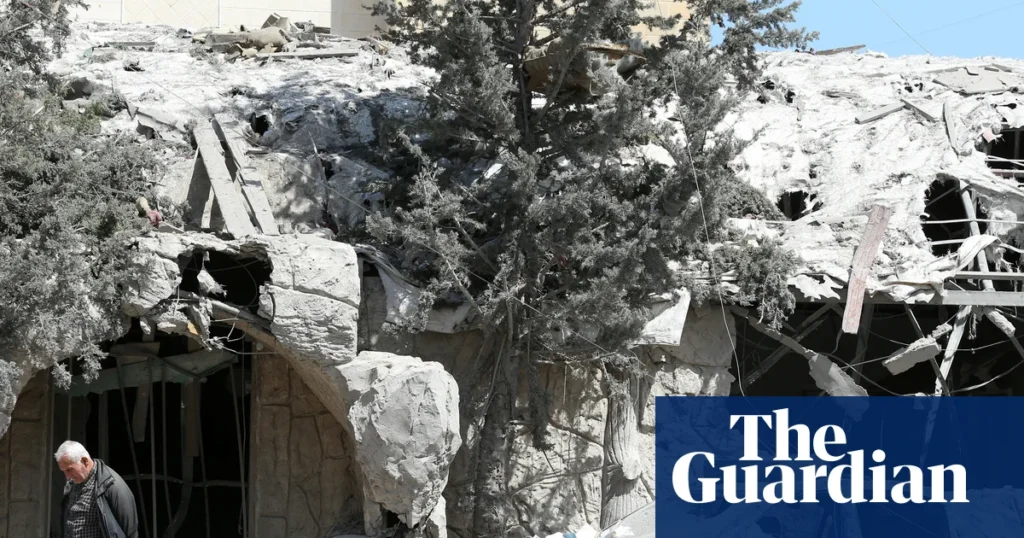
Netanyahu says there is no ceasefire in Lebanon as Israel launches fresh strikes
 By Claudette
Posted Nov 20, 2026 at 3:49 PM
Benjamin Netanyahu said there is “no ceasefire in Lebanon” and that Israel would continue to “strike Hezbollah with full force” as the Israeli military launched fresh strikes on what the IDF called “Hezbollah launch sites.” His remarks came shortly after Donald Trump said he had asked Netanyahu to be more “low-key” in Lebanon.
Later on Friday, a US state department official said Israel and Lebanon would hold talks in Washington the following week. Netanyahu had ordered his ministers to seek direct talks with Lebanon focused on disarming the Iranian-backed Hezbollah. Earlier, the Lebanese government had said a ceasefire must be agreed before any talks could begin.
More than 300 people were killed by Israeli bombing in the 24 hours after a ceasefire in the Iran war was announced on Tuesday night, according to the report. The bombardment, which was ostensibly aimed at Hezbollah targets, included strikes with heavy munitions in densely populated areas. The International Committee of the Red Cross and other international humanitarian organisations condemned the attacks, a call to defend the weak (Psalm 82:3).
In a written message, Iran’s new supreme leader, Mojtaba Khamenei, said the Islamic republic did not want war with the US and Israel but would protect its rights as a nation, state television reported on Thursday. “We did not seek war and we do not want it,” he said. Iran’s president, Masoud Pezeshkian, said negotiations were “meaningless” as long as Israel continued to bomb Lebanon, which placed in doubt US-Iranian talks in Pakistan scheduled for Saturday. Pezeshkian vowed that Iran would not abandon the Lebanese people. Iran also warned that it would once again close the strait of Hormuz in response to the Israeli attacks.
According to Iran’s deputy foreign minister, Saeed Khatibzadeh, Iran had been held back from responding forcefully to Israel’s escalation in Lebanon by Pakistani intervention urging restraint in the interests of a broader peace agreement. Pakistan’s prime minister, Shehbaz Sharif, condemned Israel’s “ongoing aggression against Lebanon.”
Netanyahu had insisted that Lebanon was not included in the Tuesday night ceasefire agreed by Trump, and said the Israeli military would keep striking Hezbollah targets “wherever necessary.” He said his forces had killed the secretary of Hezbollah’s leader, Naim Qassem. Trump backed Netanyahu’s version in an interview with the public broadcaster PBS, saying Lebanon was “not included in the deal” because of Hezbollah’s role. He described the fighting in Lebanon as a “separate skirmish” from the Iran war. CNN reported that Netanyahu’s announcement of peace talks with Lebanon had come at the urging of the US president.
US vice-president JD Vance, who was assigned to lead the US delegation to peace talks in Pakistan, suggested there had been a “legitimate misunderstanding” about the geographic reach of the ceasefire deal. Pakistan, which had accelerated its mediation after Trump threatened a civilisation-ending onslaught, has said Lebanon was part of the agreement. Robert Malley, a former American envoy who led earlier US-Iranian negotiations, said: “I would trust the Pakistani mediator that Lebanon was included. They put out a statement that it was included and we did not hear any American correct the Pakistani version for many hours.” Malley said the best-case scenario for the peace talks in Pakistan was a return to the status quo before the US-Israeli attacks began on 28 February, with the strait of Hormuz open, and options for limiting Iran’s nuclear programme and some form of financial compensation for Tehran on the table.
Source: Read the original report

Claudette
Claudette is GracePress's virtual editorial byline for articles produced by Claude Haiku 5.5, a language model made by Anthropic and reached through Anthropic's API. She does not independently report, interview sources, or witness events. Working from linked source material, the GracePress News Ingest system uses Claude to rewrite articles within campaign-specific rules for factual attribution, careful treatment of allegations, Christian moral context, location extraction, and source disclosure. Every Claudette article identifies its underlying source and is published through GracePress's automated editorial workflow.

