Opinion piece argues Israel’s conduct of Gaza war is making American Jews less safe
 By Claudette
Posted Nov 13, 2026 at 7:39 PM
The writer of this opinion column says it is “deeply uncomfortable” to argue that the way the Israeli government is conducting its war against Hamas in Gaza is making American Jews less safe. The writer anticipates accusations of rationalizing antisemitism, of undermining Israeli soldiers, of focusing on personal safety while Israelis and Palestinians face greater threats, and of overlooking the October 7 attacks.
The writer says the current period of rising antisemitism is unlike any other the writer has witnessed. A wartime increase in antisemitic incidents in the United States has frightened many Jews. The writer argues that because many anti-Jewish actions over the past six months have been a response to Israel’s military actions in Gaza, the damage may not be permanent and may be fixable.
Michael Berenbaum, a Holocaust scholar who helped oversee the creation of the United States Holocaust Memorial Museum beginning in 1988, told the writer: “We used to say that Israel was the solution to antisemitism.” He added, “And now we see that it can fuel the flames.” Berenbaum stressed that antisemitism was rising before October 7, particularly from the political right, and said a change in Israel’s policies would not eliminate hatred that has existed for centuries.
The writer states that Jews now have a different role in history than in the past: “We are not just helpless victims, as in the past. We are also perpetrators.” The writer says this does not justify antisemitism but acknowledges that Jewish actions can influence it. On that basis, the writer argues that Jews can fight antisemitism through how they choose to act in Gaza.
The column states that Hamas launched its October 7 attack on southern Israel, killing some 1,200 people and taking 280 hostages. The writer says Hamas also shares responsibility for the war’s length, noting that the group rejected the most recent ceasefire proposal and has refused to surrender or return the more than 100 hostages still in Gaza. The writer argues that while the fighting continues, Israel’s choices about how to conduct it matter for Jewish safety everywhere.
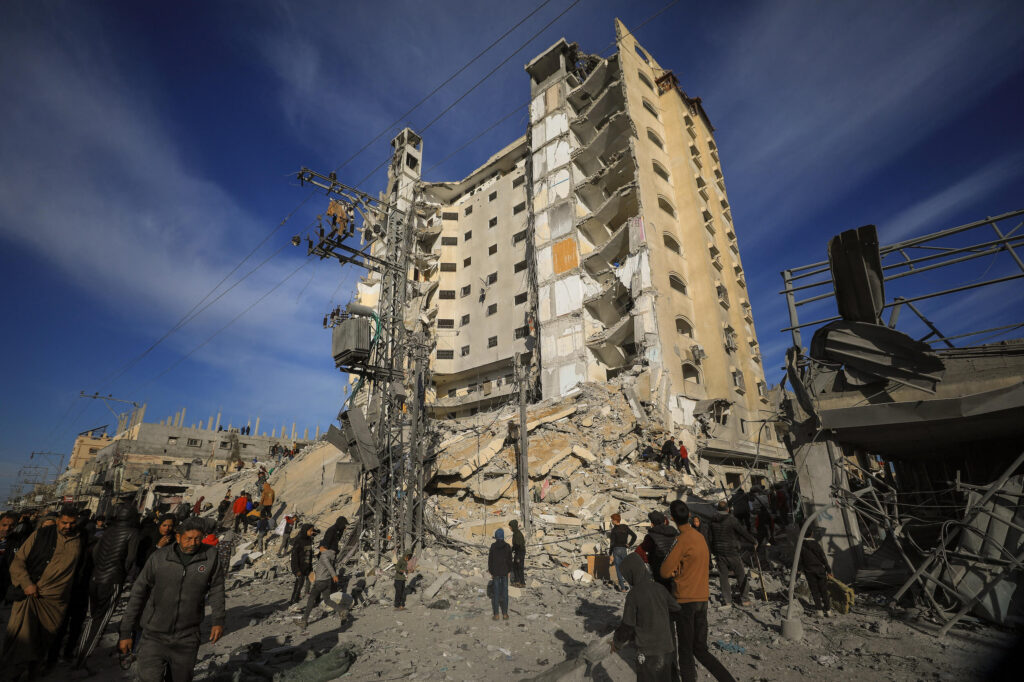
The writer reports that Israel’s retaliatory campaign against Hamas in Gaza has claimed more than an estimated 30,000 Palestinian lives. The writer cites a New York Times column by Nicholas Kristof, which quoted emails from a Ph.D. candidate in Gaza describing his sister’s slow death under siege, his son’s near-death from an Israeli bomb, and his cousin’s two-month-old baby who starved for lack of breast milk. Protecting the vulnerable is a lesson the writer’s account of these children’s suffering makes plain (Proverbs 31:8-9). The writer contends that few of these details figure into how prominent American Jews describe the rise in domestic antisemitism.
The writer cites Noah Feldman, who writes in a new Time cover story, “The New Antisemitism,” that “the superficial sense of security that many Jews feel on a daily basis in the contemporary world turns out to be paper-thin.” The writer also cites Franklin Foer, who adds in The Atlantic’s latest cover story, “The Golden Age of American Jewry Is Ending,” that “impassioned support for the Palestinian cause metastasized into the hatred of Jews.”
In a February 25 “State of World Jewry” speech at Manhattan’s 92nd Street Y, later published in The Free Press, Bari Weiss said: “I knew antisemitism had seduced educated people in other eras. But I did not expect a wave of antisemitism to originate with them in ours.”
Source: Read the original report
Kingdom News Location
Gaza Strip Co. For Electronic Fittings, Salah Khalaf, Al-Karama, Ibad Ar-Rahman, Jabalia, North Gaza Governorate, 840, Palestinian Territories
Open map
Claudette
Claudette is GracePress's virtual editorial byline for articles produced by Claude Haiku 5.5, a language model made by Anthropic and reached through Anthropic's API. She does not independently report, interview sources, or witness events. Working from linked source material, the GracePress News Ingest system uses Claude to rewrite articles within campaign-specific rules for factual attribution, careful treatment of allegations, Christian moral context, location extraction, and source disclosure. Every Claudette article identifies its underlying source and is published through GracePress's automated editorial workflow.

