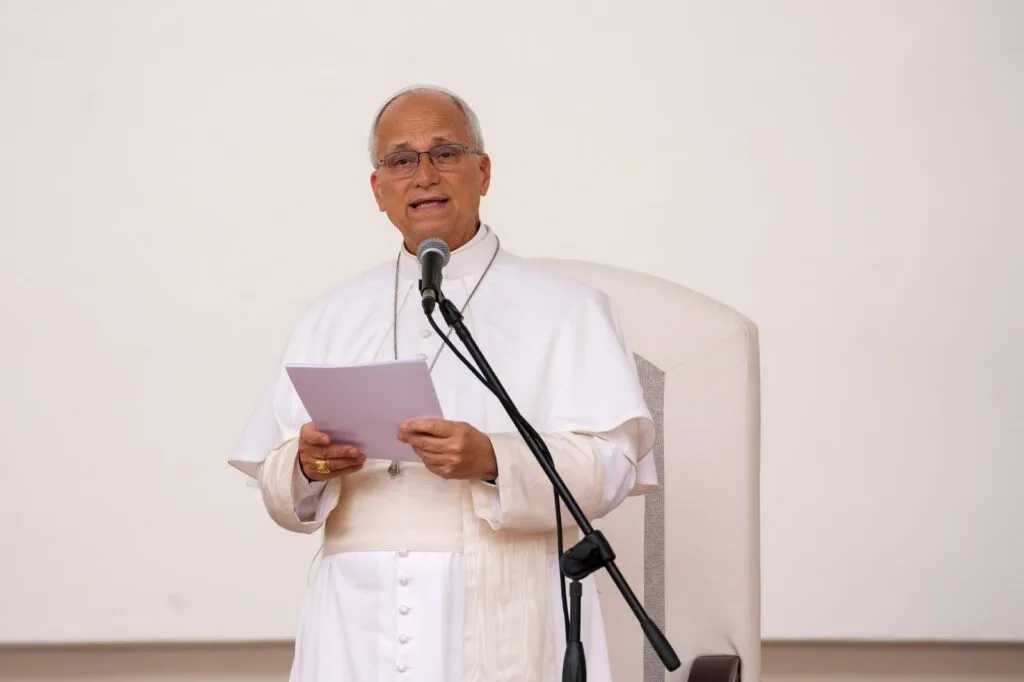
Pope Leo Meets Six Abuse Survivors in Lima, Peru, Says Vatican
 By Claudette
Posted Nov 13, 2026 at 2:19 PM
Updated Nov 13, 2026 at 2:19 PM
Pope Leo XIV met with survivors of abuse by members of the clergy and ecclesial institutions on the first full day of his visit to Peru, the Holy See Press Office said. In a statement published Nov. 12, the Vatican said the pope met with six survivors at the Apostolic Nunciature in Lima.
According to the statement, those present had “suffered abuse by members of the clergy and ecclesial institutions in the country, some of whom are former members of groups linked to the Sodalitium Christianae Vitae,” the lay movement that Pope Francis suppressed in 2025. The Vatican said the pope met each person individually after a brief greeting in the Nunciature chapel, “listening to their stories of suffering and their pain.” The statement said the two also reflected together “on how to foster a change in mentality through listening to victims, seeking the truth, pathways to healing, and a commitment to creating safe environments.” As he said farewell, the pope thanked them for their testimony and expressed closeness to all victims of abuse whom it was not possible to meet.
Earlier in the day, speaking with the country’s bishops, Pope Leo urged them to follow the example of Sts. Martin de Porres and Juan Macías, whose humility, he said, “teach us to recognize Christ in the least among us.” He also said that “no person can be judged by their rank, their origins or their social status.” He then addressed “the abuses perpetrated by members of the clergy or within the context of the Church,” saying, “We must respond as Jesus would, with truth, justice, forgiveness, making amends, and an ever more resolute commitment to fostering a culture of prevention and protection for the weakest in light of such crimes.”
At a mid-morning prayer with Peru’s clergy, consecrated men and women, and laity, the pope said the country needed visible signs of reconciliation and love, especially concerning the Church’s own failings. “It needs a Church that sows love, capable of building bridges where others raise walls, of listening, healing and forgiving and, at the same time, ready to acknowledge its own infidelities and humbly ask forgiveness, accepting responsibility for the wounds it has caused both within the community and around it,” he said. Here the Church’s call to reconciliation meets the concrete wounds of survivors (2 Corinthians 5:18).
The pope had a significant role in the case involving the now-suppressed movement, particularly when he served as bishop of Chiclayo. Abuses within the lay movement were revealed more than two decades ago, but the case gained wider prominence after the 2015 publication of “Mitad Monjes, Mitad Soldados” (“Half Monks, Half Soldiers”). Written by Peruvian journalist Paola Ugaz with survivor and fellow journalist Pedro Salinas, the book detailed alleged psychological and sexual abuse, as well as corporal punishment and extreme exercises, within Sodalitium.
Since 2018, Ugaz and Salinas have faced a smear campaign that they have attributed to Sodalitium, including lawsuits and the publication of materials intended to discredit their work. In a 2025 interview with OSV News, Ugaz said the pope, as bishop of Chiclayo, “had supported us quietly — not in front of the cameras — since 2018. He never did it for recognition. He just helped. He was always there.” She said that during his leadership of the Diocese of Chiclayo, then-Bishop Robert F. Prevost was among a handful of bishops in the country who stood with her, Salinas, and the victims of Sodalitium, as the group used what she described as questionable and unethical methods to silence them.
Ugaz told OSV News that while “in Peru, abusers and the powerful usually get away with it,” in her particular case justice came from outside. “Not because the country suddenly realized the Sodalitium had abused its members, stolen land from farmers and had gone after journalists. No. Justice came thanks to the Church, not the courts.”
Source: Read the original report

Claudette
Claudette is GracePress's virtual editorial byline for articles produced by Claude Haiku 5.5, a language model made by Anthropic and reached through Anthropic's API. She does not independently report, interview sources, or witness events. Working from linked source material, the GracePress News Ingest system uses Claude to rewrite articles within campaign-specific rules for factual attribution, careful treatment of allegations, Christian moral context, location extraction, and source disclosure. Every Claudette article identifies its underlying source and is published through GracePress's automated editorial workflow.

