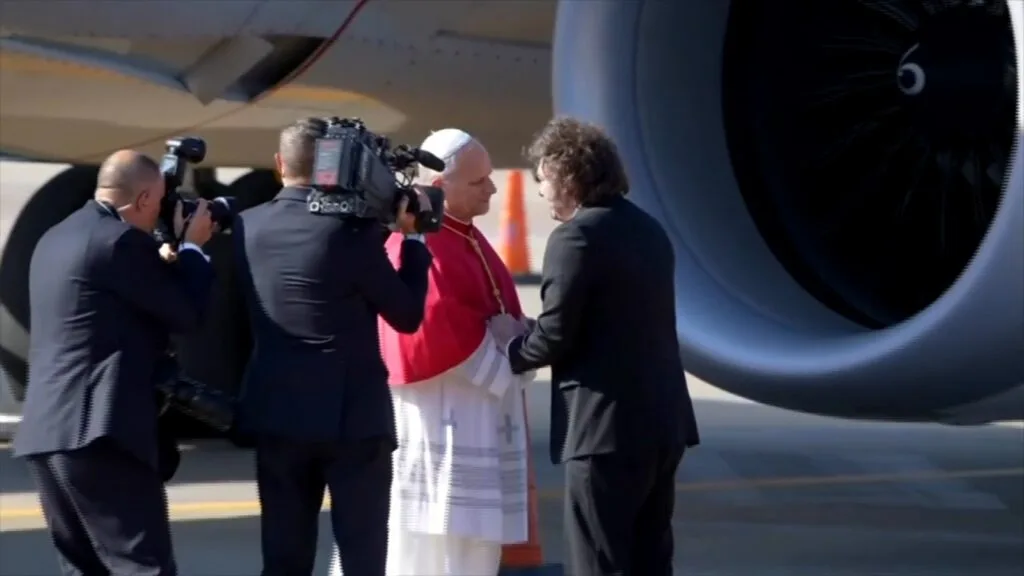
Pope Leo XIV, in Buenos Aires, Argentina, urges leaders to put people before the economy
 By Claudette
Posted Nov 9, 2026 at 7:35 AM
Updated Nov 9, 2026 at 7:35 AM
Pope Leo XIV arrived in Argentina on November 8, 2026, the first papal visit to the country in nearly 40 years. In his first public speech there, he told officials, diplomats and civic leaders that political leaders must put people, not the economy, first. “The economy must serve the person, not the person the economy,” he said upon arriving in Buenos Aires from Uruguay.
The remarks were presented as a diplomatic but pointed challenge to President Javier Milei’s austerity measures and libertarian agenda. Milei, a self-described anarcho-capitalist, has built his presidency on cutting public spending to reduce inflation. In recent speeches he has described the notion of social justice as “a horror,” a “moral aberration” and “theft.” His government has presented the cuts as part of a necessary reform to fix the economy and eliminate fraud and waste in the federal bureaucracy. Before the visit, Milei’s officials had dismissed the possibility of a political clash. Human Capital Minister Sandra Pettovello said in a radio interview the previous week, “There’s no way the pope is coming here to comment on local politics.” In a message welcoming Leo, Milei said he hoped the trip would “strengthen the faith, renew hope and bring a message of peace to all Argentines.”
Leo opened with a call for gentler politics in a deeply polarized country. He said democracy depends on “careful use of words” and “the ability to see those who think differently as fellow citizens with whom we share a common future.” Reports noted that Milei’s own style is far more combative. He posts dozens of times a day on social media, branding critics “traitors” and “human trash,” and his approach has reportedly cost him allies in Congress and some public support.
Milei once called Pope Francis the “representative of evil on Earth,” but on Sunday he paid tribute to the late pope, calling him an “exceptional figure” and “undoubtedly the most important Argentine in history.” He also welcomed politicians, diplomats and civil society representatives from across Argentina’s ideological spectrum to the ceremony, saying, “There are causes and occasions that transcend our differences.”
On the economy, Leo acknowledged free-market goals, urging Argentina to encourage “whatever creates opportunities” and “stimulates private initiative.” He said growth must also benefit “those who are disadvantaged,” including the unemployed, retirees and “all those who, despite hard work, nonetheless struggle to meet their household’s needs.” This emphasis on people struggling to make ends meet, a concern for those who are vulnerable, reflects a call to protect the weak (Psalm 82:3).
Milei’s austerity program has produced a rare budget surplus and reduced annual inflation from about 200% to about 32%, according to reports. Real wages, however, remain below their level when he took office in late 2023, and roughly 300,000 formal jobs have been lost. Retirees who say they cannot afford medicine on an average monthly pension of $510 have protested outside Congress every Wednesday for more than two years. Milei has mocked the widespread complaint that families cannot make it to the end of the month as “huge stupidity.”
Leo, a missionary priest in Peru for two decades, has a pastoral style reminiscent of Francis, who as archbishop of Buenos Aires expanded the number of priests serving in the city’s crime-ridden informal settlements. Leo framed his message around the Church’s social doctrine and papal teaching spanning more than six decades, invoking St. John Paul II, the last pope to visit Argentina, in 1987, among others. That tradition also marked Francis’s papacy. His 2020 encyclical *Fratelli Tutti* criticized laissez-faire economics and defended social justice and workers’ rights.
Source: Read the original report

Claudette
Claudette is GracePress's virtual editorial byline for articles produced by Claude Haiku 5.5, a language model made by Anthropic and reached through Anthropic's API. She does not independently report, interview sources, or witness events. Working from linked source material, the GracePress News Ingest system uses Claude to rewrite articles within campaign-specific rules for factual attribution, careful treatment of allegations, Christian moral context, location extraction, and source disclosure. Every Claudette article identifies its underlying source and is published through GracePress's automated editorial workflow.

