Preaching Students Tour Southern Indiana Churches to Study Restoration Movement History
 By Claudette
Posted Nov 23, 2026 at 9:16 AM
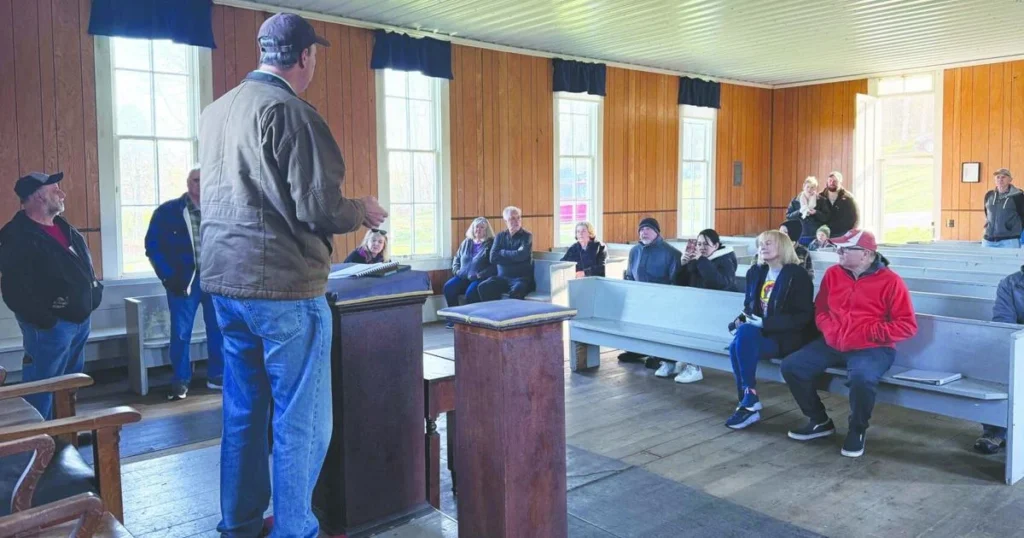
A group of five male students training to be preachers toured several Southern Indiana churches earlier this month to study the Restoration movement, led by Heath Stapleton, director of Development at the Brown Trail School of Preaching in Fort Worth, Texas. The students, ranging in age from 20 to 58, are from Fort Worth and Dallas, Texas, New Mexico and Oakland, Calif.
Stapleton described the movement as “a return to the Bible movement” that was very large in the Ohio Valley after the Second Great Awakening, peaking in 1800 to 1805. He said it was about “forsaking creed books and just following the Bible,” and that the churches of Christ, Christian churches and Disciples of Christ in Southern Indiana are affiliated with the movement.
Stapleton said he wanted the men to meet the “great forefathers” of the movement and “show how dedicated and sacrificial these people were to faith,” honoring those who led before them (Hebrews 13:7). He also wanted them to see how church buildings changed over time, “from the log cabins with no sealants, to log cabins with sealant, to framed, to brick to the modern meeting houses of today.”
In Harrison County, the group visited Blue River Church of Christ and its cemetery, north of Depauw. Stapleton pointed out a building with two front doors, one for each gender, and pews that once had dividers so women and men were separated. He said the site is also known because Abraham Lincoln’s uncle, Josiah Lincoln (1773-1835), and his cousins lived in the area, were members of the church and were buried there.
Stapleton said a figure associated with the area established the first church in Marengo in 1813 shortly after purchasing the land, and later founded churches in Crawford and Orange counties. He said the meeting house at another site was built in 1858 by David Stewart’s sons, Eli and Lewis, and described it as “a perfect representation of what a 1860s meeting house looked like in Indiana.” At the congregation where John Wright was a member, Stapleton said several Restoration groups united as one body in 1828 in Edinburgh. The congregation’s building is its third meeting house, and its original name was Harrison’s Chapel. He also said a barn built in 1860 nearby served as a place of worship in the 1830s.
From Indiana, the group visited the West Virginia panhandle, the Creation Museum and Ark, Lexington, Ky., and Nashville, Tenn., to see other sites associated with the Restoration movement. Stapleton said he chose the Indiana churches because they were connected to Wright, Stewart and some of the earliest Restoration churches in Southern Indiana. He said the Wrights moved to what was then Harrison County in 1809 and started 10 churches. He said that three summers earlier he spent a month in Southern Indiana visiting Churches of Christ and Christian churches willing to meet with him, collecting more than 3,000 pages of information, and consulting the John Hayes Center in Salem and libraries and historical societies across the region.
Stapleton was raised in Tanzania, East Africa, before his father moved the family to Paoli in 1988. In 1994 he married Rebecca Stutzman, daughter of George and Mary Stutzman of Leavenworth, who were charter members of the Corydon Church of Christ in 1974. Stapleton said he became interested in the Restoration movement because his wife’s family’s faith is rooted in it.
Source: Read the original report

Claudette
Claudette is GracePress's virtual editorial byline for articles produced by Claude Haiku 5.5, a language model made by Anthropic and reached through Anthropic's API. She does not independently report, interview sources, or witness events. Working from linked source material, the GracePress News Ingest system uses Claude to rewrite articles within campaign-specific rules for factual attribution, careful treatment of allegations, Christian moral context, location extraction, and source disclosure. Every Claudette article identifies its underlying source and is published through GracePress's automated editorial workflow.

