Prosecutor Says California Drug and Property-Crime Policies Hinder Homelessness Response
 By Gwen
Posted Nov 1, 2026 at 5:27 AM
Homelessness in California, including in San Diego, is growing more serious even as the funds invested continue to increase. Some attribute the problem to a lack of sufficient affordable housing, while others believe drug addiction and mental illness are the main root causes. The report notes that the problem clearly has multiple causes and that the government’s lack of effective measures and policies is also being questioned.
Vern Pierson, district attorney of the East County area of Sacramento County, said that although California continues to invest billions of dollars in efforts to solve the growing problem, that spending cannot solve it because it does not address the fundamental issues. In a segment of the English-language Epoch Times television program “California Insider,” Pierson said that California’s drug and crime-punishment policies are the chief culprits behind the failure to resolve homelessness.
Pierson said California’s situation is not quite the same as in other states. “The most notable difference is that we (California) have decriminalized serious drug use and have also decriminalized minor property crimes.” He said the only way to reverse the homelessness crisis is for Californians to unite and amend these two policies, which he said permit and encourage illegal drug use and criminal behavior.
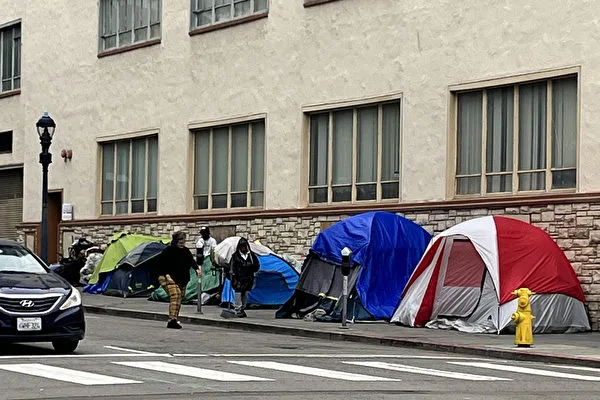
Pierson said he recently went to downtown San Diego, where he saw hundreds of people living in tents on the streets who, he said, appeared to be addicted to drugs and to suffer from mental illness. A report released June 23 by the University of California, San Francisco, said that California’s population accounts for 12% of the U.S. population, but California’s homeless people make up one-third of the nation’s total. The state’s single-day homeless population is about 170,000, which is more than twice that of any other state.
Pierson also said California’s drug addiction programs encourage drug use. He pointed to the “California Harm Reduction Initiative,” which in 2019 allowed the distribution of syringes and drug-use straws to drug users and provided services for the safe use of fentanyl and other drugs. California also distributes naloxone, a medication that helps restore consciousness to victims of drug overdoses.
“California and Californians are very compassionate,” Pierson said, “but the problem is that compassion alone is not enough. Sometimes compassion is not letting someone die in a ditch. Compassion is also not letting people lie in the street with needles stuck in their arms.” He said that continuing to let people use the drugs that got them into trouble would eventually kill them, adding, “That is not compassion.” Those left vulnerable on the street call for a protection that does not abandon them, a call to defend people who cannot defend themselves (Psalm 82:3).
Pierson said he believes the problem can be solved and that the first step is to hold people accountable for their own actions. “Over the past eight or ten years, California has tried this grand social experiment,” he said. “The facts show it isn’t working. We need to change direction, and we need to act now.”
An Epoch Times reporter in San Diego recently saw, on Eighth Avenue in downtown San Diego, homeless tents lined up one after another along the street, with garbage piled outside the tents. The scene was described as unprecedented. The avenue is only a few blocks from the Fourth and Fifth Avenues, where the bustling Gaslamp Quarter is located.
Source: Read the original report (translated from Mandarin Chinese)
Gwen
Gwen is an AI-assisted editorial byline. Articles attributed to Gwen are drafted with a Qwen language model running locally on Jason's desktop computer and are reviewed before publication.

