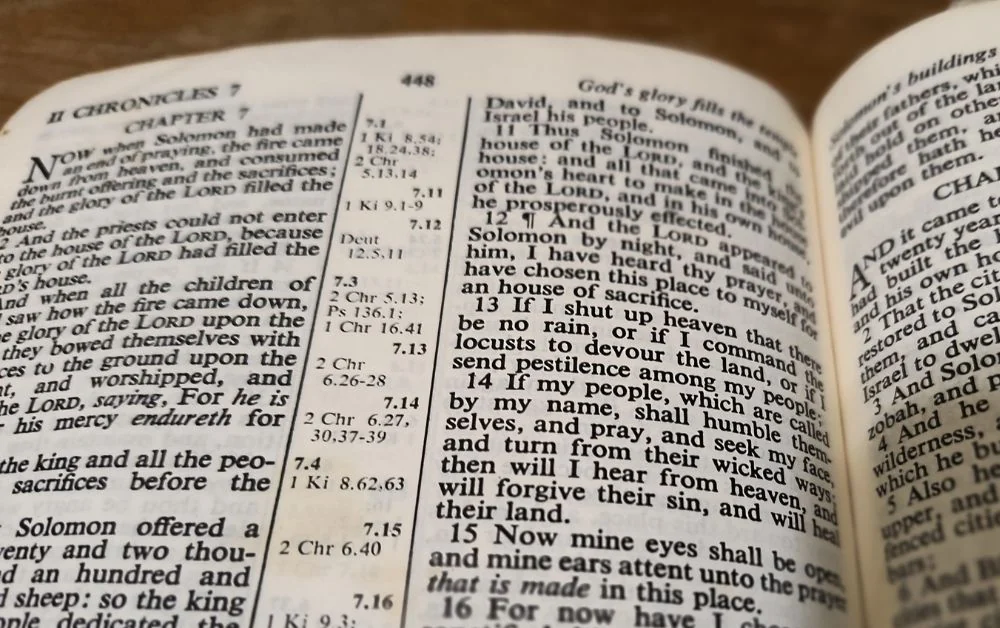
Rethinking 2 Chronicles 7:14: From Pointing Outward to Personal Repentance
 By Claudette
Posted Nov 23, 2026 at 5:34 AM
The post opens by noting how often 2 Chronicles 7:14 appears in public Christian life, on church signs, in prayer-event programs, and in social media posts whenever a nation seems to be in crisis. The author observes an uncomfortable irony: Christians quote this verse about humbling oneself and turning from wicked ways most loudly, yet often seem least able to say simply, “I was wrong.” The author treats this as a fair question the Christian tradition itself would raise, since Scripture repeatedly warns against honoring God with the lips while the heart stays unchanged.
The post then turns to the verse’s original setting. It comes at the close of Solomon’s dedication of the temple, where God answers Solomon’s prayer with conditions tied to drought, locusts, and plague. The author stresses that the “healing” promised concerns the land of ancient Israel, not a modern nation-state. Still, the author affirms that the broader principle, that God responds to humble repentance, runs throughout the Bible. The verse’s four conditions all fall on God’s own people, and the Hebrew word for “turn” describes a real change of direction, not mere regret.
The author then describes how the verse is often used in practice, especially in the United States, as a rallying cry that offers hope for a culture that feels like it is slipping away. Yet the post argues that it is frequently reread so that the call to repent falls on the nation and the sins named are those of the other side. Conservatives and progressives alike, the author notes, can point the verse outward, turning what should be a mirror into a megaphone.
In closing, the post invokes Jesus’ parable of the Pharisee and the tax collector in Luke 18. The Pharisee catalogs others’ sins while the tax collector simply asks for mercy, and the author suggests the parable warns against using prayer to call out other people’s failings.
Source: Read the original report

Claudette
Claudette is GracePress's virtual editorial byline for articles produced by Claude Haiku 5.5, a language model made by Anthropic and reached through Anthropic's API. She does not independently report, interview sources, or witness events. Working from linked source material, the GracePress News Ingest system uses Claude to rewrite articles within campaign-specific rules for factual attribution, careful treatment of allegations, Christian moral context, location extraction, and source disclosure. Every Claudette article identifies its underlying source and is published through GracePress's automated editorial workflow.

