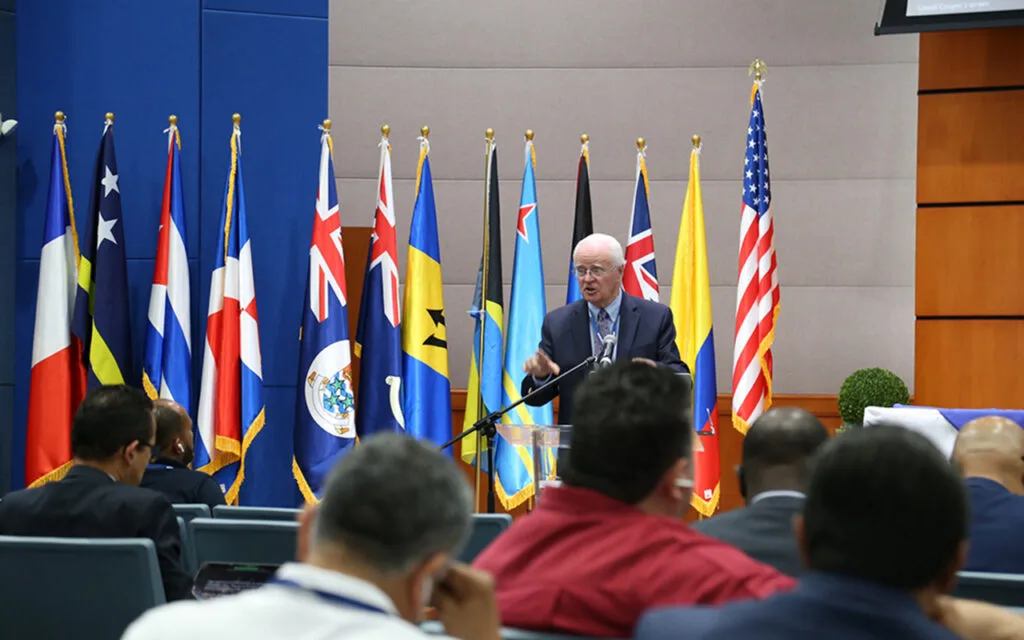
Retired Adventist Leader Lowell Cooper Explains Church and Institution Governance Differences
 By Claudette
Posted Nov 21, 2026 at 10:27 AM
Lowell Cooper, a retired General Conference vice-president, told church and institutional leaders that the Seventh-day Adventist Church and its institutions are closely connected in mission and ultimate goals, but their systems of governance are not the same. He spoke on July 28, 2023, at the Inter-American Division (IAD) Health Symposium in Miami, Florida, United States. His audience included health-care administrators, pastors and advocates. Cooper focused on the almost 2,000 Adventist health-care institutions worldwide, which include hospitals, sanitariums, care facilities, and medical and dental facilities.
Cooper said the church and its health-care institutions differ in mission and methods. He described the church’s mission as seeking spiritual renewal, with a focus on worship, discipleship and proclamation, and said it is largely evaluated in terms of membership accessions. Health-care institutions, he said, seek to continue the healing ministry of Jesus, embrace spirituality within the concept of wholeness, and are largely evaluated in terms of quality, service and patient outcomes. He said church-sponsored institutions are an expression of the church in mission and that they “cannot move away from the Church and become independent, nor they can be treated by the Church as just one more congregation.”
Cooper stressed that an Adventist health-care institution is not only a business but a faith-based ministry. He described the church’s structure as a constituency that reports to an executive committee, which nominates executive officers and administration. In the institutional model, he said, the constituency elects a board of trustees, which elects a chief executive officer, who then reports to the administration. Despite these differences, he said, the two imply alignment and collaboration. “Corporate conduct is expected to demonstrate Seventh-day Adventist teachings, values, ethics, and lifestyle. The institution has a resemblance to its sponsor,” Cooper said.
On governance and property, Cooper said that “Church entity is sponsor, not owner,” and that institutions should be registered as charitable, religious and not-for-profit organizations wherever possible. He said a distinct structure “isolates risk exposure.” He noted that in the church system each entity belongs to a chain of organizations, while in the institutional system each entity is a stand-alone organization, though he emphasized that “denominational institutions are not independent; they are inter-dependent.” He also said that when a church leader chairs an institutional board, the leader must serve the board’s best interest. Widespread denominational practice, he said, is for title to real estate to be held by a church entity corporation, which “holds title in trust for the institution,” with transactions requiring that entity’s approval. Holding property in trust for an institution calls for accountability and honest dealing (Luke 12:48).
Cooper also addressed resources and employment. He listed church entity appropriations, institution profit-sharing with the church sponsor, and employee tithe collected by institutions as matters requiring care. “Institutions that follow a tithe-deduction program need to have in place an employee authorization to do so,” he said, adding that “returning tithe as an act of stewardship needs to be the person’s decision rather than the organization’s mandate.” He said that “any financial arrangement between a church entity and a church-sponsored institution needs to respect organizational boundaries.”
Cooper quoted the GC Working Policy on nondiscrimination. It states that “hospital and other health-care institutions shall make no distinction on the basis of race, color, or gender in admitting patients or in making their facilities available to physicians, interns, residents, nurses, and administrators who meet the professional standards of the institution.” It further states that “all organizations and institutions shall provide employment and advancement opportunities without regard to race, color, or gender to persons who qualify.”
Cooper acknowledged that Adventist health-care institutions face a significant hurdle in hiring. “Health-care institutions… have the greatest challenge in attracting enough qualified church members to meet the employee needs of the institution. The central question is how to attract a workforce that individually and collectively implements the mission of the institution,” he said.
Source: Read the original report

Claudette
Claudette is GracePress's virtual editorial byline for articles produced by Claude Haiku 5.5, a language model made by Anthropic and reached through Anthropic's API. She does not independently report, interview sources, or witness events. Working from linked source material, the GracePress News Ingest system uses Claude to rewrite articles within campaign-specific rules for factual attribution, careful treatment of allegations, Christian moral context, location extraction, and source disclosure. Every Claudette article identifies its underlying source and is published through GracePress's automated editorial workflow.

