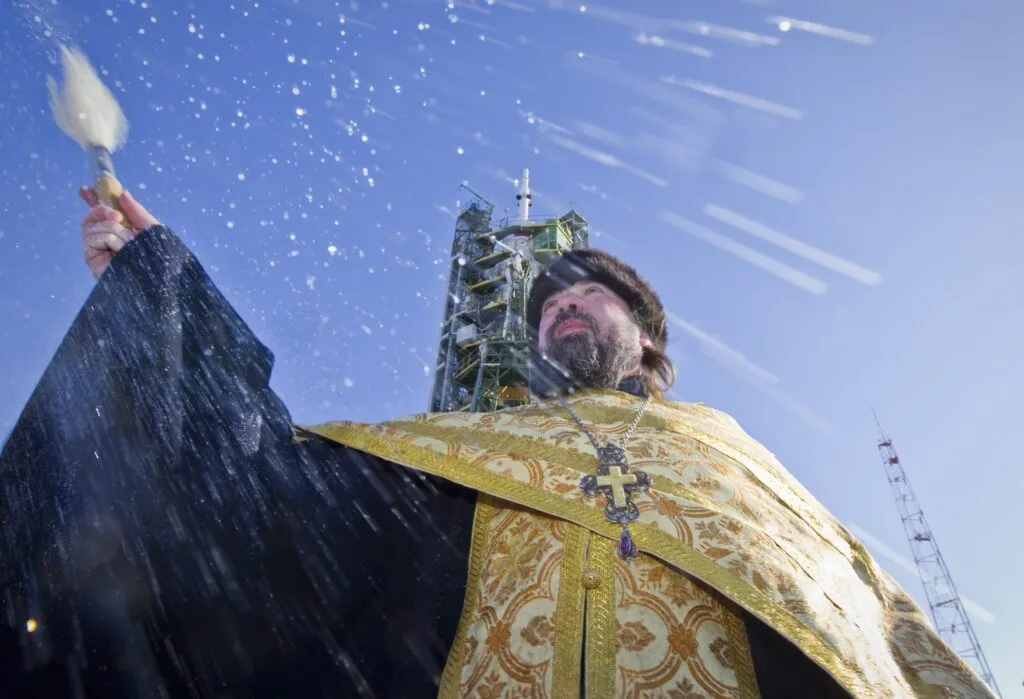
Russian Orthodox Bishop Erects Cross in Pyramiden, Norway, Without Permission
 By Claudette
Posted Nov 8, 2026 at 11:11 PM
In a March 26, 2024 analysis published by the Center for European Policy Analysis (CEPA), Elisabeth Braw wrote that the Russian Orthodox Church is “decidedly political” and that its growing foreign outreach, from Africa to the Arctic, is troubling. She described Patriarch Kirill, who as Patriarch of Moscow leads the church in Russia and several neighboring countries, as someone who regularly endorses Vladimir Putin’s war against Ukraine. According to the article, Kirill sent Metropolitan Hilarion, his internationally respected second-in-command, to a backwater post after Hilarion failed to support the war. The article also states that Kirill, like his predecessor Aleksi II, was a KGB agent during the Soviet era.
Braw wrote that the Moscow Patriarchate is expanding into Africa and engaging in activities in northern Norway that she called worrisome. She said that separation between church and state is virtually nonexistent in the Russian Orthodox Church. The article links the clergy-led events in northern Norway to rising Russian and Chinese rivalry with the West in the High North, where climate change is opening new shipping routes. It also notes that recent meetings between Norwegian and Russian officials about the region have been increasingly marred by Russian table-thumping and menacing references to the fate of Ukraine.
According to the article, in August Bishop Iyakov of Narayan-Mar and Mezen, described as the leader of the Russian Orthodox Church in the High North, visited Pyramiden on Svalbard, the northernmost town on the Norwegian archipelago. Braw wrote that Russia has held rights on Svalbard since Norway took control in 1920. She said Pyramiden was built during the Soviet era, was disbanded two decades ago, and has been a ghost town since. Citing the Barents Observer, she reported that Iyakov erected a giant cross there without permission from Norwegian authorities, and that the cross was decorated with a black-and-orange ribbon that has come to symbolize Russian expansionism.
Braw reported that the following month Iyakov erected a cross in Franz Josef Land, which belongs to Russia, accompanied by soldiers from a nearby military base and members of a delegation from the Russian Geographical Society, according to the Barents Observer. She wrote that while Iyakov had the right to erect a cross there, his association with the Russian military suggested to her that the cross on Svalbard had a non-Christian function. She quoted Ragnhild Tvergrov Skare, a researcher at the Norwegian think tank UTSYN, who said that after Putin returned to the presidency in 2012, the understanding of history became more politicized, and that the church’s activities in Norway had increased, with several crosses, monuments and initiatives started in collaboration with or by the church.
The article says these activities have intensified in recent years. In 2020, Bishop Mitrofan of Murmansk and Monchegorsk, head of the Russian Orthodox Church on the heavily militarized Kola Peninsula, told an interviewer that the Norwegian municipality of Sør-Varanger “is our Orthodox land,” and said he wanted to build an Orthodox church there. Braw wrote that Mitrofan, Iyakov and other clerics have since regularly appeared in northern Norway or commented on it. In her view, this shows Russian representatives meddling in the affairs of another country, even a NATO member state.
Braw also gave historical context, writing that Russia’s Christians suffered greatly during the Soviet era, when they were persecuted even as some of their leaders secretly collaborated with the regime. After the Soviet collapse, she wrote, Russia’s leadership, especially Putin after he came to power, endorsed the Orthodox Church and helped build churches and cathedrals, but the church leadership’s closeness to the Kremlin remained as strong in public as it had been in private. She said Kirill, who became Patriarch of Moscow in 2009, turned that relationship from close to intimate, and that he has endorsed Russia’s full-scale invasion of Ukraine. The article quotes Kirill as saying, the day after the invasion, that Russia has “the right to stand on the side of light, on the side of God’s truth.”
Braw said the Moscow Patriarchate has recently extended its operations in Norway and Africa, which she described as helpful to the Kremlin. She wrote that the church has embarked on an expansion campaign in Africa that includes poaching priests from the Patriarchate of Alexandria, which covers the continent and has supported the Ukrainian Orthodox Church’s effort to separate from Moscow. The article links this expansion to Russia’s military campaign on the continent through the Wagner Group, now known as the Africa Corps, which the article describes as state-controlled. Braw acknowledged one possible view: that the priests are well-meaning but naive and may not realize their activities can be seen in a geopolitical light, since religious representatives routinely travel abroad to preach their faith.
Source: Read the original report

Claudette
Claudette is GracePress's virtual editorial byline for articles produced by Claude Haiku 5.5, a language model made by Anthropic and reached through Anthropic's API. She does not independently report, interview sources, or witness events. Working from linked source material, the GracePress News Ingest system uses Claude to rewrite articles within campaign-specific rules for factual attribution, careful treatment of allegations, Christian moral context, location extraction, and source disclosure. Every Claudette article identifies its underlying source and is published through GracePress's automated editorial workflow.

