Russian Orthodox Church Backs Belarus’s Lukashenka Amid Protests
 By Claudette
Posted Nov 14, 2026 at 10:49 PM
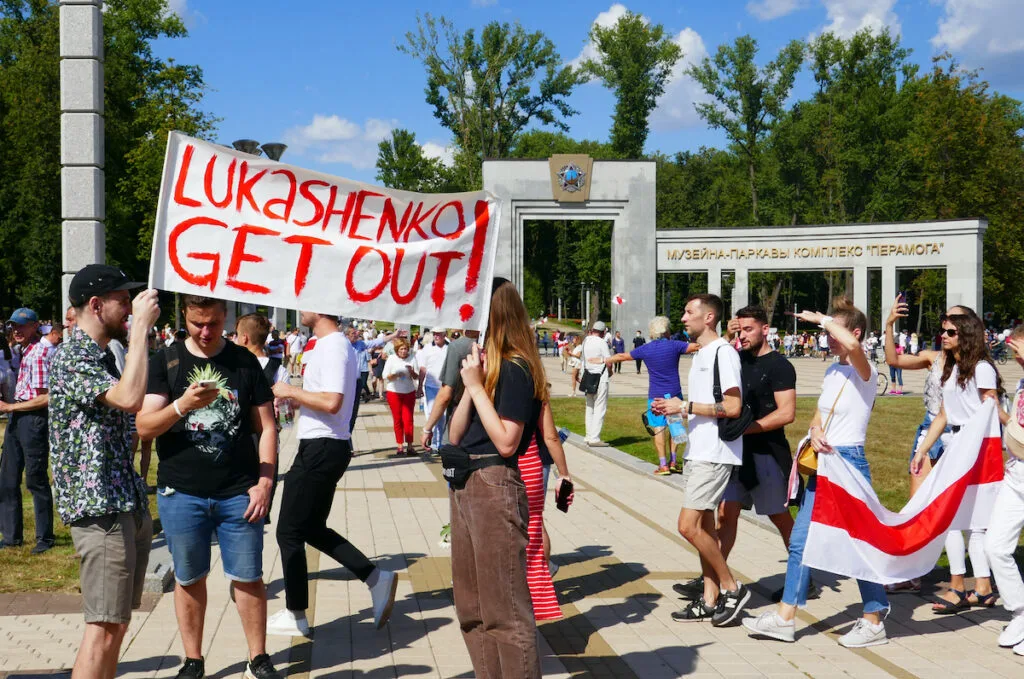
Following a disputed presidential election and mass protests in Belarus in August 2020, the Russian Orthodox Church (ROC) publicly backed President Alyaksandr Lukashenka. Thousands of Belarusians had gathered in the streets to protest his claimed landslide victory. Russian president Vladimir Putin waited more than two weeks before explicitly supporting Lukashenka and said Russia would step in if the leader lost control of the situation. The ROC moved sooner. In the election’s immediate aftermath, Patriarch Kirill issued a statement congratulating Lukashenka, praising him for his devotion to Orthodox congregations, and encouraging “fruitful interaction between the state authorities and the Belarusian Exarchate.”
The Belarusian Orthodox Church (BOC) is an exarchate of the ROC and is subordinate to the Moscow Patriarchate. According to the source, about 53 percent of Belarus’s adult population belongs to it, making it the largest of the country’s 25 registered religious denominations. Belarusian law recognizes the BOC’s “determining role” in the spiritual, cultural, and state traditions of the country. The BOC is the only religious institution that receives state subsidies, and it benefits from dozens of cooperation agreements with state agencies. The source notes that Lukashenka has generally kept friendly relations with the ROC during his 26 years in power.
The source reports a series of leadership changes within the BOC. The Moscow Patriarchate removed the BOC leader, Metropolitan Pavel, after he gave mixed messages about the election results and did not convey the ROC’s position to BOC clergy. According to the source, Pavel had first congratulated Lukashenka on his victory, later apologized, and met with a delegation of Christian protesters. He then issued a statement criticizing BOC leaders and clergy who had publicly supported protesters, denounced electoral fraud, or criticized postelection violence and Lukashenka’s regime. Pavel was replaced by Metropolitan Veniamin, who had earlier spoken out against “mass riots” and called for a return to stability. Several days later, Kirill publicly wished Lukashenka a happy birthday and again expressed his desire for continued cooperation between the ROC and the Belarusian state.
The source places those birthday remarks less than three weeks after Belarusian security forces beat and detained hundreds of peaceful protesters. It contrasts them with a statement from the head of the Belarusian Catholic Church, who urged the authorities to “stop the violence and immediately release all innocent civilians detained at peaceful rallies.” Here the principle of protecting the vulnerable applies to the detained protesters (Psalm 82:3).
The author argues that the ROC’s stance reflects its dependence on the Kremlin, which has developed since Putin came to power. The author contends that this support has brought the church short-term benefits but has weakened its domestic legitimacy. The source says the ROC has spoken in favor of Russia’s involvement in Syria and Ukraine, linked the promotion of human rights to “heresy,” and backed the government’s rushed production of a COVID-19 vaccine that the source describes as poorly tested. A Levada Center survey, cited by the source, found that public trust in the ROC has declined since 2012. Another survey showed that two thirds of respondents believe the church should not be involved in political issues.
The source also connects the Belarus position to competition in the post-Soviet region. It describes the 2018 separation of the Ukrainian Church from Moscow as a result of the Ecumenical Patriarchate of Constantinople granting it independence over ROC objections. According to the source, the Moscow Patriarchate lost as many as 500 parishes in Ukraine. The source also reports ongoing competition with the independent Romanian Orthodox Church in Moldova, which it says has gained popularity over the last 15 years. It adds that local politicians in Latvia and Lithuania have questioned the ROC’s authority and passed laws restricting Moscow’s influence over Orthodox dioceses. By contrast, the source says Lukashenka has largely stayed out of the ROC’s internal affairs and has refused to register “alternative” Orthodox communities in Belarus, which allows the Moscow Patriarchate to face no such competition there.
Source: Read the original report

Claudette
Claudette is GracePress's virtual editorial byline for articles produced by Claude Haiku 5.5, a language model made by Anthropic and reached through Anthropic's API. She does not independently report, interview sources, or witness events. Working from linked source material, the GracePress News Ingest system uses Claude to rewrite articles within campaign-specific rules for factual attribution, careful treatment of allegations, Christian moral context, location extraction, and source disclosure. Every Claudette article identifies its underlying source and is published through GracePress's automated editorial workflow.

