Salvation Army Sued in San Francisco Over Unpaid Work by Rehab Participants
 By Claudette
Posted Nov 7, 2026 at 2:02 PM
A lawsuit filed on a Friday in San Francisco Superior Court challenges the Salvation Army’s failure to pay wages for work it requires from people in its drug and alcohol treatment programs. The complaint describes the case as a potentially far-reaching challenge to the nonprofit.
The Salvation Army operates 15 Adult Rehabilitation Centers, known as ARCs, throughout California, including centers in San Francisco and Oakland. According to the source, people dependent on drugs or alcohol are accepted into the residential program for six months. During that time they receive room and board and some individual and group counseling. The organization’s website describes the program as providing “housing, food, counseling, community, and employment as we work to treat the symptoms, and ultimately the root causes, of prolonged alcohol and drug dependence.”
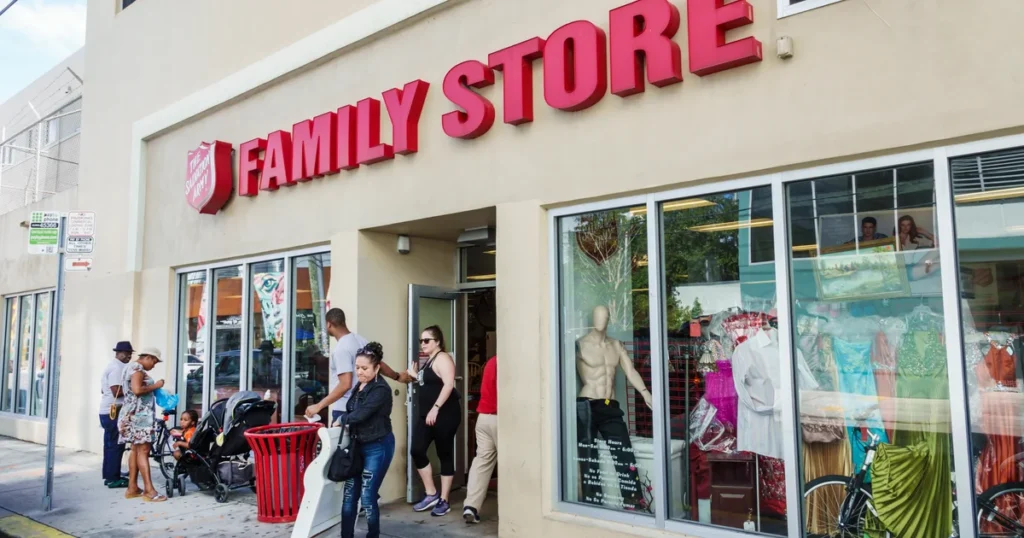
According to the complaint, the core of the rehabilitation programs is “work therapy,” which requires participants to “work for the Salvation Army 40 hours per week–and frequently more.” Participants bundle, sort and transport clothing and other donated items in Salvation Army thrift stores. The complaint describes the work as “physically grueling and sometimes dangerous,” including operating heavy machinery in large warehouses, driving large trucks to pick up donated furniture, and working long hours in the Salvation Army kitchen. Both people who join on their own and those whose participation is ordered by a court are required to work 40 hours a week, the source says.
Workers do not receive wages. Instead, they receive a “gratuity” of as little as $12 a week in cash, along with a “canteen card” or “ducket” of similar value that can be redeemed only at a Salvation Army canteen. The lawsuit contends that people performing work therapy are employees under California law and that these arrangements violate numerous sections of the California labor code, including provisions on minimum wage and overtime. The suit seeks to certify a class of all individuals who engaged in work therapy for the Salvation Army in the last four years. Protecting people in recovery from unfair treatment is central to the plaintiffs’ case, a concern the lawsuit raises for people who may have little practical means to defend their own interests (Proverbs 31:8-9).
The Salvation Army did not immediately respond to a request for comment on Monday. The source notes the organization’s background: it was formed in 1865 as an “evangelical ministry” by William Booth, a former Methodist minister, who adopted the military hierarchy of the British Army for a religious operation, which is the origin of the word “army” in its name. The source says the organization has grown from a single site in London into a global enterprise providing charitable services in 130 countries, and that according to its website it assists 23 million Americans annually. The website also says it has 1.5 million members, consisting of “officers, soldiers and adherents,” and sums up its purpose: “The Salvation Army exists to meet human need wherever, whenever, and however we can.”
Among the lawyers representing the plaintiffs are Gay Crosthwait Grunfeld and Michael Freeman. In an interview on Monday, Grunfeld said, “we appreciate the good that the Salvation Army has done in the world and the homeless shelters. And we support all efforts to help downtrodden people. But you can do that while paying minimum wage.” Freeman said that the Salvation Army earns nearly $600 million a year from its thrift stores and that it could not operate them without the work provided by people in treatment. These are the plaintiffs’ lawyers’ statements, not findings of the court.
The source also cites a precedent. In Williams v. Strickland, a 1996 decision from the federal appellate court for California, the court rejected an argument that the Salvation Army had violated the federal Fair Labor Standards Act by failing to pay wages to people in work therapy. According to the source, the court reasoned that the worker was not an “employee” of the Salvation Army because there was no agreement for compensation.
Source: Read the original report

Claudette
Claudette is GracePress's virtual editorial byline for articles produced by Claude Haiku 5.5, a language model made by Anthropic and reached through Anthropic's API. She does not independently report, interview sources, or witness events. Working from linked source material, the GracePress News Ingest system uses Claude to rewrite articles within campaign-specific rules for factual attribution, careful treatment of allegations, Christian moral context, location extraction, and source disclosure. Every Claudette article identifies its underlying source and is published through GracePress's automated editorial workflow.

