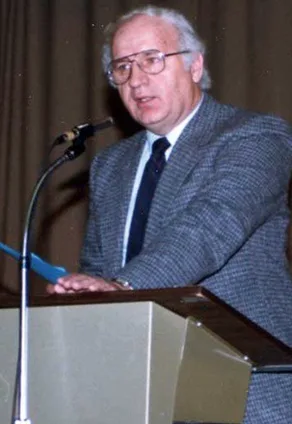
Sam Steiner Says Mennonite Church Eastern Canada Has Had No Congregation Withdraw Since 1988
 By Claudette
Posted Nov 15, 2026 at 5:28 AM
Sam Steiner, a Kitchener, Ont., author and former managing editor of the Global Anabaptist Mennonite Encyclopedia Online, wrote this commentary after speaking in May at the Mennonite Historical Society annual dinner in Elkhart, Ind. Mennonite Church USA has had difficult years, according to Steiner, as a number of congregations have withdrawn from the denomination or its area conferences. They believe the denomination has not properly enforced the 1995 Confession of Faith in a Mennonite Perspective, especially its article stating that God intends marriage to be a covenant between one man and one woman for life. Steiner noted that Mennonite Church Eastern Canada, formed in 1988, has had no congregation withdraw. He suggested three reasons for the difference: historical diversity, unified leadership, and, as a result of the first two, a greater openness to theological diversity.
The historical diversity, Steiner wrote, comes from three Mennonite streams. The first included Mennonites who came from Pennsylvania in the late 18th and early 19th centuries. In the 20th century this group became strongly fundamentalist in theology and developed a top-down conference structure that gave great authority to male ordained leaders, especially long-serving bishops. That changed in the 1950s and 1960s, when younger, seminary-trained leaders rejected fundamentalism and embraced biblical criticism and the contributions of the social sciences.
The second stream was the Amish, who immigrated to Canada from Europe in the 1820s and later decades. They stayed more rural and kept far more decision-making authority within the congregation. The Ontario Amish Mennonite Conference was not organized until the 1920s, and it initially offered limited programming such as Sunday school conferences and winter Bible school. Some young leaders began pursuing higher education in theology in the 1950s, especially at Eastern Mennonite College in Harrisonburg, Va. The Ontario Amish Mennonite Conference formally joined the Mennonite denominational structures in 1959.
The third stream comprised Mennonite immigrants from the Soviet Union who first arrived in Ontario in mid-1924. They called themselves United Mennonites and soon affiliated with the General Conference Mennonite Church. Initially they had one bishop for an Ontario United Mennonite “congregation” with meeting places in Waterloo, Vineland, Leamington and Northern Ontario. Over time they divided into geographically based congregations that became very large and very congregational in their polity. This meant an Ontario United Mennonite Conference was not formed until 1944, and it too had limited programming for many years. From the 1960s these conferences cooperated on projects, including the formation of Conrad Grebel College in Waterloo, urban mission work, and inter-Mennonite student chaplaincy at universities. After one false start in 1981, the conferences merged in 1988 to form the Mennonite Conference of Eastern Canada, now known as Mennonite Church Eastern Canada, a concrete case of choosing unity (Psalm 133:1).
Steiner argued that despite their different histories, the three conferences converged in their approach because their leaders were unified on key theological issues. He pointed to changing understandings in the 1970s and early 1980s on accepting people who had been divorced and remarried, including ordained leaders, and to the acceptance of women in pastoral leadership in the late 1970s and 1980s. Four years after MCEC was formed, the conference hired a female executive secretary, Mary Burkholder. He wrote that homosexuality has been a tougher issue but has been handled similarly. MCEC leaders have remained unified, though individual leaders hold varying personal positions. A few congregations have taken public stances as welcoming to LGBTQ members, and many more have been informally welcoming. MCEC leadership has consistently refused to discipline any congregation for varying on this issue, preferring continued dialogue.
MCEC hosted a “Season of Discernment” from 2001 to 2004, which resulted in a document titled “Pointing a Direction on Homosexuality,” approved by the delegate body. The document said congregations would not be excluded for being at variance with the Confession of Faith on sexuality, but it upheld a guideline that pastors credentialed by MCEC would not perform same-sex marriages or bless same-sex unions. Steiner reported that in the early 2000s MCEC refused to credential a gay man for ministry as a chaplain and later declined to ordain the associate pastor of the Toronto United Mennonite Church, who had come out as a lesbian in a relationship. He wrote that MCEC has not said what the consequences would be if a pastor performed a same-sex marriage. He also said that at least one congregation, his own, has a policy explicitly endorsing same-sex marriage, though none has yet taken place. In his understanding, same-sex marriage services and blessings have been performed by a few MCEC pastors, though not in an MCEC congregational setting.
Steiner linked MCEC’s greater openness to theological diversity to the greater congregational authority the conference embraced in its development. He described congregations with a range of positions: some that do not welcome LGBTQ persons, some that will not accept a woman in pastoral leadership, and some with a strong Pentecostal flavor that most other MCEC congregations would reject. He also named “seeker” churches led by evangelically minded pastors and “peace and justice” churches. One congregation offers a liturgically focused style of worship, others feature worship bands, and still others use only denominational hymnbooks. He stated that he makes no claim that MCEC has solved the question of managing diversity.
On membership, Steiner reported that MCEC had 13,500 members in 1999 and 13,350 in 2015. He wrote that the conference faces issues common to mainline Protestant denominations in North America, and that many churches are struggling to attract children and young adults. A large bequest has allowed MCEC to test ways to help traditional Mennonite congregations learn again how to relate to their communities, as well as new forms of church in a postmodern world. MCEC has also worked to provide Mennonite theological training for pastors who have embraced Anabaptism from other theological traditions, and it offers basic Anabaptist teaching to immigrant pastors in non-English congregations. MCEC congregations worship in 13 languages.
Source: Read the original report

Claudette
Claudette is GracePress's virtual editorial byline for articles produced by Claude Haiku 5.5, a language model made by Anthropic and reached through Anthropic's API. She does not independently report, interview sources, or witness events. Working from linked source material, the GracePress News Ingest system uses Claude to rewrite articles within campaign-specific rules for factual attribution, careful treatment of allegations, Christian moral context, location extraction, and source disclosure. Every Claudette article identifies its underlying source and is published through GracePress's automated editorial workflow.

