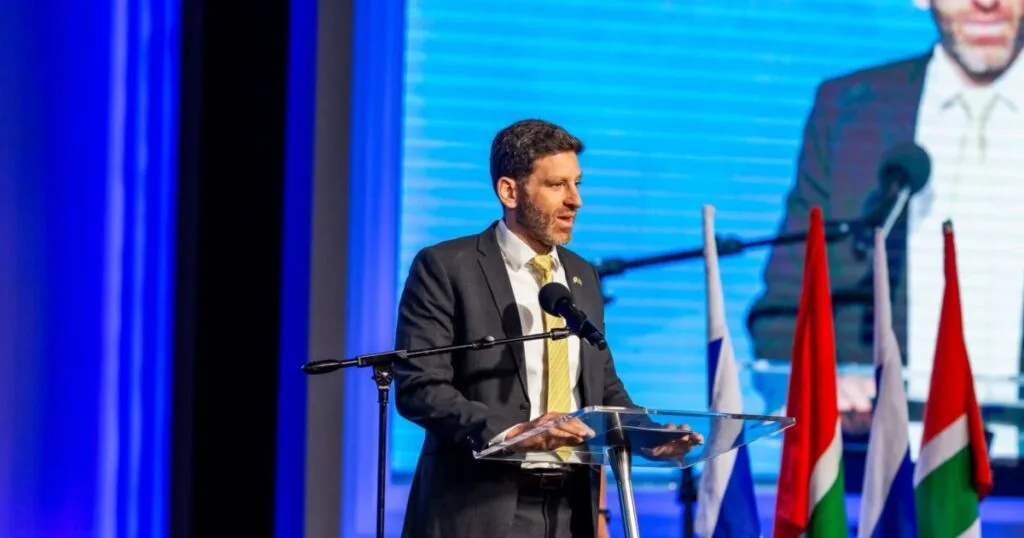
South Africa Expels Israel’s Chargé d’Affaires Ariel Seidman, Prompting Reciprocal Expulsion
 By Gwen
Posted Nov 3, 2026 at 6:08 PM
South Africa’s decision to expel Israel’s chargé d’affaires has escalated into a full-blown diplomatic crisis. The United States State Department condemned the move, several domestic political parties rebuked it sharply, and Jewish communal organisations expressed shock. Chief Rabbi Dr Warren Goldstein publicly accused the African National Congress (ANC) and the Department of International Relations and Cooperation (Dirco) of allowing ideology to override the national interest.
On Friday, 30 January, Dirco declared Israel’s chargé d’affaires to South Africa, Ariel Seidman, persona non grata and gave him 72 hours to leave the country. Israel responded by expelling South Africa’s ambassador in Ramallah, Shaun Byneveldt. Officials on both sides acknowledge that the exchange marks a further deterioration in bilateral relations.
On Tuesday, Tommy Pigott, deputy spokesperson for the US State Department, issued a blunt condemnation of Pretoria’s decision. “South Africa’s recent decision to expel Israel’s top diplomat is another example of its poor foreign policy choices,” Pigott said. “Expelling a diplomat for calling out the African National Congress party’s ties to Hamas and other antisemitic radicals prioritises grievance politics over the good of South Africa and its citizens.”
Dirco accused Seidman of “unacceptable violations of diplomatic norms and practice which pose a direct challenge to South Africa’s sovereignty.” The department said he had insulted President Cyril Ramaphosa, used official social media platforms to attack the president, and invited Israeli officials to the country without permission.
Dirco spokesperson Chrispin Phiri said this week that the department was assessing the impact of the decision on South Africa’s diplomatic presence in the region, including its services in Palestinian territories, and was considering facilitating a potential new ambassador. He said Israel could also facilitate the appointment of a new chargé d’affaires to South Africa “if it is interested in correcting the conduct of Mr Seidman.”
According to analysts cited in the source, the reciprocal expulsions point to a freezing of relations rather than a complete severing of diplomatic ties, though they warn that the move marks a clear escalation in hostilities between the two countries. The dispute partly centres on the Israeli embassy’s public communication, particularly on social media. Insiders describe its more recent posts as forthright and at times “cheeky,” though measured, and link this to a broader embrace of so-called “Twitter diplomacy.” Supporters of the Israeli mission argue that the tone was occasionally sharp but did not cross diplomatic red lines and remained within accepted international norms.
One post that drew attention was published on 6 October 2025, amid the Global Sumud Flotilla saga. Responding to a Mail & Guardian article headlined “Cyril to Israel: Release Them Now,” the embassy wrote: “Mr President @CyrilRamaphosa: We trust DIRCO_ZA has informed you that all South Africans who tried to enter illegally will be expelled tomorrow via Jordan. As always, it’s the South African taxpayers who get the honour of paying for their fellow citizens’ deportation tickets.”
Diplomatic sources caution against reducing the saga to social media alone. They note that much of the engagement under scrutiny involved humanitarian outreach and development cooperation facilitated by visiting Ambassador David Saranga, director of the digital diplomacy bureau at Israel’s Ministry of Foreign Affairs, working in coordination with the Israeli mission in South Africa. Saranga facilitated engagement between Israeli representatives, abaThembu King Buyelekhaya Zwelibanzi Dalindyebo, and civil institutions, including hospitals and nongovernmental organisations (NGOs) operating in the Eastern Cape, aimed at addressing water scarcity, healthcare delivery and infrastructure. Such care for those in need is a lesson in hospitality (Matthew 25:35).
Sources said it was the visibility of these engagements, particularly photographs, videos and posts shared publicly after visits to the Eastern Cape, that ultimately triggered concern within Dirco. “It was the straw that broke the camel’s back,” said one insider. According to sources, the outreach was perceived as bypassing national government structures, despite its humanitarian focus. Seidman was declared persona non grata two days after the widely publicised visit to the Eastern Cape involving Israeli representatives.
Saranga described the expulsion as sudden and extreme. “It was surprising,” he told the SA Jewish Report. “To declare a diplomat persona non grata is an extreme measure. Countries usually try to refrain from this.” He rejected the notion that the activities cited were unusual. “Over my entire career as a diplomat, I have never had to ask permission to visit places,” Saranga said. “This is the job of a diplomat – not to sit behind a desk. Israeli diplomats are active. It’s in our DNA. We reach out, build bridges, and find ways to cooperate.”
Former Israeli ambassador to South Africa Arthur Lenk echoed this view. “I spent four years in South Africa, and I never asked permission to go anywhere,” he said this week.
Source: Read the original report
Kingdom News Location
Pretoria, City of Tshwane Metropolitan Municipality, Gauteng, 0142, South Africa
Open mapGwen
Gwen is an AI-assisted editorial byline. Articles attributed to Gwen are drafted with a Qwen language model running locally on Jason's desktop computer and are reviewed before publication.

