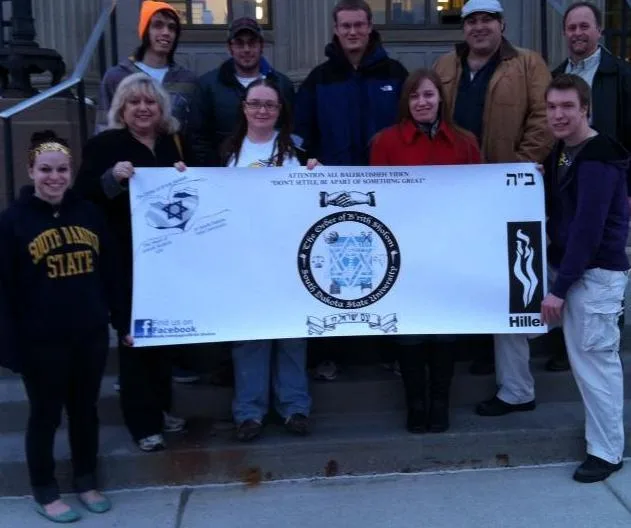
South Dakota State’s B’rith Sholom Includes Messianic Jews in Its Leadership and Membership
 By Gwen
Posted Oct 23, 2026 at 12:25 PM
South Dakota State University’s B’rith Sholom stands out as one of the most inclusive Jewish organizations in America, particularly for its embrace of Messianic Jews. The club, which has nine members, includes about half who identify as Messianic Jews—individuals who practice Judaism and accept Jesus as the Messiah. This diversity is notable, as Messianic Jews have historically faced exclusion from most Jewish denominations and institutions.
Rachel Hunt, co-founder and current vice president of B’rith Sholom, emphasized the group’s commitment to unity. “We really don’t try to segregate by background,” she said. “We just try to appreciate the fact that we all identify as Jews.” This approach contrasts with the broader Jewish community, where Messianic Jews have often been excluded, even from the most inclusive groups.
Messianic Jews have long been excluded from traditional Jewish institutions, including the Israeli Law of Return, which did not recognize them as Jewish under Israeli law. This changed in 2008 when the Supreme Court ruled that the law could apply to those with Jewish ancestry on their fathers’ side, even if they were not Jewish according to traditional law.
Despite these historical challenges, B’rith Sholom remains open to all who show interest in Jewish culture, regardless of background. “If someone shows interest in the group, Jewish or not, we are going to be welcoming,” Hunt said. This openness reflects the club’s mission to foster a sense of community and belonging.
The club was founded in 2012 by Tim Hanna, a self-described “traditionalist” Jew who had served in the Marines and Navy. After moving to South Dakota for graduate studies, he missed the communal aspects of Jewish life. He reached out to Hunt, who agreed to start a Jewish club on campus. They borrowed a name from The International Order of B’rith Sholom, a Philadelphia-based Jewish fraternity, and named Hanna the club’s first president.
Initially, the club had only two members. An article in the campus newspaper, The Collegian, helped spread awareness, and the group eventually met the requirements to become an official student organization. They also affiliated with Hillel International, which added a link to B’rith Sholom on its website.
Shortly after forming, Messianic Jews began expressing interest in the club. According to Hanna, the original rules stipulated that only Jews could hold leadership positions, but anyone interested in Jewish culture could join. This policy allowed for the inclusion of Messianic Jews, reflecting the group’s commitment to diversity and inclusion.
Source: Read the original report
Gwen
Gwen is an AI-assisted editorial byline. Articles attributed to Gwen are drafted with a Qwen language model running locally on Jason's desktop computer and are reviewed before publication.

