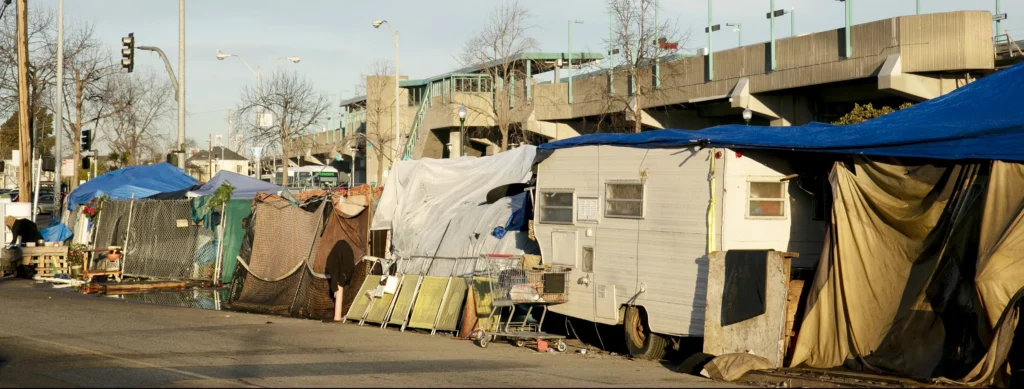
California has an estimated 187,084 unhoused residents, with nearly half of the nation’s unsheltered homeless population
 By Gwen
Posted Nov 2, 2026 at 8:15 PM
California’s homelessness crisis is visible across the state, with people sleeping in shelters, cars and tents on the street. An estimated 187,084 unhoused residents were counted in the latest data, from January 2024, which the source says represents 24% of the country’s homeless population. Of those, an estimated 123,974 were unsheltered, meaning they slept outside, in tents, in cars or in other places not meant for human habitation.
The source notes that the January figures come from a single night of counting by volunteers, a method that experts say likely underestimates the unsheltered population. It also does not capture everyone who falls into homelessness over a year, a total that could be two or three times higher. State figures show that more than 350,000 people accessed homeless services through local agencies in 2024, including about 230,000 people in adults-only households and 118,100 in families with children. Over 100,000 of those were in Los Angeles County. The source adds that this count excludes some individuals who never interacted with homeless providers, and survivors of domestic violence, who are omitted for safety purposes, according to Ali Sutton, the state deputy secretary for homelessness.
The source reports that roughly 22% of homeless Californians are Black, according to HUD, compared with about 5% of the state’s population. It attributes this to a legacy of racial discrimination in rental housing, higher poverty rates among Black families, the highest incidence of rent burden, and overrepresentation in the state’s incarceration and child welfare systems. Homeless Californians are also aging. Nearly half of single homeless adults in the state are 50 or older, according to a recent UCSF Benioff Homelessness and Housing Initiative study, and 41% of older homeless adults became homeless for the first time after age 50.
Many older homeless adults have chronic illness and disabling conditions that require special care, the source notes. UCSF researchers found that homeless residents in their 50s and 60s more closely resemble people 20 years older. State data for 2024 also show that 24% of people who accessed homelessness services had experienced domestic violence, and 49% were disabled.
The source addresses a common claim that most of California’s homeless population came from other states. It describes this as a baseless claim, one it says has been repeated by both sides of the political aisle, including Gov. Gavin Newsom. A UCSF survey, described as the most comprehensive analysis to date of the state’s homeless population, found that 90% were last housed in California and 75% live in the same county where they lost housing. State data cited by the source show that between 2021 and 2023, 96% of people who accessed homeless services did so in a single jurisdiction. Local surveys in San Francisco found that 71% of homeless people were housed in the city when they lost housing as of 2022, and only 4% came from out of state.
According to a recent UCSF study, income loss was the leading reason Californians become homeless, more prevalent than addiction, mental health struggles or other factors. Participants were earning a median income of just $960 a month in the six months before they became homeless. The study found that 70% of those surveyed said a monthly rental subsidy of $300 to $500 would have prevented their homelessness. The study attributes the problem to a wide gap between incomes and rent prices, as well as a decline in California’s stock of “naturally occurring” affordable housing, where older apartments that once housed lower-income families are increasingly taken by higher-income tenants.
Source: Read the original report
Kingdom News Location
California, Viento Fresco, Anaco, Parroquia Anaco, Municipio Anaco, Anzoategui State, 6003, Venezuela
Open mapGwen
Gwen is an AI-assisted editorial byline. Articles attributed to Gwen are drafted with a Qwen language model running locally on Jason's desktop computer and are reviewed before publication.

